(Lady justice fights for the rights and protections)
American justice is being rewritten in real time by algorithms, body cameras, and political pressure, but the central question has not changed: who gets protected, who gets punished, and who gets believed. The strongest path forward is not anti-police or anti-citizen it is a system that is transparent, documented, de-escalatory, and accountable on both sides.
The pressure point
The real-world challenge is that criminal justice now sits at the intersection of old human bias and new machine scale. AI can help sort evidence, speed transcription, and support investigations, but it can also amplify discrimination, weaken due process, and hide decision-making behind proprietary systems. A major 2024 criminal-justice convening warned that AI can improve outcomes only if privacy, fairness, explainability, and accountability are treated as first-order constraints, not afterthoughts.
Predictive policing is where that tension becomes most visible. The NAACP has warned that unregulated predictive systems can inherit bias from historical arrest data and deepen disproportionate surveillance of Black communities, while critics note that departments often reveal little about how these tools are trained or audited.
What the data suggests
The best-supported fear is not that AI is uniquely evil, but that it can industrialize existing error. Research summarized in 2025 argued that some widely used risk models do more than mirror bias they can worsen it, especially when flawed data is fed back into policing and sentencing systems. At the same time, anti-fraud and identity tools are being used alongside deepfakes, synthetic voice, and forged documents, which makes verification harder for courts and investigators alike.
That is why evidence handling matters so much. Digital evidence must be authenticated, protected by chain of custody, and shown to be reliable; otherwise it can be excluded, weakened, or attacked in court. Body-worn camera footage, livestreams, metadata, and recordings are useful only if they can be shown to be what they claim to be.
Police encounters under scrutiny
During a traffic stop or street encounter, the law favors calm, not escalation. The ACLU says people may ask whether they are free to go, may remain silent, and should not consent to searches; it also stresses that police interactions in public can be recorded under the First Amendment.aclunorcal+1
That legal reality matters because many of the worst outcomes begin as misunderstandings that spiral. Crisis-intervention training and co-response models using mental-health professionals have been associated with fewer injuries and less use of force in mental-health encounters, and a cited police-training source reported steep reductions in officer injuries in departments using CIT programs. In practice, the safest encounters are usually the ones where officers get clarity fast, civilians know their rights, and a third party can lower the temperature before the moment turns irreversible.
Where GoVia fits
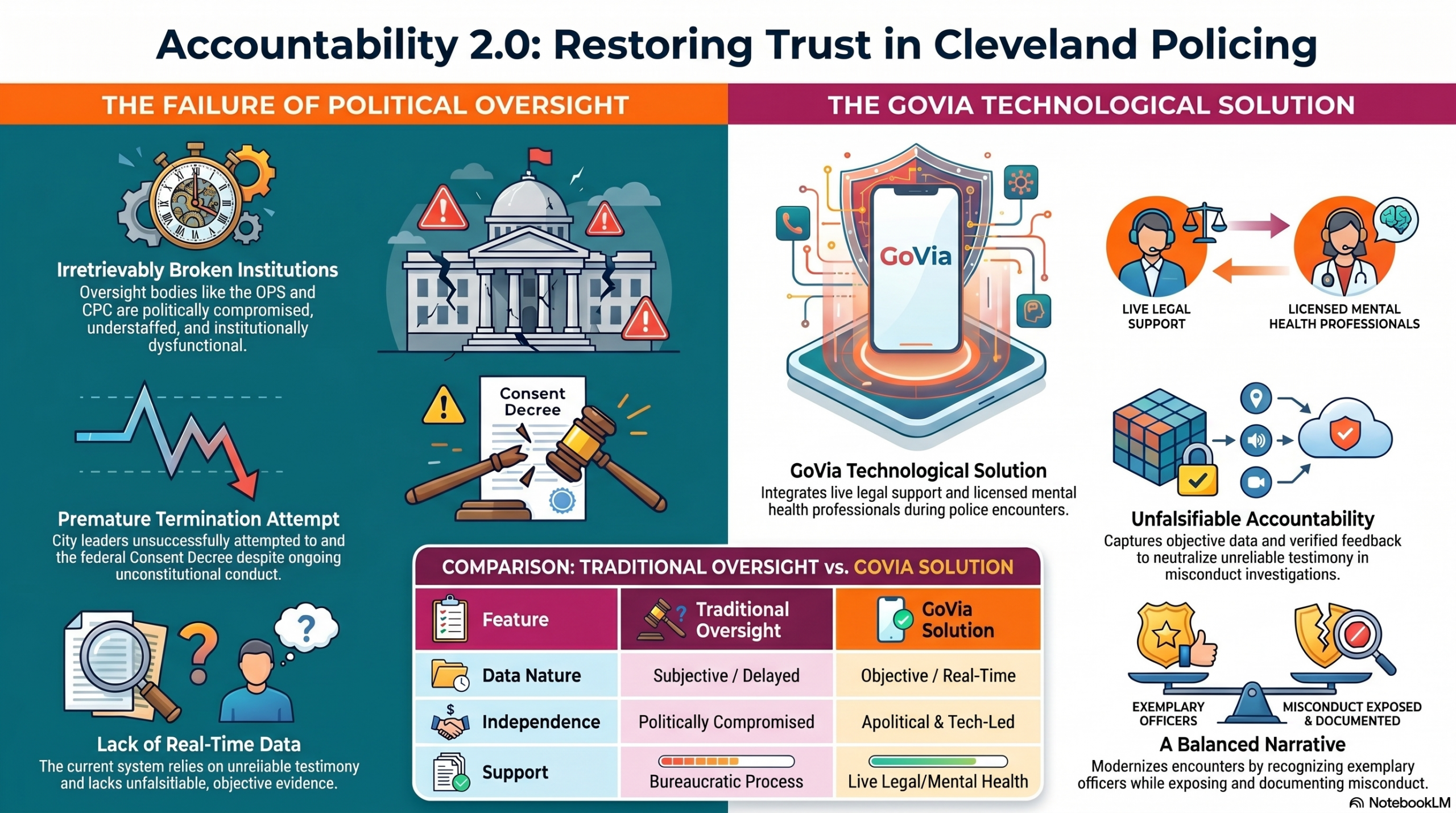
GoVia, as you describe it, would sit in the narrow but critical gap between confrontation and proof: a documented, real-time, court-ready record that helps both sides reduce confusion. If a user is pulled over, the platform could guide them through rights-based prompts, preserve audio/video with metadata, and route the encounter into an evidence chain that is faster, cleaner, and easier to authenticate. That structure could help police, civilians, attorneys, and courts by reducing disputes over “what happened” and moving the fight toward verifiable facts.
The strongest version of this model is not “record the police” as a slogan; it is “create a better record.” If a mental-health professional and attorney are present in a controlled, non-obstructive role, the encounter can shift from adversarial improvisation to documented de-escalation, which is exactly what fair systems need when liberty, safety, and public trust are all at stake.
Federal and local fault lines
At the federal level, DOJ policy shapes how much pressure local departments feel to reform, investigate misconduct, and adopt or reject federal oversight. In 2025, DOJ under Trump moved to dismiss certain Biden-era police investigations and criticized overbroad consent decrees as federal micromanagement, signaling a major shift toward local control and away from expansive federal monitoring.
That matters because local agencies do not operate in a vacuum. They decide what tools to buy, how much AI to trust, whether to preserve exculpatory evidence, and whether to train officers to de-escalate or to dominate. When federal policy changes, the incentives around accountability, consent decrees, and oversight shift with it.
Good and bad outcomes
The good stories are the ones where documentation prevents a mistake from becoming a tragedy. Proper recordings can protect innocent civilians, support honest officers, preserve Brady material, and make courts less dependent on memory under stress.
The bad stories are the ones where opaque systems magnify harm: biased data drives biased patrols, hidden models evade scrutiny, and a person in crisis meets a force-first response instead of a stabilized one. The lesson from current research is blunt: AI is not a substitute for judgment, and technology without governance can make injustice faster rather than fairer.
A safer standard
A credible public-safety platform should not promise immunity or special treatment; it should promise legibility, preservation, and de-escalation. For citizens, that means knowing how to behave during a stop, how to assert rights without provoking unnecessary conflict, and how to preserve evidence cleanly. For officers, it means getting a clearer scene, fewer surprises, and a better evidentiary record if an arrest becomes necessary.
The deepest reform idea here is simple: the encounter should be safer because the facts are safer. If GoVia can help both sides move from confusion to verified record, it could become less like a gadget and more like infrastructure for trust.