I. The Promise vs. the Practice
In theory, the American justice system rests on a simple premise: equal protection under law. In practice, it operates as a layered ecosystem—federal directives, local policing cultures, prosecutorial discretion—often pulling in different directions at once.
Data from the Bureau of Justice Statistics shows that the U.S. relies on fragmented reporting systems, with gaps in crime data, underreporting, and inconsistent participation by police agencies. (Council on Criminal Justice)
The result: a system where perception frequently outruns reality—and where political narratives can fill the void left by incomplete data.
II. Washington’s Influence: The DOJ Under Trump
Under Donald Trump, the U.S. Department of Justice has shifted toward a more enforcement-heavy, less oversight-focused posture.
- Civil rights enforcement units investigating police misconduct have shrunk dramatically, reducing accountability capacity. (Reuters)
- Consent decrees—federal tools used to reform troubled police departments—have been scaled back or frozen. (Wikipedia)
- Critics, including former prosecutors, warn of politicization, arguing the DOJ has increasingly pursued cases aligned with political priorities. (The Guardian)
At the same time, the administration has promoted a “law-and-order” narrative, crediting aggressive enforcement strategies with reductions in crime in some jurisdictions. (Department of Justice)
But experts caution: crime trends often precede political leadership and are influenced by broader socioeconomic forces. (Vera Institute of Justice)
The contradiction:
A federal government claiming success in public safety while simultaneously weakening the mechanisms designed to ensure police accountability.
III. Local Reality: Four Cities, Four Versions of Justice
Los Angeles
Despite political rhetoric portraying major cities as crime epicenters, Los Angeles ranks far lower in violent crime than often suggested in national discourse. (Stateline)
Yet public perception—shaped by national politics—often diverges sharply from data.
Cleveland
The Cleveland Division of Police has long operated under a federal consent decree after a DOJ investigation found systemic excessive force and weak accountability systems. (Wikipedia)
This illustrates the value of federal oversight—now increasingly uncertain.
New York City
The DOJ has clashed with NYC over “sanctuary city” policies, reflecting a deeper tension:
local trust-building vs. federal enforcement priorities. (Politico)
Miami
In Miami, collaboration between local police and federal immigration authorities has produced a surge in arrests—often during routine stops. Critics argue this raises concerns about profiling and due process. (Axios)
IV. Surveillance State: FISA, Section 702, and the Patriot Act
At the center of modern justice debates lies surveillance.
- The USA PATRIOT Act expanded government authority to monitor communications after 9/11.
- FISA Section 702 allows warrantless collection of foreign intelligence—but can incidentally capture Americans’ data.
Critics argue:
- These tools blur the line between foreign intelligence and domestic policing.
- Oversight is limited, with courts operating largely in secrecy.
Supporters counter:
- They are essential for counterterrorism and national security.
The tension: security vs. civil liberties—now amplified by digital surveillance and AI.
V. “Wag the Dog”: The Politics of Perception
The phrase “wag the dog”—where political actors redirect public attention—has become a recurring lens in justice debates.
Consider the pattern:
- National leaders spotlight crime in select cities
- Media cycles amplify isolated incidents
- Public fear rises—even when crime trends decline
Crime data in the U.S. is notoriously imperfect:
- Not all crimes are reported
- Not all agencies submit data
- Statistics lag behind real-time conditions (KSBW)
This creates a vacuum where narrative becomes power.
VI. The Systemic Fault Line: Accountability vs. Authority
Across federal and local systems, one fault line persists:
| Priority | Outcome |
|---|---|
| Strong enforcement | Increased arrests, deterrence |
| Strong oversight | Increased accountability, trust |
When one expands, the other often contracts.
The scaling back of DOJ oversight, combined with expanded enforcement partnerships (as seen in Miami), suggests a system tilting toward authority over accountability.
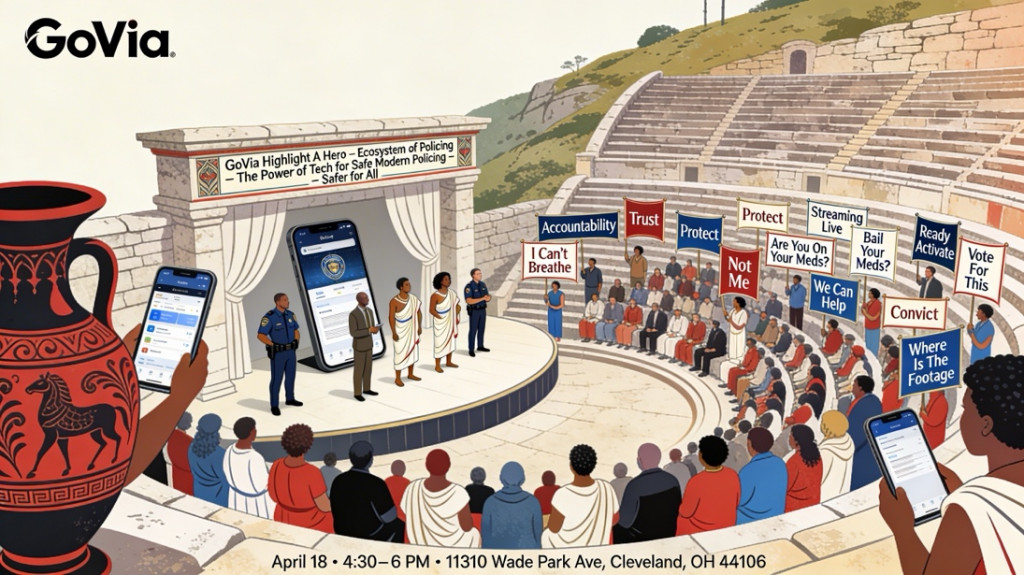
VII. What Would “GoVia Highlight a Hero” Do?
In a fractured justice ecosystem, a platform like
GoVia Highlight a Hero could function as a bridge layer—between citizens, officers, and institutions.
Core Benefits
- Transparency: Real-time documentation of encounters (bodycam integration, citizen recording)
- De-escalation tools: AI-assisted prompts for officers and civilians during tense interactions
- Accountability ledger: Immutable records of stops, use-of-force incidents, and outcomes
- Recognition system: Highlighting officers who resolve situations without force
Key Features
- Dual-sided reporting: Both citizen and officer perspectives captured
- Bias detection alerts: Flagging patterns of stops, searches, or force
- Legal awareness prompts: Informing citizens of rights during encounters
- Community trust metrics: Public dashboards showing department performance
Strategic Impact
- Reduces “he said, she said” conflicts
- Creates data-driven accountability outside political influence
- Reinforces the idea that justice is not just enforced—it is witnessed
VIII. Conclusion: A System at a Crossroads
America’s justice system is not failing in one place—it is diverging across many.
- Federal policy is shifting toward enforcement
- Local realities remain uneven
- Surveillance powers expand quietly
- Public perception is increasingly politicized
The question is no longer whether the system works.
It is: for whom—and under whose version of reality?
In that uncertainty lies both risk—and opportunity.