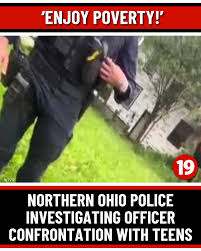
TOLEDO, Ohio — In a climate of systemic friction, a single phrase captured on a cell phone and trailing off into the evening air has exposed the deep chasm in American community policing.
When a Toledo Police Department (TPD) officer weaponized socioeconomic status by shouting “Enjoy poverty!” at a group of local teenagers, it did more than trigger an internal investigation. It laid bare a stark, real-world contrast between the institutional pressures of judicial fairness and the raw, unedited reality of community alienation.
The Incident: Anatomy of a Street Encounter
On May 20, 2026, TPD Officers Zachary Cairl (a ten-year veteran) and Chase Baney (a five-year veteran)—both members of the department’s elite SWAT team—initiated a pedestrian stop on Sylvan Avenue. The initial infraction? The juveniles were allegedly jaywalking in the street.
What followed was a rapid escalation of rhetoric that transformed a routine, low-level compliance check into a viral flashpoint:
- The Confrontation: Body-worn camera footage and teen-recorded video reveal an exchange that deteriorated as a young girl noted, “It’s because he’s Black.”
- The Escalation: An officer fired back, calling a female teenager “f—ing annoying and stupid,” and adding, “This is a high-gang, high-crime area. It’s not my fault you guys live in this f—ing neighborhood.”
- The Parting Shot: As the teenagers walked away, the definitive, parting insult was hurled: “Enjoy poverty!”
- The Missing Footage: In a detail that has drawn sharp scrutiny, the exact moment the phrase “enjoy poverty” was uttered was not captured on the official bodycam footage. A TPD spokesperson confirmed that the officer had already deactivated his camera by that point.
The Digital Town Square: A Community Divided
The release of the footage sparked an immediate public reckoning. The comments sections of local media platforms like 13abc’s Digital Outlets became a microcosm of a deeply polarized national debate on discipline, decorum, and race.
┌─────────────────────────────────────────────────────────────────────────┐
│ THE COMMUNITY CHASM: ANATOMY OF AN ONLINE DEBATE │
├─────────────────────────────────────────────────────────────────────────┤
│ THE “TOUGH LOVE” & COMPLIANCE FACTION │ THE DE-ESCALATION & EQUITY FACTION │
├─────────────────────────────────────────────────────────────────────────┤
│ “If they keep doing what they’re doing, │ “I’m convinced nobody actually watched │
│ he’s absolutely correct… Maybe he │ the video because those kids didn’t │
│ gets through to one of them.” │ have anything on them.” │
│ — Nagel J. │ — Kayda Grinder │
├─────────────────────────────────────────┼─────────────────────────────────────────┤
│ “We used to call that keeping it real, │ “I don’t know, I felt they were │
│ stop coddling kids when they are │ targeted for color and disrespectful │
│ messing up.” │ to these teens.” │
│ — Aaron Michael │ — Karen Garmon │
├─────────────────────────────────────────┼─────────────────────────────────────────┤
│ “Wrong. So the truth hurts.” │ “3 juveniles jaywalking… officers are │
│ — William Schrock │ suppose to deescalate situations, not │
│ │ create them.” │
│ │ — Libby Reilly-Wilkerson │
└─────────────────────────────────────────┴─────────────────────────────────────────┘
Some community members, like Nancy Johnson, dismissed the outrage entirely, arguing, “Who cares, maybe these kids are trouble makers… good job to the police officers, tell it like you see it.”
Yet, this undercurrent of support for blunt force friction collides directly with the official mandate of modern law enforcement. Toledo Mayor Wade Kapszukiewicz condemned the video, calling it “the worst video of policing” he had seen, while TPD Chief Mike Troendle openly acknowledged that “words matter… the relationship between the police department and the community depends heavily on professionalism, trust, and respectful communication.”
Fact Check: The Structural Reality of Discretionary Policing
To understand why a jaywalking stop matters, one must look at the macro-level data governing police misconduct and community relations across the region.
According to public data compiled on institutional accountability in Ohio:
- Sustain Rates: Only 25% of civilian complaints filed against law enforcement are historically ruled in favor of civilians.
- State Rankings: Ohio ranked 8th nationally in a comprehensive review of police misconduct settlement cases between 2009 and 2023.
- The “Pretextual” Loop: Discretionary stops for minor infractions (like jaywalking or cracked windshields) are heavily concentrated in lower-income zip codes, structurally compounding racial and economic disparities.
When an officer tells a youth to “enjoy poverty,” it shifts the interaction from a legal enforcement mechanism to an explicit weaponization of structural inequality.
GoVia Highlight a Hero: Rekindling Structure and Decorum
Incidents like the Toledo confrontation emphasize that community trust cannot survive when the gatekeepers of justice abandon professional decorum. It is precisely within these fractured spaces that initiatives like GoVia Highlight a Hero seek to intervene.
Rather than focusing solely on punitive measures after a crisis, systemic reform requires a dual-pronged approach:
- Humanizing the Badge: Elevating officers who actively practice de-escalation, cultural competency, and empathetic communication.
- Empowering the Citizen: Ensuring youth understand their civil rights while maintaining a standard of mutual civic respect during field interviews.
True “structure and decorum” on our streets cannot be built on intimidation or economic mockery. Ending the cycle of poverty, ending systemic bias, and achieving judicial fairness all rely on a singular baseline: treating every citizen—regardless of their zip code—with the dignity required by law.