GoVia: From Cleveland to MIT Solve — The Journey to Reimagine Public Safety
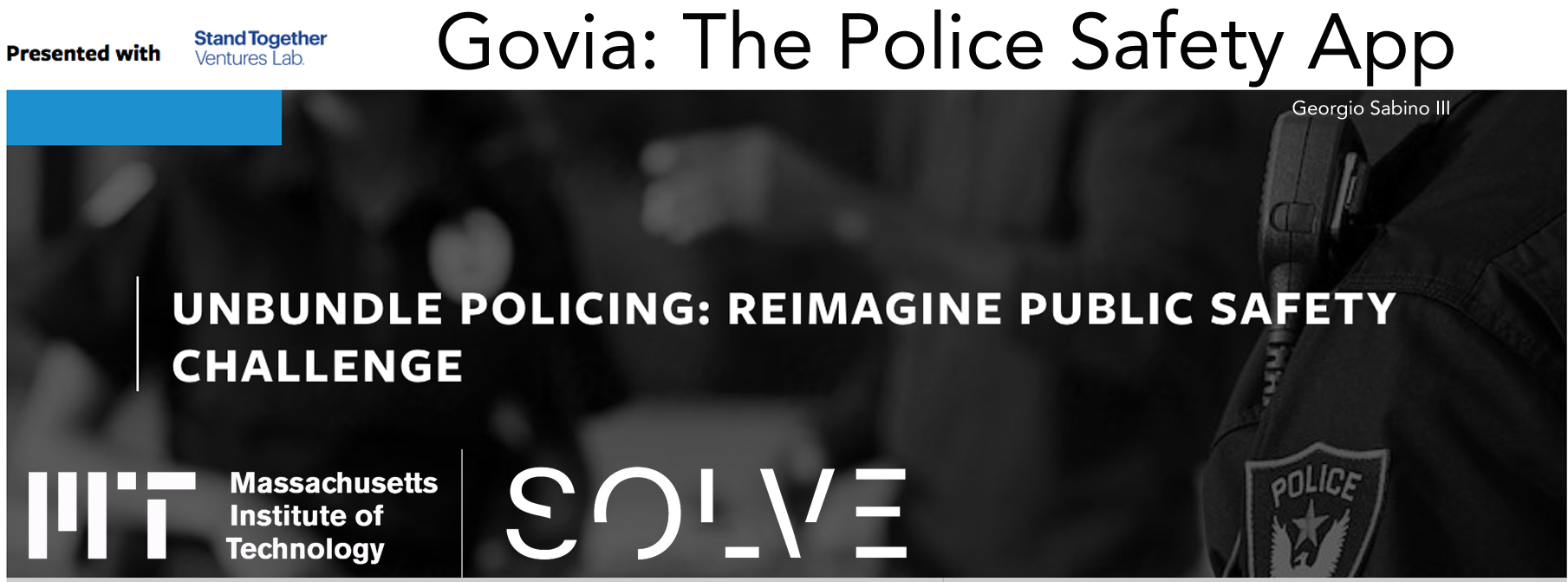
For Georgio Sabino III and the GoVia team, being accepted into the MIT Solve ecosystem was more than another startup accomplishment—it was validation that an idea born in Cleveland could stand alongside innovators working on some of the world’s most difficult social problems. GoVia: A Community/Police Safety App was submitted to MIT Solve’s Unbundle Policing: Reimagine Public Safety Challenge, a national initiative created with Stand Together Ventures Lab and powered by MIT Solve to identify technology and community-based solutions capable of reducing unnecessary and harmful law-enforcement encounters. The challenge specifically sought solutions that could use technology and data, engage law enforcement and communities, incorporate conflict resolution and trauma-informed approaches, and create safer alternatives to traditional policing responses. (MIT Solve)
GoVia entered that competition at an early and vulnerable stage. According to its MIT Solve application, the company was still a prototype-stage venture, with its front-end registration and main menu developed while the team continued building the back end and other features. But the technology was only one part of the work. Sabino and his team had already spent significant effort researching the problem, developing partnerships, engaging community members, refining the business model, and protecting the underlying intellectual property. MIT Solve’s published application identifies Georgio Sabino as team leader and lists the solution as based in Cleveland, Ohio. (MIT Solve)
That distinction mattered because MIT Solve was not simply looking for another app. The challenge was designed around one of America’s most complicated public-safety problems: how to reduce unnecessary and adverse police encounters while improving safety and community well-being. MIT Solve and Stand Together explicitly recognized that policing encompasses many functions and that some situations—including mental-health crises and other nonviolent needs—may be better addressed through alternative or coordinated resources. The program therefore sought entrepreneurs, technologists, researchers, justice professionals, activists, and others capable of approaching the problem from different perspectives. (MIT Solve)
GoVia’s answer was to approach the police encounter from both sides. Its original MIT Solve submission described a technology platform combining AI-based sentiment analysis, crowdsourced accountability, and real-time connections to legal, mental-health, and community resources. The concept was designed to give people tools that could help lower emotional intensity during an encounter while creating information that could later support transparency, accountability, and evidence-based improvements. (MIT Solve)
The road to MIT Solve was difficult because the standard was not simply whether an idea sounded good. MIT Solve’s Unbundle Policing process evaluated solutions on alignment with the challenge, the strength and diversity of the team, scalability, market opportunity, potential impact, innovation, inclusive human-centered design, and financial viability. In other words, GoVia had to demonstrate not only that the problem was real, but that its proposed solution could realistically become a scalable venture capable of producing measurable social impact. (MIT Solve)
The program itself was highly structured. The Incubator was a three-month development experience designed to help participants refine solutions, strengthen teams, and obtain expert feedback before applying to the follow-on Accelerator. Participants received mentorship, feedback from criminal-justice and technology experts, stakeholder connections, investor and partner access, product and launch support, and other resources. The subsequent Accelerator was invite-only and was structured as a six-month program, with $50,000 in immediate funding per accepted team and additional potential investment opportunities. (MIT Solve)
GoVia ultimately earned a place on MIT Solve’s public platform through the Unbundle Policing: Reimagine Public Safety Challenge. MIT’s own published record documents GoVia’s submission, its Cleveland origin, its prototype stage, its team, and its proposed approach to modernizing police encounters. That public record remains an important part of GoVia’s story because it demonstrates that the company was willing to put its solution, problem definition, team, and vision into a highly visible innovation marketplace. (MIT Solve)
For Sabino, the significance goes beyond the MIT name. GoVia was attempting something unusually difficult: building a technology company in the intersection of public safety, law, mental health, technology, community trust, and policing. Those systems have different stakeholders, incentives, legal considerations, and definitions of success. GoVia’s central philosophy was that safety should not be framed as citizens versus police. Instead, technology should create mechanisms that can protect citizens, support officers, encourage de-escalation, connect people to appropriate professional resources, and create better information about what happens during encounters.
That philosophy is reflected in GoVia’s flagship concept, “Highlight A Hero.” Rather than designing the platform exclusively around negative encounters, GoVia sought to create a mechanism through which communities could also recognize officers who demonstrate professionalism, communication, service, and effective de-escalation. The broader vision is accountability that does not simply punish failure but also identifies and reinforces what works.
The achievement is particularly meaningful because GoVia came from Cleveland rather than from an established Silicon Valley technology company. Its journey demonstrates what can happen when a founder takes a difficult community problem, develops a technology-based solution, builds partnerships, protects intellectual property, and repeatedly places the company in environments where the idea can be challenged and improved.
GoVia’s MIT Solve experience became a foundation for the company’s larger journey. The company has subsequently highlighted its participation in additional entrepreneurship, technology, legal, and public-safety programs and partnerships. Its own materials describe MIT Solve as an important source of credibility, expertise, relationships, and visibility. (Govia: Highlight A Hero)
Most importantly, MIT Solve gave GoVia something that cannot simply be purchased: the opportunity to have its idea examined within an international social-impact innovation ecosystem. The accomplishment was not that GoVia had already solved policing. It was that a Cleveland startup at the prototype stage had developed a sufficiently compelling response to a national public-safety challenge to earn a place on MIT Solve’s platform.
That is the story of GoVia’s breakthrough: an idea that started with a Cleveland founder, a difficult problem, and a belief that technology could change the moment when a police encounter becomes dangerous—eventually making its way onto the MIT Solve stage.
And that is why GoVia’s MIT chapter matters. It represents more than a cohort or a logo. It represents the moment when GoVia moved from saying “we believe this problem can be solved” to demonstrating that respected institutions in the innovation ecosystem were willing to examine the solution.
View GoVia’s official MIT Solve profile
View GoVia’s MIT Solve application record
More effective police–community relations
Dr. Gene Ira Katz, DMCJ Published March 22, 2024 @ 6:00 am PDT