Michael Morton’s wrongful conviction—and the evidence-access challenge GoVia Highlight A Hero hopes to confront
An evidence-based analysis connecting a documented Texas miscarriage of justice, Cleveland’s police-oversight struggles and the promise—and limits—of real-time legal-support technology.
Michael Morton lost nearly a quarter-century of freedom for a murder he did not commit. Ken Anderson, the prosecutor who concealed evidence pointing toward Morton’s innocence, later received a 10-day jail sentence for criminal contempt and served five days, according to the Innocence Project’s detailed account. The circulating claim that Anderson “served nine days” does not match that account.
That correction does not diminish the injustice. It makes the contrast more precise.
Morton’s case exposes a failure that reaches beyond one prosecutor or one courtroom: evidence can exist without reaching the people whose liberty depends on it. GoVia Highlight A Hero, a community-police safety platform promoting live attorney access, mental-health support and encounter documentation, is attempting to intervene earlier in that process. But its public-interest value will depend on more than recording an encounter. It will depend on whether evidence remains complete, accessible, secure and open to meaningful challenge. The company’s descriptions establish its ambitions—not independently verified results.
The central issue is disclosure: who possesses the record, who can examine it and what happens when someone keeps it hidden.
The evidence that did not reach the defense
Christine Morton was murdered in her Texas home in August 1986. Her husband, Michael, was convicted in 1987 and sentenced to life in prison. Prosecutors argued that he had killed her after she declined sex on his birthday. According to the Innocence Project’s case account, the prosecution presented no witness or physical evidence tying him to the killing.
Other information pointed away from him.
The couple’s three-year-old son told his grandmother that a “monster,” not his father, had attacked his mother. He specifically said his father was not home. Neighbors reported a man parking a green van behind the Morton home and walking into nearby woods. Investigators also had information suggesting that Christine’s missing credit card had surfaced in San Antonio. Morton’s defense lawyers said these records were not disclosed at trial.
The problem was not simply that defense attorneys failed to ask questions. Suspecting undisclosed material, they raised the issue with the trial judge, who ordered the prosecution to provide investigative reports for review. The records supplied to the judge omitted the child’s account, the green-van information and the credit-card evidence.
Years later, two different avenues helped expose what had happened: DNA testing and litigation over access to government records.
Testing of a bloody bandana recovered near the home identified Christine’s DNA and a male DNA profile that matched Mark Norwood through CODIS, the DNA database system. Further investigation linked Norwood to evidence from another woman’s murder, committed while Morton was imprisoned. Morton was released on October 4, 2011, and officially exonerated on December 19.
His lawyers also obtained previously withheld records through a public-information request during the post-conviction litigation. The physical evidence helped establish innocence; the documentary evidence helped establish how the original prosecution had gone wrong.
For any technology company promising to improve justice, that distinction matters. Capturing evidence and securing access to evidence are separate tasks.
What actually happened to Ken Anderson?
The viral account is substantially right about the injustice but wrong about the jail time.
| Claim | What the reviewed record supports |
| Anderson secured Morton’s murder conviction in 1987. | Supported. Morton was convicted and sentenced to life. |
| Anderson concealed evidence pointing toward innocence. | Supported. Anderson entered a plea to criminal contempt for deliberately withholding exculpatory evidence. innocenceproject+1 |
| Morton spent “25 years” in prison. | “Nearly 25 years” is the more precise formulation used in the case narrative. |
| Anderson served nine days in jail. | The detailed Innocence Project account says he received 10 days and served five because of good-behavior credit. |
| Anderson resigned as a judge and surrendered his law license. | Supported. His resignation preceded the November 2013 plea; he permanently surrendered his license. innocenceproject+1 |
The agreement also included a $500 fine and 500 hours of community service. It was punishment for criminal contempt—not a sentence equivalent to the years Morton wrongfully spent incarcerated.
There is a source inconsistency worth making explicit: a separate Innocence Project article mentions a nine-day sentence. Its detailed Anderson account and contemporaneous 2013 announcement instead specify a 10-day sentence, with the detailed account reporting five days actually served. “Sentenced to 10 days; served five” is therefore the better-supported wording for publication.
The case also answers part of the question posed in the circulating story: can a prosecutor face criminal proceedings for evidence concealment? Anderson did. The Innocence Project explains that his intentional violation of a specific disclosure order was important to the ability to bring the case. That does not mean every disclosure failure automatically constitutes a prosecutable crime; the applicable law and evidence of the conduct matter.
The reform that followed—and the limit of a new rule
Morton’s exoneration helped drive passage of the Michael Morton Act in Texas.
A 2019 Texas Supreme Court opinion describes the law as expanding prosecutors’ disclosure obligations beyond the pre-existing constitutional framework associated with Brady v. Maryland. Under Brady, prosecutors already had a duty to disclose evidence favorable to the accused within the rule’s requirements; the Morton Act broadened access to case materials.
That history is important because Morton was not imprisoned merely because modern recording technology was unavailable. Crucial information already existed in government files.
The failure concerned institutional conduct: what officials preserved, what they disclosed and whether anyone could effectively challenge their account.
An app cannot fix that by generating another file alone.
From Texas courtrooms to Cleveland oversight
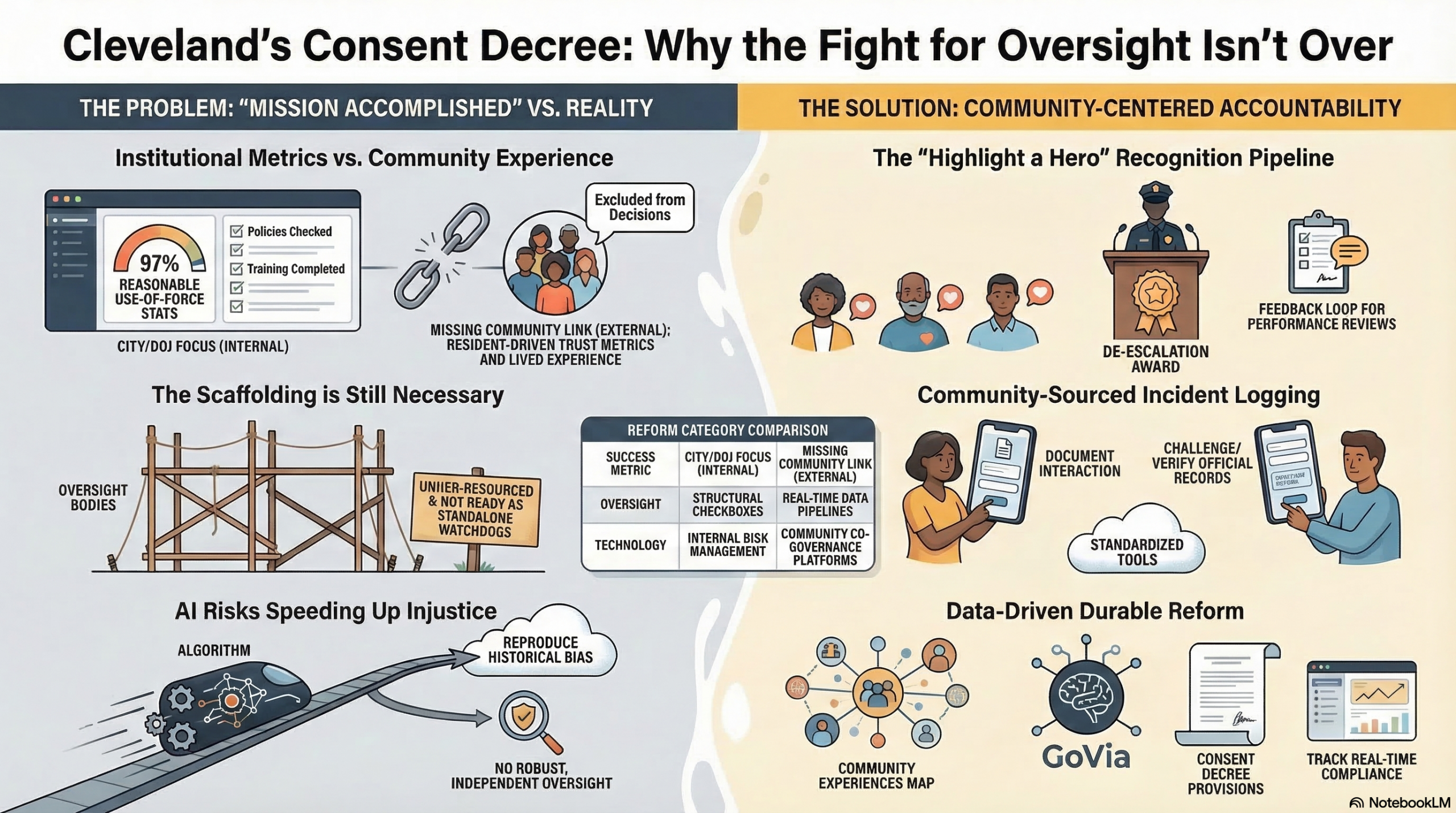
Signal Cleveland’s reporting describes a different but connected accountability problem: cities can establish oversight bodies without ensuring those bodies function effectively.
Cleveland voters approved Issue 24 in November 2021, giving civilian institutions unusually strong authority over police discipline and policy. Implementation has nevertheless encountered staffing shortages, internal disputes, disagreements with city officials and challenges from police unions.
The article identifies parallel struggles elsewhere:
- Seattle’s commission has faced vacancies, turnover and concerns about responsiveness.
- Oakland’s commission has clashed with officials, staff and police leadership.
- Newark’s oversight board lost important investigatory powers following a state Supreme Court ruling.
- Austin’s stronger oversight structure took years to reach its first meeting.
These are not all versions of prosecutorial evidence suppression. Police oversight, prosecutorial disclosure and judicial review are distinct responsibilities. Their connection is more basic: formal authority means little when the institution cannot obtain information, act on it or compel a response.
Cleveland’s federal consent decree is another separate layer. Signal Cleveland reports that Judge Solomon Oliver rejected the city’s request to end it in May 2026 and extended oversight another two years in October. A technology deployment would not itself satisfy the decree or substitute for a court’s assessment of compliance.
East Cleveland must also remain distinct. The Cleveland decree concerns the Cleveland Division of Police; separate federal prosecutions documented misconduct by former East Cleveland officers involving stolen money, illegal searches and fabricated reports. Those prosecutions are not the same thing as a citywide consent decree.
Where GoVia could intervene
GoVia describes a platform combining live legal and mental-health assistance, streaming and post-encounter accounts. Its website also promotes recognizing exemplary officers through resident-submitted affidavits. These are company representations; the materials reviewed do not independently establish consistent response times, nationwide professional availability, evidence integrity or reductions in wrongful arrests.
Its strongest potential contribution is an additional, resident-accessible account of an encounter.
Consider a hypothetical traffic stop in which a driver disputes being the person named in a warrant. A properly functioning service might connect the driver with counsel, preserve the interaction and help organize follow-up documentation.
But the value would lie in the whole process—not simply the presence of a video call.
| Point in the process | Proposed contribution | What it cannot establish by itself |
| During an encounter | Live professional support and a contemporaneous record. | That an officer will engage with the remote professional or that an arrest will stop. |
| Immediately afterward | A structured account linked to available recordings and documents. | That the participant’s interpretation is correct. |
| Defense investigation | An additional source for comparing statements, timestamps and official accounts. | What happened outside the recording or inside undisclosed government files. |
| Oversight review | Material a resident can submit through a lawful complaint process. | That investigators have authority, staffing or willingness to act. |
| Recognition of good policing | Documented examples of respectful, effective conduct. | That favorable feedback cancels unrelated misconduct. |
These are proposed uses, not demonstrated outcomes.
The Morton connection must therefore be stated carefully: GoVia cannot credibly claim that it would have prevented his wrongful conviction. His case turned on concealed investigative material and later DNA testing, not a recorded roadside encounter. The defensible connection is that independent documentation and timely legal assistance may help people challenge an incomplete official narrative earlier.
NCIC: powerful information, not a verdict
The National Crime Information Center, or NCIC, adds another dimension.
Operated by the FBI’s Criminal Justice Information Services Division, NCIC links authorized agencies to criminal-justice information. Its purpose is to provide timely, accurate information to authorized personnel around the clock. The FBI reported that its total record count reached more than 19.3 million during fiscal year 2025.fbi+1
That figure needs context: it is a count of records across NCIC, not a count of outstanding warrants, convicted people or unique individuals. It cannot be used to answer how many warrants exist in Ohio or how those warrants break down by ethnicity in Cleveland, Cincinnati and Columbus.fbi+1
Another distinction is essential: Morton’s DNA match came through CODIS, not NCIC. The systems should not be conflated.
Why a database response still requires scrutiny
The FBI has described safeguards for NCIC data that include timely entry and removal, validation, second-party checks and hit confirmation. Those safeguards exist because information has to be maintained and interpreted—not merely retrieved.
Different NCIC files also carry different implications. The FBI explicitly says that a positive response in its Violent Person File is not, by itself, probable cause to arrest. It is an officer-safety alert. That warning should not be generalized into a claim that every database response has the same legal significance.
For GoVia, the credible role would be to support documentation and lawful follow-up around an encounter involving a database response—not to pronounce the underlying record valid or invalid.
There is no evidence in the reviewed materials that GoVia has authorized NCIC access or an FBI-approved integration. The FBI’s privacy assessment states that access is restricted to authorized users and that NCIC record information is not released for open-data, research or statistical-analysis purposes. A live attorney connection does not itself create database access.
GoVia therefore should not be presented as a public NCIC search tool, a warrant-clearing service or a way to guarantee someone’s legal status.
“Evidence for all” must mean access with safeguards
A platform built around evidence faces a hard design question: evidence for whom?
Residents need meaningful access to material documenting their own encounters. Defense lawyers may need originals and context. Investigators may need records relevant to a complaint. Officers may need a fair opportunity to challenge an allegation.
None of that requires broadcasting sensitive recordings to everyone.
For GoVia’s proposition to withstand scrutiny, an independent technical and legal review should examine:
- Original-file preservation. Are recordings retained in their original form, with reliable metadata?
- Integrity controls. Can the system detect changes and document transfers? A digital fingerprint can help identify changes; it cannot prove that the scene recorded was complete or truthful.
- Access and export. Can users and authorized counsel obtain usable copies without unreasonable delay or cost?
- Confidentiality boundaries. Are private attorney consultations separated from encounter recordings? An attorney’s presence should not be marketed as making every captured communication privileged.
- Retention and deletion. What happens when a phone is seized, an account closes, a subscription lapses or the company ceases operating?
- Equal treatment of evidence. Does the system preserve material that contradicts the user as reliably as material supporting the user?
- AI accountability. If summaries or automated labels are generated, are they clearly distinguished from original recordings and open to correction?
These are evaluation requirements, not verified descriptions of GoVia’s current architecture.
The distinction is especially important when a company uses terms such as “verified,” “immutable” or “AI.” Such labels should lead to questions about the underlying method, not replace them.
The numbers a city should demand
A serious public-sector pilot should measure outcomes before making claims about fairness or safety.
The first questions are operational: How often does a qualified professional connect? How long does it take? How many recordings fail? Can users retrieve their records?
The next questions concern outcomes: Do participants report better understanding? Do records assist legitimate investigations? Are complaints processed more effectively? Are there unintended consequences, including distraction, privacy breaches or unequal access?
Evaluation should also examine differences by race, ethnicity, disability, language and ability to pay, with transparent collection methods and missing-data reporting. Arrest disparities should not be substituted for warrant disparities, and demographic characteristics should not be guessed from names or appearances.
That discipline responds directly to a problem raised in Signal Cleveland’s article: University of Chicago law professor Sharon Fairley said the evidence on whether civilian oversight works remains limited and difficult to measure. GoVia should not receive a lower evidentiary standard merely because its proposed intervention is digital.
Its own reported subscriber numbers likewise should not be treated as proof of active use, successful attorney connections or improved outcomes. Those are different measures requiring separate verification.
The fairness test runs in both directions
GoVia’s “Highlight A Hero” concept could provide a constructive counterweight to a complaint-only model by documenting officers who communicate clearly, act patiently and handle difficult situations professionally. The company explicitly promotes recognition of exemplary behavior.
But fairness requires more than favorable stories.
A credible system must preserve evidence that supports a resident and evidence that supports an officer. It must distinguish an allegation from a finding, an automated summary from an original record and a positive encounter from an officer’s broader disciplinary history.
The same principle applies to prosecutors and judges. A record should be evaluated according to what it establishes—not according to which institution or participant benefits.
What Michael Morton’s case demands
Morton’s exoneration required more than the eventual discovery of a useful object. It required access to testing, persistent legal work, comparison through a DNA database and the recovery of documents that had not reached his defense. Anderson’s punishment followed another difficult process aimed at establishing responsibility for the concealment.
That history offers both a rationale and a warning for GoVia.
The rationale is that timely support and independently preserved information could give people more ability to question an official account.
The warning is that evidence does not protect anyone merely by existing.
For GoVia Highlight A Hero, the public-interest test is not whether it can record more encounters. It is whether it can help preserve reliable records, deliver meaningful access and support fair review—without promising powers it does not have or turning private distress into public content.
Michael Morton’s story shows the cost when evidence and accountability become separated. The challenge for GoVia is to demonstrate, rather than simply declare, that its technology can help keep them together.
Summary
Justice, Evidence, and Accountability in Modern Legal Technology
Michael Morton’s tragic wrongful conviction resulting from prosecutorial evidence suppressionillustrates how critical information can fail to reach the defense. While technological safety platforms like GoVia’s Highlight A Hero aim to assist citizens during police encounters by providing live legal support and independent documentation, such apps cannot independently guarantee database access or prevent systemic failures. Furthermore, municipal police oversight boards nationwide frequently struggle with staffing shortages, structural limitations, and enforcement challenges, demonstrating that formal authority remains insufficient without proper execution. Evaluating these digital interventions requires rigorous independent technical review of evidence preservation, access safeguards, and confidentiality boundaries rather than relying on unverified corporate claims. Ultimately, meaningful justice depends on transparent institutional accountability and reliable record-keeping that fairly evaluates evidence for all parties involved.