A legal earthquake. The Encounter Doctrine
Cleveland, Ohio. —The Encounter Doctrine: Real-Time Counsel, Emotional Intelligence, and the Demilitarization of the American Traffic Stop —a blueprint.
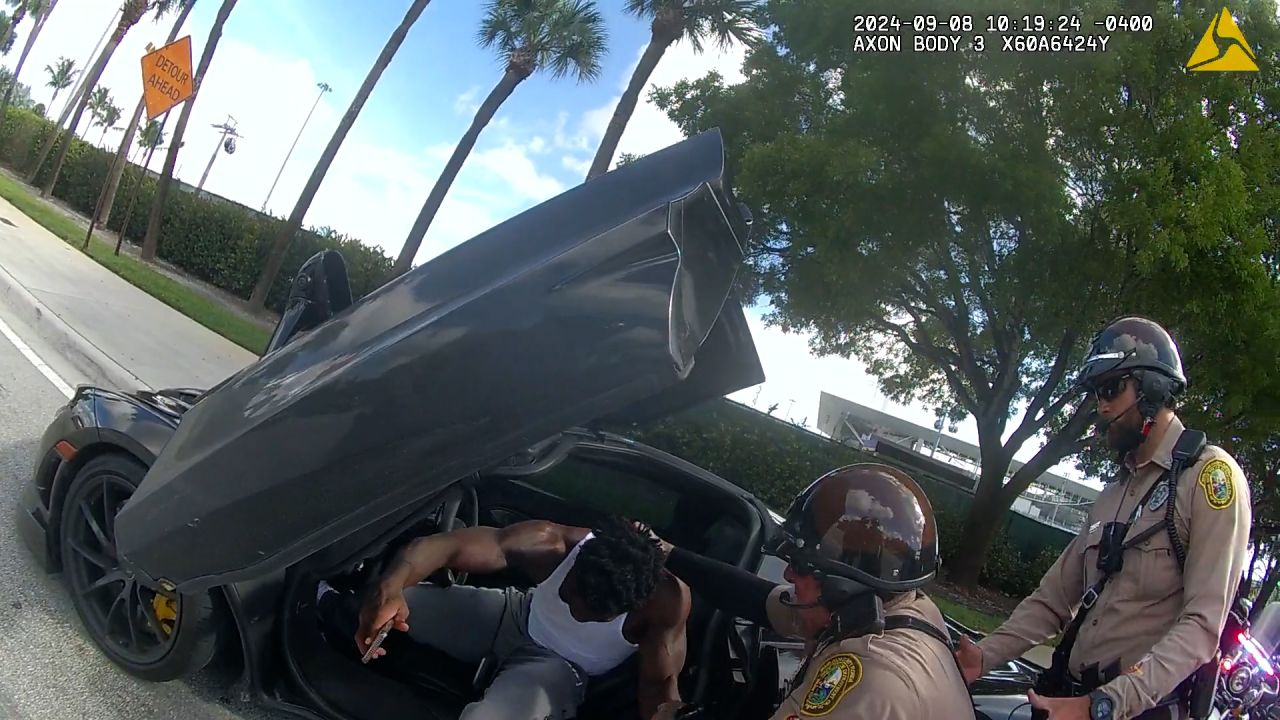
The central argument is simple: the American traffic stop is broken not because of bad actors on either side, but because of an architecture that forces two frightened people — an officer and a citizen — into a confrontation with no neutral observer, no real-time accountability, and no off-ramp for de-escalation. Estimates show that roughly 50,000 drivers are pulled over daily in the United States. The financial residue of those encounters is documented in municipal budgets: the 25 largest U.S. police departments spent over $3.2 billion on misconduct settlements over a decade. New York City alone paid $206 million in 2024 to settle 980 police misconduct lawsuits, the highest annual payout in years.
Those numbers are not the story. They are the ledger. The story is what a cross-functional team — of GoVia — has built behind the paper.
What the Research Shows
The GoVia does not invent a problem. It maps one.
A 2017 study by researchers Casey Delehanty, Jack Mewhirter, Ryan Welch, and Jason Wilks found that receipts of military equipment through the Department of Defense’s 1033 program were associated with an increase in the number of observed police killings in a given year, as well as year-over-year changes in police killings. The authors concluded that 1033 receipts lead to more law enforcement violence. Subsequent research has been mixed — a 2021 study in the Journal of Criminal Justice found that the relationship between 1033 acquisitions and deadly force was not straightforward when data was cleaned — but the policy implication remains: heavy hardware does not purchase trust, and it may purchase escalation.
On the training side, the evidence is equally nuanced. A randomized experimental evaluation of de-escalation training in Tempe, Arizona, found that the program improved intermediate behaviors — communication techniques, displays of empathy — but did not produce a statistically significant reduction in use-of-force incidents. A scoping review published in 2025 noted that while over 90% of American law enforcement academies now include de-escalation in their curriculum, the evidence base for its effectiveness remains “quite limited and mixed”.
The mental-health co-response model has stronger empirical footing. A 2025 study published in Nature Human Behaviour found that an emergency mental health co-responder program reduced involuntary psychiatric detentions by 16.5% — 370 fewer detentions over two years. A separate quasi-experimental study of a law-enforcement-operated co-responder program for youths found that 80% of incidents involving a co-response between a police officer and a mental-health professional were de-escalated. In Miami-Dade County, a co-responder program was associated with statistically significant improvements in mental-health functioning at six-month follow-up, including reductions in violence risk, depressive symptoms, anger, and perceived stress, with an estimated cost savings of $3,338 per participant in reduced crisis stabilization services in the first six months.
On the legal question at the center of the program’s citizen curriculum, the crime-fraud exception to attorney-client privilege is well established. Under Florida’s Evidence Code and similar provisions in other states, there is no lawyer-client privilege where the services of the lawyer were sought or obtained to enable or aid anyone to commit or plan to commit what the client knew was a crime or fraud. The case law is clear: the exception applies only when communications to the attorney are intended by the client to directly advance criminal or fraudulent activities with the attorney’s assistance. The GoVia translates this doctrine into a simple operational rule for citizens: do not commit a crime in front of your attorney. Comply now. Litigate later.
The Three Pillars
GoVia’s program built on research has three components. They are designed as a single system.
Citizen Education: The Encounter Curriculum
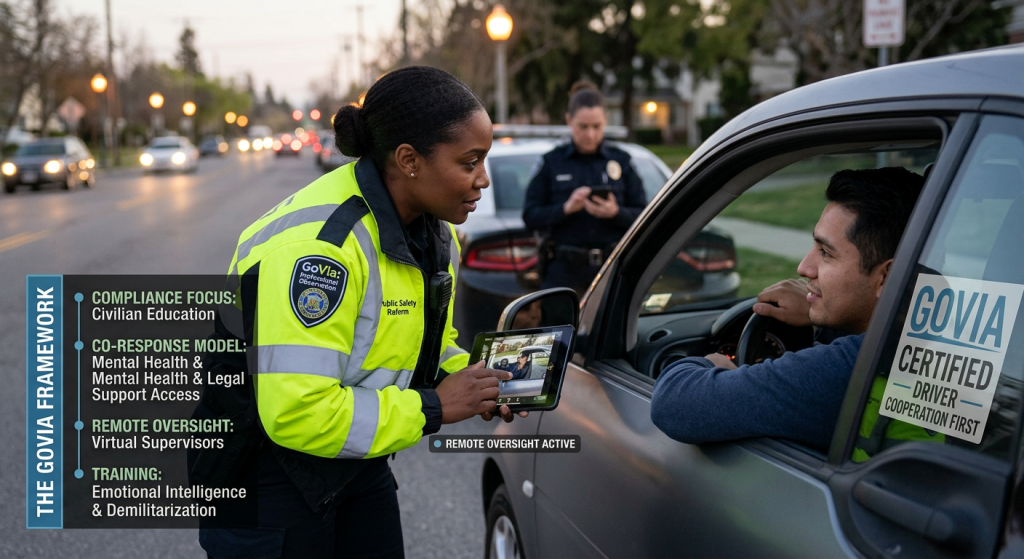
The curriculum teaches what every police department already publishes but almost no civilian has internalized: keep your hands visible, make slow movements, do not touch the officer, do not argue. It goes further, using emotional intelligence frameworks to help citizens understand the officer’s perspective without abandoning their own rights. The central instruction is that the citizen must remain the de-escalator for the duration of the encounter — even if arrested, even if they believe they are being treated unjustly. The moment a citizen escalates, they hand the officer a justification. The curriculum teaches that the encounter is not the place to fight. The courtroom is.
Officer Education: The Co-Response Curriculum
The officer curriculum integrates emotional intelligence training, trauma-informed de-escalation, and peer-support frameworks. The rationale is both humanitarian and operational: officers who understand their own triggers are better equipped to regulate their responses under stress. Research on emotional intelligence in law enforcement suggests that organizations investing in emotional-intelligence training are more adept at de-escalating situations and experience fewer cases of post-traumatic stress in their personnel. The curriculum also teaches officers that the citizen may be powering an attorney in the moment of their need — not as a threat, but as a signal that both parties have agreed to be accountable. The officer and the attorney are co-laborers in the same project: ensuring the encounter does not become a tragedy.
Technology: De-Escalation Infrastructure
The technological layer is not a weapon. It is a camera with a lawyer attached. When a user activates the encounter screen, secure streaming begins, GPS location is stamped, and chosen contacts are alerted. A licensed attorney and a licensed mental-health professional can join the livestream. The call is recorded, encrypted, and stored.
The feature with the most immediate operational relevance is the virtual supervisor protocol. When a citizen asks for a supervisor — and they have the right to do so — the system can send a secure video link to the command center. The supervisor joins a live feed showing both the citizen and the officer in real time. The supervisor can see the officer’s body language, hear the citizen’s voice, and intervene. The encounter becomes a three-way conversation, mediated by someone with the authority to resolve the issue on the spot. The officer is not alone. The citizen is not unheard.
The Demilitarization Argument
The program’s position on demilitarization is not ideological. It is structural. When a vehicle is documented as protected — with a visible marker indicating that live counsel and mental-health support are active — the officer approaches knowing that this is a recorded, professionally observed interaction. The power equation shifts. The officer no longer needs to rely on the implicit threat of force to secure compliance, because the citizen is already complying. The heavy hardware becomes what it always was: a substitute for trust.
The research supports the logic. The 1033 program studies do not prove that every armored vehicle causes a shooting. They suggest that the availability of military equipment changes the calculus of escalation. When the encounter is already de-escalated — when the citizen is compliant and the attorney is present — the equipment is redundant.
What Comes Next: Atlanta, NYC, United Kingdom and Los Angeles
GoVia’s will be cited in law reviews and policy briefs in the future. It will be attacked from both directions — dismissed by some as a sellout, by others as a threat to officer safety. It will survive because it is built on evidence rather than ideology.
The pilot data is preliminary. The sample is small. But the direction is consistent with the existing literature: co-response reduces involuntary detentions; emotional-intelligence training improves de-escalation; real-time supervision creates accountability; and the crime-fraud exception gives citizens a clear, legally grounded reason to comply rather than resist.
The status quo is not sustainable. The settlements, the killings, the officers who take their own lives — these are not separate problems. They are the same problem, expressed in different ledgers.
The encounter is not a battle to be won. It is a moment to be survived. The only way to survive it is together.