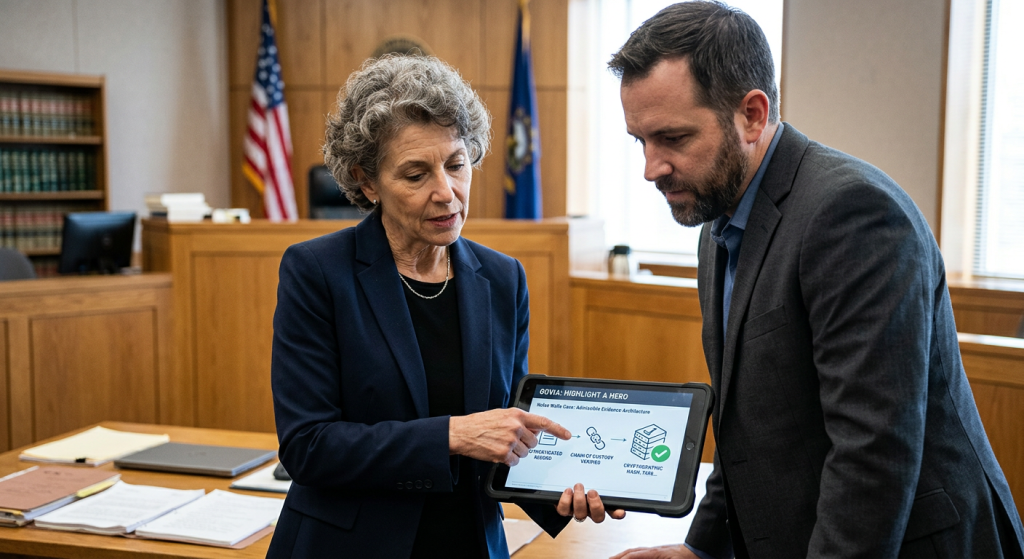
The Immutable Chain: How GoVia’s Evidence Architecture Solves the Prosecutor’s Dilemma
AN INVESTIGATIVE SPECIAL REPORT
BILOXI, MS / CLEVELAND, OH —
On September 21, 2026, a Jackson County grand jury issued a “no true bill” in the tragic death of 18-year-old Nolan Wells on Horn Island. Despite months of intense public scrutiny, independent legal reviews, and audio recordings from emergency distress calls, prosecutors faced a fatal legal barrier: the inability to establish an unassailable, tamper-evident Chain of Custody (Continuity of Possession) that could bridge the gap between digital recordings and court admissibility.
The resolution of the Wells case highlighted a growing crisis in modern criminal justice. In an era dominated by smartphone recordings, marine distress calls, and bystander footage, why do prosecutors routinely fail to introduce digital evidence before grand juries?
The answer lies in the stringent evidentiary hurdles imposed by Federal Rule of Evidence 901 (Authenticating or Identifying Evidence) and state equivalents. When digital evidence lacks immutable verification at the moment of creation, defense attorneys dissect its integrity, leaving prosecutors hesitant to base indictments on contested digital files.
Enter GoVia: Highlight A Hero, a patented community safety and legal intervention platform. By utilizing a cryptographically verifiable Digital Chain of Custody (DCoC) protocol, GoVia provides a real-world technological framework designed to make digital evidence legally undeniable in courtrooms.
Part I: The Evidentiary Autopsy of the Nolan Wells Case
When Nolan Wells died on Horn Island on July 4, 2024, the primary digital artifacts included cellular device logs, Snapchat data reports, and a distress call made to marine response assistance. While experts hired by the family scrutinized the emergency audio, prosecutors were constrained by three core evidentiary challenges:
* The Authentication Gap (FRE 901(b)(9)): Digital audio recorded across commercial cellular networks or marine radio relays often lacks system performance telemetry. Without direct testimony from the system operator proving that the process produces an accurate result, defense counsel can challenge the recording’s integrity.
* The Integrity Challenge (FRE 1002 / The Best Evidence Rule): Audio files that pass through multiple cloud servers or localized downloads are vulnerable to claims of frame dropping, compression artifacting, or unauthorized metadata modification.
* The Hearsay and Contemporaneous Statement Exception (FRE 803(1) & (2)): For emergency audio to be admitted without the caller testifying, it must qualify as a Present Sense Impression or Excited Utterance. Proving the exact millisecond time stamp and environmental context is vital to surviving defense motions to suppress.
Because the state medical examiner’s autopsy listed the cause of death as undetermined, prosecutors required absolute evidentiary certainty from digital sources to establish probable cause. When the digital chain of custody relies on third-party telecommunications logs subject to gaps in accounting, reasonable doubt takes root before the grand jury ever convenes.
Part II: The GoVia Architecture — Lawful Evidence Ingestion
If Nolan Wells or his companions had activated GoVia: Highlight A Hero during the maritime emergency, the digital footprint would have followed a fundamentally different legal trajectory.
GoVia’s platform operates not merely as a recording application, but as a Cryptographic Deposition Engine designed to meet strict statutory standards:
[ Citizen Encounter / Emergency ]
│
▼
[ GoVia Client Edge Engine ] ──► (Real-Time SHA-256 Hashing & GPS Telemetry)
│
▼
[ Decentralized Immutable Vault ] ──► (Zero-Trust Ledger & Write-Once-Read-Many Storage)
│
▼
[ Certified Evidence Packet ] ──► (Self-Authenticating FRE 902(11)/(14) Record)
│
▼
[ Prosecutor / Grand Jury Admissibility ]
1. Contemporaneous Hash Generation (Lex Cryptographia)
The moment a GoVia session is initiated, the video, audio, and metadata (GPS, cellular tower handoffs, device barometer data) are processed through a SHA-256 cryptographic hashing algorithm directly at the chip-level memory buffer. Before the data is written to local storage or transmitted across the network, an immutable mathematical fingerprint is generated.
2. Live Attorney & Expert Witness Telemetry
Under GoVia’s operational model, a licensed attorney or certified professional joins the live stream in real time. In legal terms, this transforms the digital recording from an unverified media file into an Affirmed Contemporaneous Observation. The attending attorney acts as a contemporaneous officer of the court, establishing immediate personal knowledge under FRE 602.
3. WORM Storage & Blockchain Notarization
Transmitted data is sent directly to an enterprise-grade WORM (Write-Once-Read-Many) cloud repository. The generated SHA-256 hash is published to a decentralized, tamper-evident ledger. If a single byte of the audio—even a millisecond of background noise—is altered, cropped, or filtered, the hash verification fails instantly, identifying any unauthorized modification.
Part III: Case Law Framework — Why GoVia Evidence Survives Judicial Review
To force a grand jury or trial judge to admit evidence, a system must satisfy established judicial precedents governing digital forensics. GoVia’s evidence workflow aligns directly with controlling case law:
Lorraine v. Markel American Insurance Co. (D. Md. 2007)
* The Rule: In the landmark decision Lorraine, Magistrate Judge Paul Grimm outlined the five-stage evidentiary hurdle for digital evidence: (1) Relevance, (2) Authenticity, (3) Hearsay, (4) Original Document Rule, and (5) Probative Value vs. Unfair Prejudice.
* GoVia’s Compliance: GoVia’s system generates an automated Certificate of Authenticity accompanying every evidence package. By bundling raw media with system telemetry, GoVia satisfies all five Lorraine prongs out of the box, preventing pre-trial suppression motions.
State v. Swinton (Conn. 2004)
* The Rule: The Connecticut Supreme Court ruled that computer-enhanced or computer-generated evidence requires proof that the recording system was operating properly, that the input data was accurate, and that the software used is accepted as reliable in the scientific community.
* GoVia’s Compliance: GoVia utilizes standard, non-proprietary cryptographic algorithms (SHA-256, AES-256 encryption) validated under NIST (National Institute of Standards and Technology) guidelines, eliminating defense claims that the media was processed via speculative software.
United States v. Jackson (11th Cir. 2007)
* The Rule: Authenticating web-based or digital cloud records requires demonstrating a reliable, secure path from the original creation point to the stored cloud record without third-party intervention.
* GoVia’s Compliance: By bypassing local camera rolls and streaming directly over an encrypted TLS 1.3 pipeline straight to WORM storage, GoVia eliminates the “middleman vector”—preventing allegations that a user or third party edited the file prior to police impound.
Part IV: Legal Terminology Glossary for Evidence & Property
To understand how GoVia interfaces with the District Attorney’s office, it is necessary to examine the formal legal terminology governing digital evidence and property:
| Term | Legal Definition | GoVia Technical Equivalent
| Continuity of Possession | The unbroken, demonstrable log tracking the physical or digital movement, custody, and transfer of an item of evidence. | Automated Immutable Audit Log recording every access request, export, and judicial transfer. |
| Res Gestae | Statements or events so closely connected to the main fact that they form part of the transaction itself; admissible as an exception to hearsay. | Live-streamed video/audio authenticated by a participating attorney at the exact moment of the incident. |
| Self-Authenticating Records (FRE 902(14)) | Data copied from an electronic device, storage medium, or file, conditioned upon a certification by a qualified person showing digital hash matching. | Automated Affidavit of Digital Integrity signed cryptographically by the platform’s custodian of records. |
| In Custodia Legis | Property or evidence held under the direct legal guardianship and authority of the court or law enforcement officers. | Vault-level evidentiary hold accessible exclusively via judicial subpoena or prosecutorial portal. |
Part V: The Grand Jury Imperative — Transforming “Undetermined” into Actionable Justice
In the Nolan Wells case, the grand jury was presented with ambiguous physical findings and disputed digital artifacts, leading to a “no true bill.”
Had GoVia’s Digital Chain of Custody Protocol been active:
* Clear Distinguishing of Environmental Audio: The high-fidelity, uncompressed audio pipeline paired with ambient pressure sensors would have provided exact acoustic telemetry, enabling forensic experts to separate marine noise from human speech without altering the primary file.
* Elimination of Spoliation Claims: The defense could not allege that emergency recordings were edited, truncated, or mishandled by civil authorities, as the original SHA-256 hash would match the grand jury submission bit-for-bit.
* Self-Authenticating Submission: Under Rule 902(11), prosecutors could present the GoVia evidence packet to the grand jury without needing to call multiple IT vendor technicians or telecom record custodians to establish foundation—streamlining the indictment process.
GoVia’s Conclusion: The Future of Evidentiary Integrity
The tragedy on Horn Island underscores a fundamental reality of 21st-century jurisprudence: Justice cannot exceed the quality of the evidence preserved.
When digital evidence is left to unencrypted local storage, commercial cellular compression, or informal sharing channels, the chain of custody degrades. By embedding legal framework requirements directly into the software architecture, GoVia: Highlight A Hero bridges the gap between public safety technology and courtroom admissibility—ensuring that when prosecutors present digital evidence to a grand jury, the truth remains unassailable under the law.
GoVia: Highlight A Hero – Transforming Police Accountability
This video provides important context on how GoVia operates in real time during citizen-police interactions, demonstrating how live legal assistance and recording features create transparent, verifiable documentation designed for legal review.
Summary:
The Immutable Chain: Solving the Prosecutor’s Dilemma
The provided text examines the legal and technical obstacles that prevent digital recordings from being admitted as evidence in criminal court cases. Using the Nolan Wells case as a primary example, the report illustrates how traditional digital files often fail to meet stringent evidentiary standards due to concerns regarding authenticity and the chain of custody. To address these failures, the document introduces GoVia: Highlight A Hero, a platform that utilizes cryptographic hashing and real-time attorney monitoring to create legally undeniable records. This system ensures data integrity by employing decentralized immutable ledgers and write-once-read-many storage to prevent any unauthorized tampering. Ultimately, the source argues that such advanced evidence architecture is essential for transforming modern digital artifacts into self-authenticating tools that can survive rigorous judicial review.