A Community Police Safety Platform Built Around Safety, Evidence, Support, and Trust
The Executive Question
Why should a university, corporation, police department, police union, citizen, or international visitor join GoVia Highlight A Hero?
Because safety should not begin after something goes wrong.
GoVia is designed around a different principle: give people access to support, documentation, education, and trusted resources while an encounter is happening, not days or weeks later when memories conflict and evidence may be incomplete.
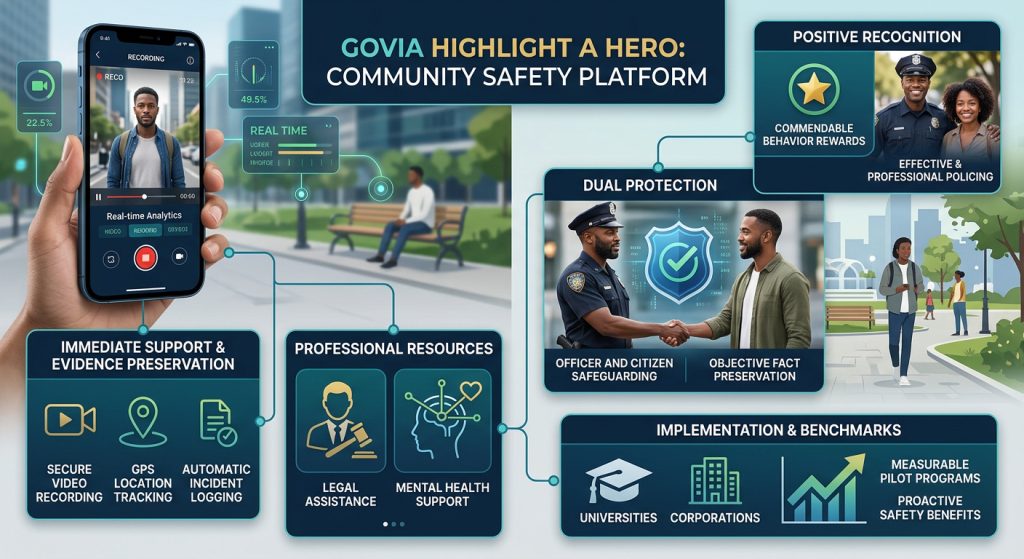
GoVia Highlight A Hero is a community police safety and accountability platform designed to create a more informed and constructive interaction among citizens, law enforcement, attorneys, mental-health professionals, families, and community organizations. Its public materials describe capabilities including encounter documentation, affidavits, evidence storage, GPS-based resources, live connections with participating professionals, and positive recognition of officers.
The fundamental proposition is simple:
Protect the person. Protect the officer. Preserve the facts. Support the family. Strengthen the community.
Q1. Why should a UNIVERSITY join GoVia?
Because student safety is no longer simply a campus-security issue. It is part of the university’s promise to students and their families.
When a university tells a prospective student, “We care about your safety,” GoVia provides an opportunity to turn that statement into a tangible safety initiative.
Universities could offer GoVia as part of a broader student-safety ecosystem for students, faculty, staff, visitors, and potentially parents or guardians.
The opportunity
A university could establish a GoVia Campus Safety Pilot that allows researchers and administrators to evaluate how technology can support students during encounters involving:
- Campus police
- Local police departments
- Traffic stops
- Off-campus incidents involving students
- Mental-health situations
- Emergency or high-stress encounters
- Documentation of incidents
- Access to appropriate legal or community resources
The university would not simply be purchasing another safety application.
It would be testing a new model of community safety and accountability.
The student proposition
Imagine telling an incoming freshman:
“Your university does not simply tell you that your safety matters. We have invested in a system designed to help you document, communicate, and access appropriate support when a serious encounter occurs.”
That message can become part of the university’s student experience and recruitment strategy.
The research opportunity
A university could measure:
- Student awareness of safety resources
- Student confidence during police encounters
- Officer perceptions of encounter safety
- Response and escalation patterns
- Use of documentation tools
- Access to legal and mental-health resources
- Student retention and satisfaction
- Community-police trust
- Training outcomes
That makes GoVia particularly interesting to universities because the platform can become both a safety initiative and a research environment.
The question is not whether GoVia can solve every campus safety problem.
The question is:
Can a university test whether real-time access to information, documentation, and professional support improves outcomes?
GoVia believes the answer is worth testing.
Q2. What would a GoVia university pilot look like?
A university could begin with a controlled pilot rather than making a campus-wide commitment immediately.
Phase 1 — Research
Select a defined student population, campus department, or geographic area.
Phase 2 — Training
Educate students, campus police, administrators, attorneys, mental-health professionals, and participating community partners.
Phase 3 — Deployment
Make GoVia available to participating users.
Phase 4 — Measurement
Track defined safety, engagement, documentation, and satisfaction metrics.
Phase 5 — Independent Evaluation
Compare the results against the university’s existing safety and incident-response processes.
This approach transforms GoVia from a technology purchase into a measurable public-safety research project.
Q3. Why should a COMPANY provide GoVia to its employees?
Because employers already provide benefits designed to protect employees and their families.
Health insurance protects physical health.
Employee assistance programs support mental health.
Cybersecurity protects digital assets.
Workers’ compensation addresses workplace injuries.
GoVia introduces another potential layer:
Safety during high-stress encounters outside the workplace.
Employees drive to work. Employees travel. Employees have families. Employees interact with police and emergency systems. Employees may experience traffic crashes, domestic emergencies, or other situations where documentation and professional support become important.
A company could provide GoVia as:
- An employee benefit
- A family safety benefit
- An onboarding benefit
- A corporate wellness/safety resource
- A travel-safety resource
- A community engagement initiative
The message to employees becomes:
“We care about your safety when you are at work, and we care about your safety when you leave work.”
That is a meaningful distinction.
Q4. Why would a Fortune 100/500 company care about GoVia?
Because modern corporations increasingly recognize that employee safety extends beyond the four walls of the workplace.
A corporation has thousands or hundreds of thousands of employees moving through communities every day.
GoVia creates an opportunity to explore a new category of benefit:
Community Safety as an Employee Benefit.
For a large employer, the potential value extends beyond the individual employee.
It can involve:
Employee → Family → Community → Employer
A company that provides GoVia could potentially strengthen employee confidence while demonstrating a commitment to community safety and responsible technology.
The strongest corporate pilot would establish measurable objectives rather than making unsupported claims about outcomes.
Q5. Why should a POLICE DEPARTMENT join GoVia?
Because GoVia is not designed to be “anti-police.”
Its strongest proposition is actually dual protection.
GoVia’s public materials describe the platform as being designed to improve the interaction between citizens and law enforcement while protecting both sides of the encounter.
That matters.
A police officer enters an encounter with uncertainty.
A citizen enters an encounter with uncertainty.
GoVia is designed around reducing that uncertainty through information, communication, documentation, and appropriate professional support.
For the officer, GoVia can potentially provide:
- Encounter documentation
- Safety education
- De-escalation support
- Access to relevant resources
- Positive recognition
- Training data
- A documented record of positive interactions
- Additional context when an encounter is later questioned
For the department:
GoVia can potentially support:
- Community engagement
- Officer training
- Transparency
- Documentation
- Accountability
- Positive recognition
- Data-informed policy development
- Community trust
The objective should not be:
Citizen versus police.
The objective should be:
Citizen + Police + Community = Safer Encounter
Q6. Why should a POLICE UNION consider GoVia?
Police officers deserve protection too.
A union could present GoVia as part of a broader officer-safety and professional-development strategy.
The message is:
“We want our officers to come home safely, and we want the public to come home safely.”
That means supporting both sides of the encounter.
A police union could explore GoVia for:
- Officer education
- De-escalation training
- Encounter documentation
- Positive officer recognition
- Family safety education
- Community engagement
- Professional development
- Post-incident analysis
The “Highlight A Hero” philosophy is especially important.
Public safety technology does not have to focus exclusively on misconduct.
It can also document and recognize good policing.
That creates a more balanced accountability model.
Q7. Why should an individual CITIZEN join GoVia?
Because evidence is most powerful when it is documented close to the time an event occurs.
A person may eventually need to explain what happened during:
- A traffic stop
- A traffic crash
- A police encounter
- A domestic-violence incident
- A dispute
- An assault
- Another incident requiring documentation
GoVia is designed to give individuals tools for documenting encounters and connecting with appropriate support. Its public materials specifically identify affidavits, encounter documentation, evidence storage, legal support, and mental-health resources as components of its broader model.
The platform’s larger proposition is:
Don’t rely solely on memory when technology can help document the event.
That does not mean every recording automatically becomes admissible evidence.
Court admissibility depends on jurisdiction, circumstances, authentication, chain of custody, privacy laws, recording laws, and the rules of the particular court.
GoVia’s goal is to build the technology and workflows that can make responsible documentation more useful for later legal review.
Q8. What is the “privilege and credibility” proposition?
This is one of GoVia’s most important social-impact ideas.
Access to professional resources is not equally distributed.
A person with money may immediately call an attorney.
A person with family connections may know who to call.
A person from a lower-income community may have neither.
GoVia’s vision is to give ordinary people a pathway toward greater access to information, documentation, and professional support.
That is what GoVia means by expanding privilege and credibility.
Technology can help reduce the gap between:
“I know what happened.”
and
“I can document what happened.”
That distinction can matter enormously.
Q9. Why focus on young people ages 12–26?
Young people increasingly live in environments where digital documentation is already part of everyday life.
They use phones to communicate, record events, share information, and seek help.
The opportunity is to introduce another concept:
Responsible documentation.
For college students and young adults, GoVia can potentially become part of safety education surrounding:
- Traffic stops
- Campus encounters
- Travel
- Mental-health crises
- Community safety
- Legal awareness
- Personal documentation
For minors, deployment would require appropriate parental, school, privacy, consent, and legal safeguards.
The objective is not to encourage confrontation with police.
It is the opposite:
Teach young people how to stay safe, remain calm, understand their rights, and document responsibly.
Q10. Why should GoVia be available beyond police encounters?
Because the underlying problem is larger than policing.
The same documentation and support architecture can potentially apply to other situations in which an individual needs reliable records.
Potential use cases include:
Traffic crashes
Document the scene and preserve relevant information for later insurance or legal review.
Domestic violence
Create a pathway toward documentation and appropriate professional resources.
Sexual assault
Provide access to appropriate resources while recognizing that evidence collection, medical care, reporting, and legal processes require specialized protocols.
Disputes and confrontations
Create a contemporaneous record where legally appropriate.
Emergency situations
Connect individuals with appropriate resources.
Mental-health crises
Provide pathways toward trained support where available.
GoVia’s public materials also envision connections to community resources, including legal aid, mental-health crisis resources, and advocacy organizations.
The larger opportunity is therefore:
GoVia is not simply a police app.
It is being developed as a community safety and documentation ecosystem.
Q11. Why should INTERNATIONAL STUDENTS and VISITORS use GoVia?
International students and travelers can face an additional challenge:
They may not understand the local legal system, language, or emergency-response culture.
Someone traveling from another country may not know:
- What to say
- What not to say
- Who to call
- What their rights are
- What local procedures mean
- Where to find legal assistance
- How to communicate during a stressful encounter
GoVia’s international opportunity is therefore significant.
A multilingual platform could potentially provide:
- Language support
- Location-specific information
- Access to participating attorneys
- Mental-health resources
- Family notifications
- Encounter documentation
- Local community resources
The goal would be:
Wherever you are, you should not feel completely alone during a high-stress encounter.
However, international deployment must be designed country by country because privacy, recording, telecommunications, professional licensing, data residency, and law-enforcement rules vary substantially.
Q12. What makes GoVia different from simply recording an encounter on a phone?
This may be the most important question.
A phone records.
GoVia is designed to organize support around the recording.
That distinction matters.
The larger GoVia architecture brings together:
Documentation
GPS/location context
Professional support
Mental-health resources
Family notification
Affidavit/reporting workflows
Evidence preservation
Community resources
Positive officer recognition
Data and accountability
The public GoVia materials describe the platform as seeking to combine video, testimony, legal backup, positive recognition, and community support within one workflow.
That is the larger vision.
Q13. What does “Highlight A Hero” mean?
Accountability should not only identify what went wrong.
It should identify what went right.
Police officers perform difficult work under pressure.
When an officer demonstrates professionalism, patience, compassion, courage, or exceptional service, citizens should have a way to recognize that behavior.
Highlight A Hero creates a positive-feedback mechanism.
The message is:
Good policing deserves to be documented too.
This creates an important cultural shift:
Accountability + Recognition
rather than accountability alone.
Q14. What is the strongest reason to join GoVia?
Because nobody knows when they will need it.
Most people do not wake up expecting to have a police encounter.
A student does not expect to be stopped.
An employee does not expect to be involved in an accident.
A traveler does not expect to need an attorney.
A family does not expect a crisis.
A police officer does not know what the next call will bring.
That is exactly why safety infrastructure exists.
We wear seatbelts before an accident.
We purchase insurance before an emergency.
We back up our computers before losing data.
And GoVia asks:
Why wait until after a critical encounter to think about documentation, support, and accountability?
Q15. Why should an organization pilot GoVia instead of simply buying it?
Because responsible innovation requires evidence.
GoVia should be evaluated through measurable pilots.
A university, corporation, municipality, police department, or community organization could establish a defined pilot with:
- A specific population
- A specific geographic area
- Defined use cases
- Training
- Privacy and security protocols
- Legal review
- Baseline measurements
- Outcome measurements
- Independent evaluation
- A clear decision point for expansion
This allows the organization to answer the question that matters most:
Does GoVia improve the safety and quality of encounters?
Not through marketing.
Through evidence.
THE GO VIA VALUE PROPOSITION
For Universities
Recruit students with a stronger safety promise.
Give students access to a new safety resource and create a living research environment for studying technology, policing, law, mental health, and community trust.
For Corporations
Extend employee safety beyond the workplace.
Offer employees and potentially their families another resource for serious encounters, documentation, and access to appropriate support.
For Police Departments
Protect officers while improving community trust.
Use technology to support education, documentation, de-escalation, professional development, and recognition.
For Police Unions
Protect the people who protect the public.
Provide officers with another layer of education, documentation, and professional support.
For Citizens
Turn uncertainty into preparation.
Create a pathway toward documentation, information, and appropriate professional resources when something important happens.
For Young People
Teach safety before the crisis.
Build responsible habits around communication, documentation, de-escalation, and knowing where to seek help.
For International Students and Travelers
Make unfamiliar systems easier to navigate.
Provide multilingual and location-aware pathways to appropriate legal, mental-health, and community resources where available.
THE BIGGER IDEA
GoVia Highlight A Hero is built around a simple belief:
Safety should be shared.
Police should be safe.
Citizens should be safe.
Students should be safe.
Employees should be safe.
Families should be safe.
Visitors should be safe.
And when something goes wrong, people should have a better pathway toward understanding what happened and finding appropriate support.
GoVia is therefore not asking organizations to choose between police and citizens.
It is asking them to invest in a system where both sides have a better chance of getting home safely.
GO VIA: HIGHLIGHT A HERO
Document the moment.
Support the person.
Protect the officer.
Preserve the facts.
Recognize the good.
Build trust.
The next step is not to believe every claim about what GoVia can accomplish.
The next step is to pilot it, measure it, research it, improve it, and let the evidence determine how far it should go.
Summary:
The provided materials introduce GoVia Highlight A Hero, a comprehensive community safety platform designed to assist individuals and law enforcement during high-stress encounters. Unlike standard video recording tools, this system organizes immediate support around incidents by integrating evidence preservation, GPS location tracking, and professional resources such as legal and mental-health assistance. The platform emphasizes dual protection, aiming to safeguard both citizens and police officers while preserving objective facts and community trust. Furthermore, the initiative seeks to reward commendable behavior through its positive recognition features, highlighting effective and professional policing alongside traditional accountability. Organizations like universities and corporations are encouraged to implement measurable pilots of the platform as a proactive safety benefit for students and employees.