Atlanta sits at the center of a national fight over who gets freedom before trial, who profits from detention, and whether technology can make a broken system fairer or simply faster. In Georgia, that fight is sharper than in much of the country because Senate Bill 63 expanded mandatory cash bail for dozens of offenses and then triggered a legal backlash over restrictions on charitable bail support, while Fulton County’s jail crisis has continued to draw scrutiny over overcrowding and racial disparity.
Atlanta vs. the Nation
Across the U.S., cash bail remains deeply controversial because it can keep people jailed not for danger, but for poverty. Georgia’s SB 63 went further than many states by broadening secured bail requirements and limiting how many bonds some groups can post, a move critics argued would worsen detention and favor commercial bail businesses. At the national level, Trump has made ending no-cash-bail policies a federal talking point, arguing they are a public-safety failure and pushing the Justice Department toward tougher legislation, though the legal power to reshape bail still largely sits with states and courts.
Why Atlanta matters
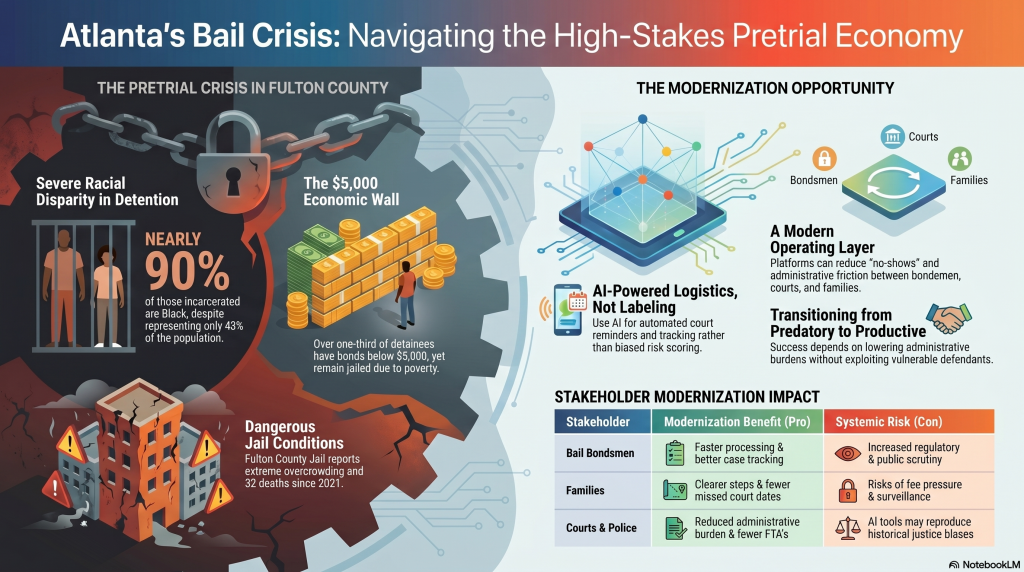
Atlanta is not just another city in the bail debate; it is a pressure point where policy, race, and jail capacity collide. A 2026 ACLU-backed analysis cited by The Bail Project said Fulton County Jail remained dangerously overcrowded, that nearly 90% of those incarcerated were Black even though Black residents were 43% of the county population, and that 32 people had died in the jail since 2021. The same report said more than a third of people in custody had bonds below $5,000, which can still be impossible for families living paycheck to paycheck. That is the real-world tension: a small bond can function like a wall when income is unstable.
The bail bondsman business
Bail bondsmen are not disappearing; in a stricter bail environment, they may become more central. Georgia’s law and Trump’s national rhetoric both strengthen the case for secured release, which can expand the pool of people who need a bondsman’s services. But the industry’s reputational challenge remains severe, because critics see it as monetizing pretrial liberty while shifting risk onto poor defendants and their families. That makes any new entrant into the market, including a platform like GoVia Highlight A Hero, dependent on trust, transparency, and workflow value rather than just access to defendants.
AI and fairness
AI can help a bail platform by speeding up verification, tracking court dates, flagging compliance risks, and reducing paperwork, but it also carries major fairness risks if it learns from biased arrest or court patterns. In justice settings, AI can become a force multiplier for discretion, or a machine that automates old inequities more efficiently. The winning approach is narrow and auditable: use AI for logistics, not for unreviewed punishment decisions; for reminders, not secret scoring; for case management, not opaque risk labeling. That framework is especially important in Atlanta, where concerns about racial disparity and pretrial detention are already intense.
How GoVia can win
GoVia can win if it becomes the operating layer between bondsmen, families, courts, and defense teams rather than just another app. The strongest revenue stream is not replacing the bondsman, but helping them close cases faster, reduce no-shows, automate reminders, document compliance, and better manage repeat business in a regulated environment. That is especially attractive in Georgia, where the legal climate has made cash bail more embedded, not less. If GoVia can prove it lowers administrative friction, improves court appearance rates, and creates cleaner communication without exploiting defendants, it can position itself as a modernization tool instead of a predatory layer.
Pros and cons
| Angle | Pros | Cons |
| For bondsmen | More leads, faster processing, better case tracking, improved collections captira+1 | Stronger public criticism, regulatory scrutiny, dependence on a controversial market aclu+1 |
| For families | Faster information, clearer steps, fewer missed court dates captira | Risk of fee pressure, surveillance concerns, and unequal access if design is not careful |
| For courts and police | Better notification systems, fewer failures to appear, less administrative burden | AI tools can reproduce bias if trained on skewed justice data justicebailbonds+1 |
| For GoVia | Clear niche, recurring revenue, scalable B2B workflow product | Needs trust, compliance, and careful legal positioning |
The sharper truth
The national argument is no longer just “bail or no bail.” It is whether the system will keep using money as a proxy for risk, and whether technology will make that system more efficient without making it more unjust. Atlanta is a high-stakes proving ground because the city’s jail conditions, Georgia’s expanding cash-bail rules, and the federal political mood are all pushing in the same direction: more people entering the pretrial market, and more pressure on companies that can organize it. GoVia’s opportunity is real, but its legitimacy will depend on whether it helps people navigate the system more humanely, not just more profitably.
We will navigate this ship with all hands on deck! We need your participation!