How One Minor Traffic Stop Could Transform America’s Constitutional Debate
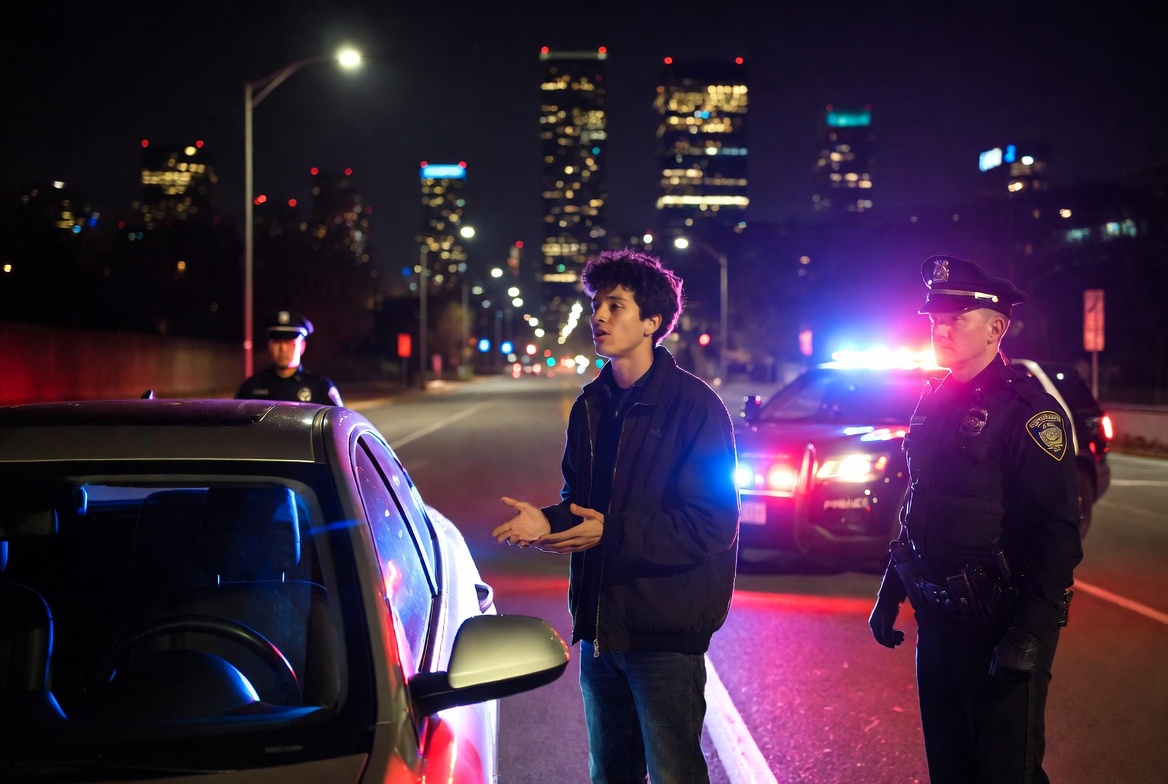
On a spring evening in New Jersey, a driver is pulled over because a rear license plate light is out. The violation is trivial. The car is registered. The driver is sober. No reckless behavior is observed. Yet within minutes, the encounter becomes a constitutional test. The officer approaches. The driver is anxious. A misunderstanding escalates. Backup arrives. Hands move. Voices rise. A search follows.
What began as a $25 equipment issue becomes another entry in America’s vast database of police encounters—one more interaction in a justice system increasingly shaped not only by human discretion, but by artificial intelligence.
Now imagine a different scenario. Before the officer reaches the window, a clearly visible bumper sticker reads:
GoVia Highlight A Hero™
A QR code invites the officer to join a live secure video conference with a licensed attorney and retired law enforcement professional. AI sentiment analysis monitors tone, speech patterns, and escalation risk in real time. The entire encounter is recorded and encrypted.
The officer is no longer alone.
The citizen is no longer isolated.
The Constitution gains a digital witness.
If New Jersey adopts both traffic stop reform and platforms like GoVia, the state could become the first in America to modernize policing at the intersection of civil rights, constitutional law, and artificial intelligence.
The Broken Taillight Problem
Across the United States, millions of drivers are stopped each year for technical violations such as:
- Expired registration
- Cracked windshields
- Obstructed license plates
- Broken headlights
- Hanging air fresheners
These infractions are often unrelated to crash prevention, yet they provide legal justification for police to detain motorists under the Terry v. Ohio framework and the broad constitutional authority affirmed in Whren v. United States. In Whren, the Supreme Court of the United States ruled that as long as officers observe a traffic violation, the subjective motive behind the stop is largely irrelevant. That decision created the legal foundation for the modern pretext stop.
New Jersey’s Data Tell a Disturbing Story
In April 2026, ACLU of New Jersey released a landmark report calling for the elimination of non-safety traffic stops. The findings were stark:
- More than 6 million traffic stops analyzed.
- Black drivers represented 18.8% of all stops while accounting for only 8.2% of New Jersey drivers.
- Black motorists made up 36.5% of all searches.
- In windshield obstruction and tint stops, Black drivers accounted for 49.3% of searches.
- Contraband was found in only 0.76% of stops.
- Equipment issues involving lights, windows, mirrors, or windshields were associated with just 45 of 11,750vehicles involved in fatal crashes from 2010–2023—only 0.38%. (ACLU of New Jersey)
The conclusion is difficult to avoid:
Minor equipment stops consume police resources, disproportionately burden Black communities, and do almost nothing to reduce fatal crashes.
The Trump Administration and the Federal Retreat from Oversight
Under President Donald Trump, the United States Department of Justice sharply curtailed the use of pattern-or-practice investigations and consent decrees, the federal government’s primary tools for reforming unconstitutional police departments. Critics argued that local departments were left with fewer federal accountability mechanisms even as public scrutiny intensified. The result was a widening governance gap: police agencies were expected to improve trust while facing less centralized oversight and growing political polarization. That vacuum has accelerated interest in technological accountability systems capable of documenting encounters independently and objectively.
Artificial Intelligence Enters the Justice System
AI already influences critical legal decisions across the country:
- Pretrial risk assessments
- Sentencing recommendations
- Facial recognition
- Investigative analytics
- Police deployment strategies
Research from scholars including Sharad Goel and colleagues has shown that algorithmic fairness involves unavoidable tradeoffs between accuracy and competing definitions of equity. The central lesson is profound: AI can reduce arbitrary human discretion, but if poorly designed, it can also encode and scale existing biases. The question is no longer whether AI will shape justice. It is whether it will reinforce inequality or constrain it.
What Is GoVia Highlight A Hero™?
GoVia Highlight A Hero™ is envisioned as a constitutional technology platform designed to bring transparency and professional oversight to police encounters.
Core features include:
- Live attorney participation via secure video conference
- Real-time retired police mentorship
- AI sentiment and escalation analysis
- Automatic encrypted recording and evidence storage
- Time-stamped chain of custody
- Supervisory and judicial review tools
Unlike predictive policing systems that estimate who might commit a crime, GoVia focuses on what is happening in the present moment: a real encounter between a government agent and a citizen.
A Digital Public Defender at the Driver’s Window
The platform functions as a “digital public defender.”
When activated, GoVia introduces immediate procedural safeguards:
- The citizen invokes legal assistance.
- The officer scans a QR code or joins via secure link.
- Counsel appears live.
- AI flags rising hostility or stress.
- The encounter is preserved as evidence.
This changes incentives for everyone involved.
Officers know conduct is documented.
Citizens feel less isolated.
Attorneys can intervene before escalation.
Judges later review a complete record.
If New Jersey Adopted GoVia
New Jersey is uniquely positioned to lead.
The state is already debating legislation to reduce non-safety traffic stops and expand public data collection on police encounters. (New Jersey Legislature) If New Jersey paired legislative reform with GoVia, the result could be transformative.
Potential Effects
- Fewer stops for technical violations
- Lower racial disparities in searches
- Reduced use-of-force incidents
- Stronger Fourth Amendment protections
- Faster complaint resolution
- Better officer training
- Richer, more objective evidence in court
New Jersey could become a national laboratory for “constitutional technology”—tools that operationalize civil liberties in real time rather than litigating violations years later.
The Fourth Amendment Reimagined
The Fourth Amendment to the United States Constitution protects against unreasonable searches and seizures. For much of modern policing, those protections have depended on after-the-fact litigation, often long after the harm has occurred. GoVia proposes a different model. Instead of relying solely on courts to correct violations retrospectively, constitutional safeguards are inserted directly into the encounter itself. Rights become active, not theoretical.
What Police Leaders May Discover
Many officers do not seek confrontation.
Traffic stops are among the most unpredictable and stressful aspects of policing. A neutral technological witness may protect officers as much as civilians by reducing misunderstandings and preserving objective evidence.
Departments could use GoVia to:
- Defend officers against false accusations
- Improve de-escalation training
- Identify problematic patterns early
- Strengthen public legitimacy
Transparency can function as both shield and spotlight.
The Ethical Risks
No justice technology is inherently fair.
A system like GoVia would require rigorous safeguards:
- Independent algorithmic audits
- Privacy protections
- Attorney-client confidentiality
- Data minimization
- Public oversight boards
- Clear limits on government access
Without these guardrails, accountability technology could become surveillance infrastructure.
The architecture of governance matters as much as the software.
A National Inflection Point
America’s justice system is confronting three converging crises:
- Declining public trust in policing
- Persistent racial disparities
- Rapid expansion of artificial intelligence
New Jersey now stands at an unusual crossroads. It can continue to rely on a 20th-century enforcement model rooted in minor technical stops and retrospective litigation. Or it can build a 21st-century system where constitutional rights are protected in real time.
The Next Time the Lights Flash
The next time a driver in New Jersey is pulled over for an expired registration or broken taillight, the stop could unfold in one of two ways. In the old system, a routine encounter depends almost entirely on discretion, memory, and unequal power. In the new system, an attorney appears instantly, AI monitors escalation, and every word is preserved. The difference is not merely technological. It is constitutional. It is democratic. And it asks a profound question of the American legal system: What if justice did not begin in the courtroom—what if it began at the driver’s window?