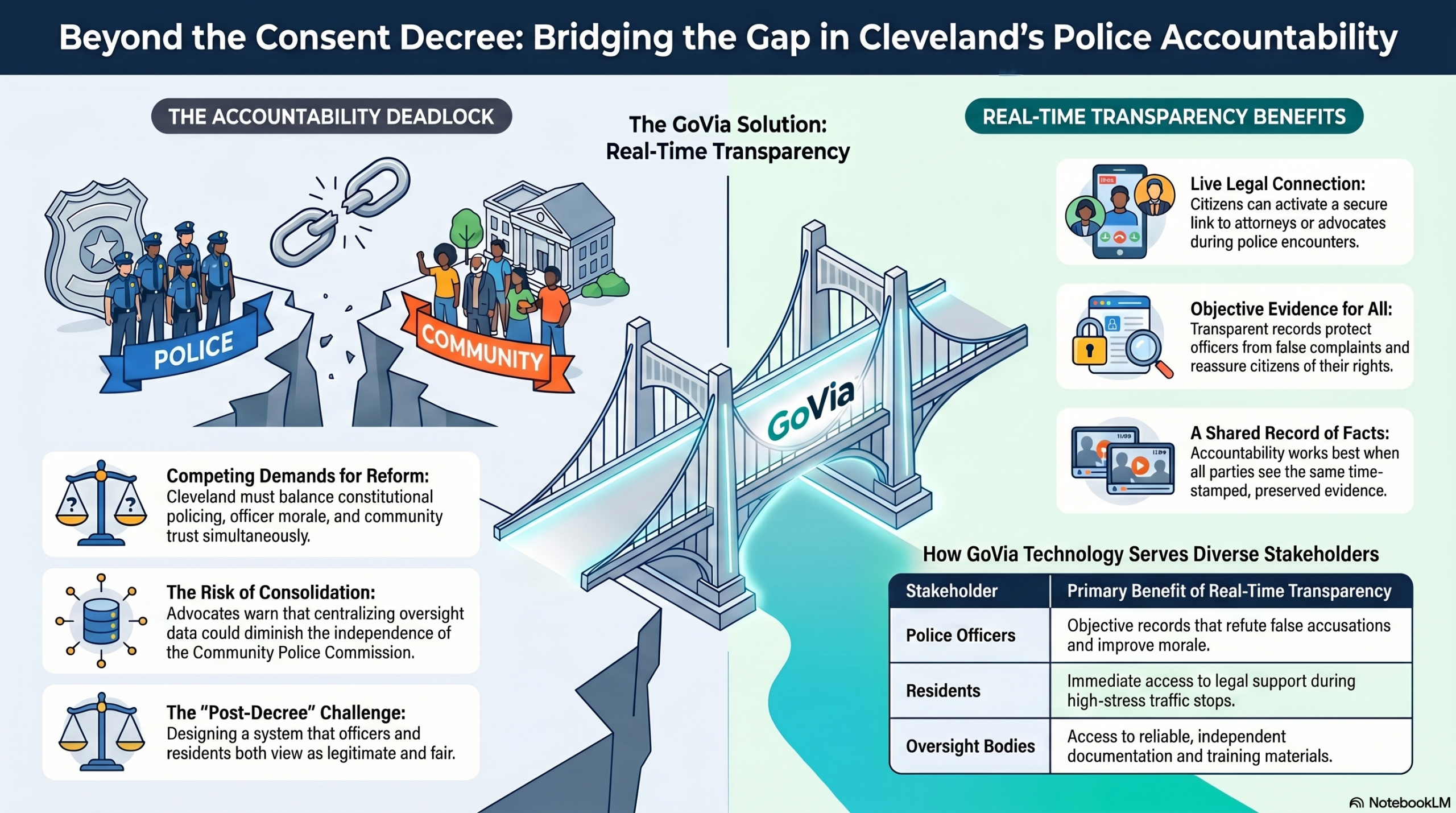
GoVia Highlight A Hero: A Community Police Safety App
Modernizing police encounters through integrated video communication with attorneys and mental-health professionals.
There is a question that sounds simple but demands an honest answer:
Do you care about the mission?
Not the slogan.
Not the social-media post.
Not the conversation that disappears after the news cycle.
The mission.
The mission is to create safer police encounters by bringing people, technology, professional support, transparency, and better communication into the same system.
That is the vision behind GoVia Highlight A Hero, a Community Police Safety App.
And if we truly care about the future of police-community relations, the question cannot stop at whether GoVia is a good idea.
The bigger question is:
What are you willing to do to help build it?
A Mission Is More Than an Idea
Every major social change begins with an idea.
But ideas do not change institutions by themselves.
People do.
Organizations do.
Researchers do.
Police officers do.
Attorneys do.
Mental-health professionals do.
Entrepreneurs do.
Citizens do.
Investors do.
Politicians do.
Communities do.
The GoVia mission begins with a simple belief:
A police encounter should not automatically become a battle between two sides.
The citizen should have dignity.
The officer should have safety.
The attorney should have an opportunity to provide appropriate legal guidance.
The mental-health professional should have an opportunity to help when behavioral health is part of the situation.
And the community should have greater confidence that what happens during an encounter can be documented, understood, and reviewed.
That is not anti-police.
That is not anti-citizen.
It is pro-life, pro-safety, pro-due-process, and pro-professionalism.
The U.S. Department of Justice has described procedural justice around four principles: giving people a voice, applying rules neutrally, treating people with respect and dignity, and demonstrating trustworthiness.
GoVia’s mission asks an important modern question:
Can technology help make those principles more practical during real encounters?
That is the experiment worth having.
Why This Matters Now
America already has technology everywhere.
People carry smartphones.
Police departments use body-worn cameras.
Courts increasingly depend upon digital evidence.
Attorneys communicate through video.
Mental-health professionals increasingly use telehealth.
Emergency systems use digital dispatch and location information.
Artificial intelligence can analyze enormous quantities of information.
Yet these technologies often operate in separate systems.
The opportunity is not necessarily to create another isolated technology.
The opportunity is to connect the right people at the right time.
That is where GoVia’s vision becomes important.
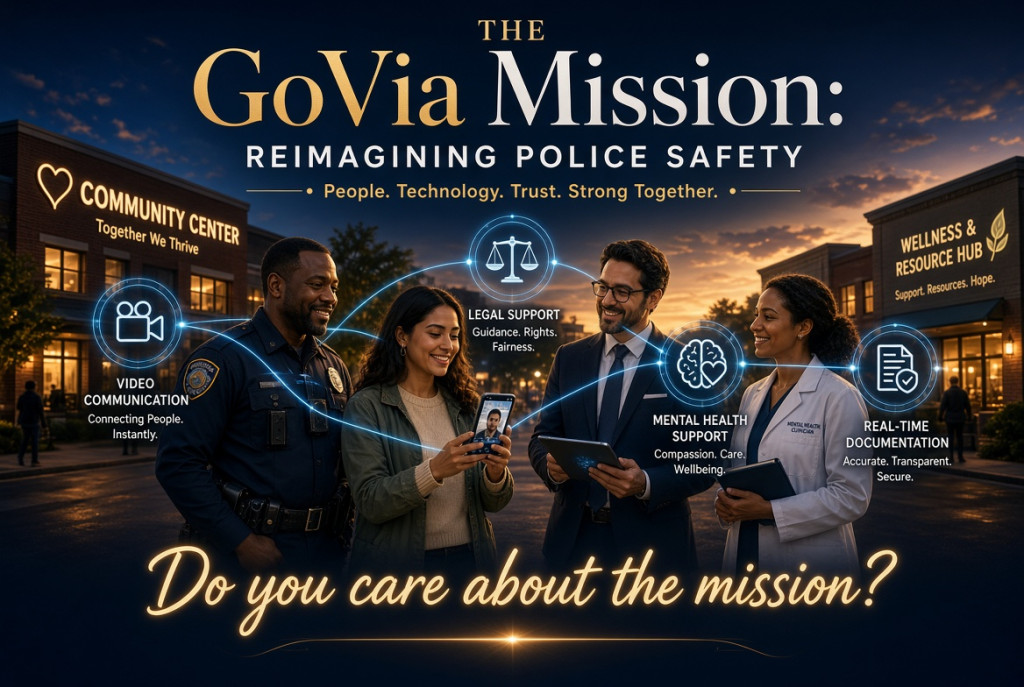
GoVia proposes a community safety platform in which a citizen involved in a police encounter can potentially connect through video communication with an attorney and a mental-health professional while information about the encounter can be documented and preserved.
The objective is not to have technology argue with the officer.
The objective is to introduce professional support into an encounter that may otherwise become increasingly emotional, confusing, or adversarial.
That distinction matters.
What GoVia Is Trying to Build
Imagine a citizen is stopped.
Instead of immediately thinking:
“Me versus the police.”
Imagine the system says:
“Slow down. Document what is happening. Communicate. Get appropriate professional support. Preserve the facts.”
Now imagine the other side.
The officer does not have to assume that every citizen recording the encounter is attacking the department.
The system can become part of a professional environment where the officer’s conduct is documented as well.
If an officer acts professionally, respectfully, and safely, that should matter.
If a citizen behaves appropriately, that should matter too.
If there is a disagreement, there should be evidence.
If there is a misunderstanding, there should be an opportunity to clarify it.
If there is a mental-health component, there should be a pathway toward appropriate professional assistance.
If there is a legitimate legal question, there should be a pathway toward legal guidance.
That is the philosophy behind Highlight A Hero.
The hero is not automatically the citizen.
The hero is not automatically the police officer.
The hero is the person who helps move the situation toward safety, truth, professionalism, and resolution.
The Mental-Health Connection Is Not a Side Issue
America’s approach to behavioral-health crises is changing.
SAMHSA’s current national crisis-care guidance describes a system built around three elements:
someone to contact, someone to respond, and a safe place for help.
It also recognizes mobile crisis teams and co-responder models that bring behavioral-health expertise together with public-safety resources when appropriate.
That matters to GoVia because a police encounter and a behavioral-health issue can sometimes intersect.
An officer should not be expected to become a psychiatrist.
A mental-health professional should not be expected to become a police officer.
An attorney should not be expected to become a mental-health clinician.
Each professional brings a different form of expertise.
The opportunity is to create systems that allow those forms of expertise to work together appropriately.
That is the type of infrastructure America should be investigating.
What About the Police Officer?
This mission must include the officer.
Period.
A technology designed to protect only one side will eventually lose the confidence of the other.
Police officers enter uncertain situations.
They make decisions with incomplete information.
They face physical risks.
They have legal responsibilities.
They have departmental policies.
They also deserve due process when accusations are made against them.
Video documentation can help establish what happened, but video is not automatically the complete truth. Context matters. Policies matter. Law matters. Human interpretation matters.
NIJ’s research on body-worn cameras illustrates precisely why evidence-based thinking is necessary. Cameras can provide useful documentation and may improve some outcomes, but technology also creates privacy, policy, training, and resource challenges.
GoVia should therefore not promise that technology magically solves policing.
It should promise something more realistic:
Better information can create better opportunities for better decisions.
That is a mission worth testing.
What About the Citizen?
The citizen deserves a voice.
A citizen should not have to choose between remaining silent and escalating a confrontation.
A citizen should be able to seek appropriate professional assistance.
A citizen should be able to preserve information.
A citizen should be able to understand what happened.
And a citizen should have a pathway to accountability when something goes wrong.
The goal is not to encourage citizens to challenge police officers in the middle of an encounter.
The goal is to encourage calm, informed, documented communication.
That distinction could become one of GoVia’s most important principles:
Do not escalate the encounter. Improve the information surrounding the encounter.
What About Attorneys?
For attorneys, GoVia presents a potential new form of legal-tech infrastructure.
An attorney could potentially become part of a pre-established network of professionals available to support appropriate client needs.
That does not mean every attorney can provide legal advice to every person in every jurisdiction.
It does not mean a video call automatically creates an attorney-client relationship.
It does not eliminate professional responsibility rules.
Those questions must be addressed through appropriate legal, ethical, jurisdictional, privacy, and operational policies.
But the underlying opportunity is significant:
What happens when legal expertise becomes easier to reach at the moment it is needed?
That is a question legal-tech innovators should take seriously.
What About Mental-Health Professionals?
The same principle applies.
Mental-health professionals should not be asked to perform police work.
Police officers should not be asked to perform clinical work.
GoVia’s vision is about creating pathways between people and professionals.
A qualified clinician could potentially help recognize when a situation requires calm communication, behavioral-health support, referral, or another appropriate intervention.
But the technology should never pretend that an AI system is a licensed clinician.
AI can potentially assist with information organization, pattern recognition, summarization, and other approved functions.
Human professionals remain responsible for professional judgments.
That principle is consistent with modern AI risk-management thinking from NIST, which emphasizes human oversight, transparency, accountability, testing, and managing risks associated with AI systems.
What About Police Unions?
Police unions should not automatically see GoVia as an accountability threat.
They should ask a different question:
Could better documentation protect good officers?
If a professional officer is accused of misconduct, reliable evidence can matter.
If an encounter demonstrates appropriate de-escalation, professionalism, and lawful conduct, that evidence can matter too.
The future should not be:
citizen versus officer.
It should be:
facts versus uncertainty.
Police unions have an opportunity to participate in the design of policies that protect officer privacy, officer safety, due process, evidence integrity, and appropriate use of technology.
That is participation.
What About Insurance Companies?
Insurance companies should pay attention.
Insurance is fundamentally about risk.
Police departments, municipalities, universities, transportation systems, hospitals, security organizations, and other institutions all manage operational risk.
If technology can eventually demonstrate measurable improvements in documentation, training, communication, or risk management, insurers should want to understand the evidence.
But GoVia should not claim insurance savings before they are demonstrated.
The responsible path is:
Pilot. Measure. Validate. Compare. Improve.
If the evidence eventually demonstrates fewer claims, faster investigations, improved training, or reduced losses, insurers will have something more valuable than a marketing promise.
They will have data.
What About Bail Bondsmen?
Bail bondsmen are part of the justice ecosystem too.
Their business intersects with defendants, families, attorneys, courts, and law enforcement.
GoVia’s mission creates an opportunity to think about how trusted communication and documentation could support people navigating the justice system.
Again, the principle is not to interfere with lawful police work or court processes.
It is to create better information and communication around the people moving through those systems.
Every stakeholder does not need to agree on every issue.
They need to agree that better systems are worth investigating.
What About Politicians?
Politicians have a responsibility beyond making statements after a crisis.
They can help create environments where communities test responsible solutions.
City councils, mayors, county executives, state legislators, public defenders, prosecutors, police chiefs, sheriffs, and other public officials can ask:
What problem are we trying to solve?
What evidence would tell us whether the solution works?
How do we protect constitutional rights and privacy?
How do we protect officers?
How do we protect citizens?
How do we measure outcomes?
What does the community say?
That is leadership.
Not choosing a side before the facts.
Building systems that make the facts easier to understand.
What About Activists?
Activism has always helped America confront problems that institutions were reluctant to confront.
But activism can evolve.
The next generation of activism can move from:
“Something is wrong.”
to:
“Here is the problem.”
to:
“Here is the evidence.”
to:
“Here is the proposed solution.”
to:
“Here is how we measure whether it works.”
GoVia needs activists who are willing to participate in that process.
Challenge it.
Question it.
Test it.
Criticize it.
Improve it.
Demand evidence.
Demand privacy.
Demand fairness.
Demand accountability.
That is not opposition to the mission.
That is how a serious mission becomes stronger.
What Kind of Society Are We Building?
Every technology reflects a philosophy.
We can build a society where every police encounter becomes content.
Or we can build a society where encounters become opportunities for accountability, learning, documentation, professionalism, and resolution.
We can build a society where people immediately choose sides.
Or we can build one where people choose safety first.
We can build a society that rewards outrage.
Or we can build one that rewards responsible participation.
We can build systems that ask:
Who is winning?
Or we can build systems that ask:
Did everyone make it home safely?
That last question is where GoVia begins.
What Does Success Look Like?
The GoVia mission should ultimately be judged by measurable outcomes.
Not by how many people like a post.
Not by how many people attend a launch event.
Not by how many people say the idea is inspiring.
Success should eventually be measured through evidence.
Potential areas of study could include:
- encounter outcomes
- de-escalation indicators
- citizen experiences
- officer experiences
- response times
- professional-support utilization
- complaints and complaint resolution
- evidence quality
- training opportunities
- behavioral-health referrals
- repeat incidents
- privacy and security performance
- system reliability
- user adoption
- cost and operational impact
Some of these measures would require carefully designed research before any causal claim could be made.
That is exactly why GoVia needs researchers.
The goal is not to prove GoVia works before it has been properly tested.
The goal is to build the conditions under which GoVia can be tested honestly.
GenAI and Machine Learning: Powerful, But Not the Boss
GoVia’s long-term technology vision can include artificial intelligence and machine learning.
But responsible innovation requires discipline.
AI could potentially help organize large volumes of encounter information, identify patterns, assist with training analysis, summarize records, or flag information for human review.
There is already federal research exploring automated analysis of police body-worn-camera footage to assess procedural-justice metrics.
That means the broader research question is real.
But GoVia should learn from the mistakes of the technology industry.
AI should not become the judge.
AI should not become the police officer.
AI should not become the attorney.
AI should not become the therapist.
AI should not decide someone’s guilt.
AI should assist qualified humans within clearly defined boundaries.
NIST’s AI Risk Management Framework emphasizes trustworthy characteristics such as validity, reliability, safety, security, accountability, transparency, explainability, privacy, and management of harmful bias.
That should be the standard GoVia strives toward.
Investors: Here Is the Bigger Opportunity
Investors should not look at GoVia simply as another mobile application.
The larger opportunity is the development of justice infrastructure.
Justice infrastructure connects people, institutions, information, professional services, evidence, and technology.
The potential market is not limited to individual citizens.
It can involve:
Citizens.
Attorneys.
Police departments.
Police unions.
Mental-health organizations.
Municipalities.
Counties.
Public defenders.
Courts and justice-system partners.
Insurance organizations.
Bail-bond professionals.
Universities.
Researchers.
Technology companies.
Community organizations.
The investor question should therefore become:
Can GoVia build a trusted platform that multiple parts of the justice ecosystem actually want to use?
That is a much bigger question than whether someone downloads an app.
What Can You Do?
You do not have to invest millions.
You do not have to be a police chief.
You do not have to be an attorney.
You do not have to be a politician.
You do not have to be a technology expert.
You can participate.
Citizens can:
Share the mission.
Ask questions.
Join the community.
Test the technology when appropriate.
Provide constructive feedback.
Tell organizations about GoVia.
Encourage responsible police-community dialogue.
Police officers can:
Ask questions.
Participate in pilots.
Identify operational problems.
Help design officer-safety protections.
Share what actually happens on the street.
Police departments can:
Explore pilots.
Develop policies.
Engage officers and communities.
Measure outcomes.
Partner with researchers.
Police unions can:
Protect officer rights.
Participate in policy development.
Evaluate privacy and labor concerns.
Help determine how technology can protect officers as well as citizens.
Attorneys can:
Evaluate legal models.
Develop professional participation standards.
Help define appropriate attorney-client boundaries.
Research jurisdictional requirements.
Mental-health professionals can:
Help design behavioral-health pathways.
Evaluate crisis-response models.
Develop appropriate clinical safeguards.
Insurance companies can:
Study risk-management applications.
Support controlled pilots.
Evaluate evidence.
Explore whether measurable outcomes could eventually affect risk.
Universities can:
Research the technology.
Conduct independent evaluations.
Study outcomes.
Publish findings.
Challenge assumptions.
Investors can:
Provide capital.
Demand evidence.
Build governance.
Open institutional doors.
Help create sustainable economics.
Politicians and public officials can:
Create responsible pilot environments.
Bring stakeholders together.
Support evidence-based experimentation.
Help communities evaluate results.
Activists can:
Push the mission forward.
Demand transparency.
Challenge bad assumptions.
Protect civil rights.
Protect human dignity.
Help keep the mission accountable.
And What Can You Do Today?
You can do something very simple.
Share the story.
Send it to one police officer.
Send it to one attorney.
Send it to one mental-health professional.
Send it to one elected official.
Send it to one activist.
Send it to one investor.
Send it to one citizen.
Send it to someone who disagrees with you.
Then ask them:
What would you change?
That conversation is participation.
Do You Care About the Mission?
Here is where the question returns.
Do you care about the mission?
If you do, where is your participation?
Where is your curiosity?
Where is your sharing?
Where is your research?
Where is your criticism?
Where is your willingness to test the idea?
Where is your willingness to introduce GoVia to a police department?
Where is your willingness to introduce GoVia to an attorney?
Where is your willingness to introduce GoVia to a mental-health organization?
Where is your willingness to introduce GoVia to an investor?
Where is your willingness to help build something that may become bigger than any one person?
A mission does not become real because its founder believes in it.
A mission becomes real when a community decides that it is worth building.
GoVia’s Larger Vision
GoVia Highlight A Hero is built around an ambitious proposition:
Technology can help create a better environment for police encounters by connecting people with information, professional resources, documentation, and communication.
That proposition deserves serious examination.
It deserves skepticism.
It deserves research.
It deserves investment.
It deserves police participation.
It deserves citizen participation.
It deserves legal participation.
It deserves mental-health participation.
It deserves academic participation.
It deserves government participation.
It deserves responsible technology development.
And most importantly, it deserves people who are willing to move beyond talking about the problem.
The future will not be created by people who simply ask why America has not changed.
It will be created by people willing to participate in changing it.
The Mission Is Bigger Than GoVia
GoVia is one organization.
The mission is bigger than one organization.
If GoVia succeeds, the victory should not belong to one founder, one investor, one police department, one attorney, one city, or one community.
The victory belongs to the people who helped build a society where safety and accountability are not competing ideas.
Where officers can be protected without abandoning citizens.
Where citizens can have rights without treating officers as enemies.
Where mental-health professionals can contribute without being forced into police roles.
Where attorneys can provide appropriate legal support without replacing the justice system.
Where technology can document without becoming the judge.
Where artificial intelligence can assist without becoming the authority.
Where evidence matters more than rumors.
Where professionalism matters more than outrage.
Where human life matters more than winning an argument.
That is the society GoVia wants to help build.
And that is why the mission needs you.
Share it. Question it. Test it. Improve it. Invest in it. Research it. Partner with it. Challenge it. Help build it.
Because the mission is not simply to create another app.
The mission is to help create a safer way forward.
GoVia Highlight A Hero.
A Community Police Safety App.
Technology for communication.
Technology for documentation.
Technology for professional connection.
Technology designed around people.
A mission built around life.
And the next chapter cannot be written by GoVia alone.
It has to be written by all of us.
GoVia’s State of the Union Address
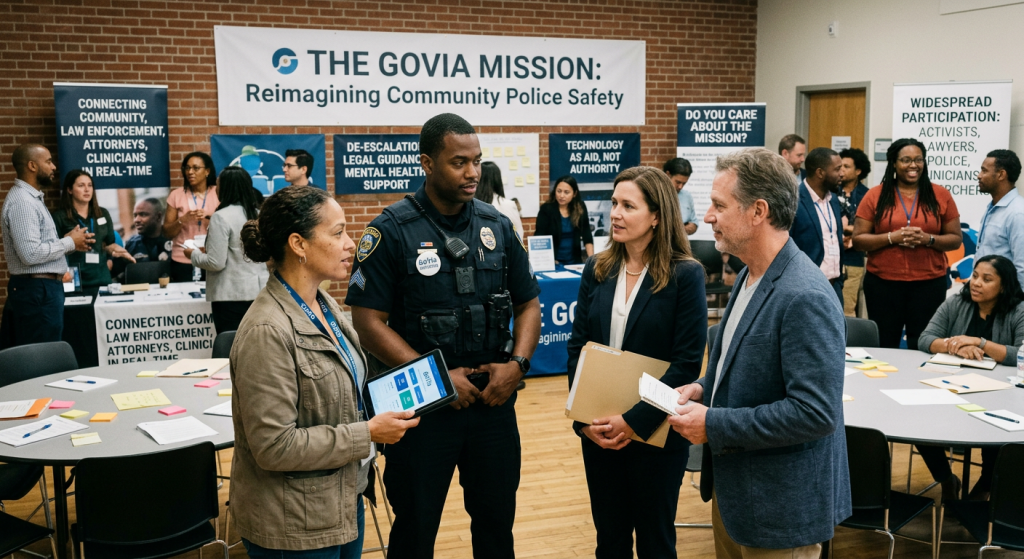
The GoVia Mission: Reimagining Community Police Safety
The GoVia Highlight A Hero community safety platform aims to transform police encounters by integrating video communication, legal guidance, and mental health support into a single system. Rather than replacing human judgment, the technology connects citizens, law enforcement, attorneys, and clinicians in real time to improve documentation, de-escalate tension, and preserve factual evidence. The initiative emphasizes that artificial intelligence should strictly assist human professionals rather than act as an authority or judge. Ultimately, the project invites widespread stakeholder participation, including researchers, activists, unions, and investors, to rigorously test and build a safer infrastructure for community justice. “Do you care about the mission”
Inspired by Andre Cato