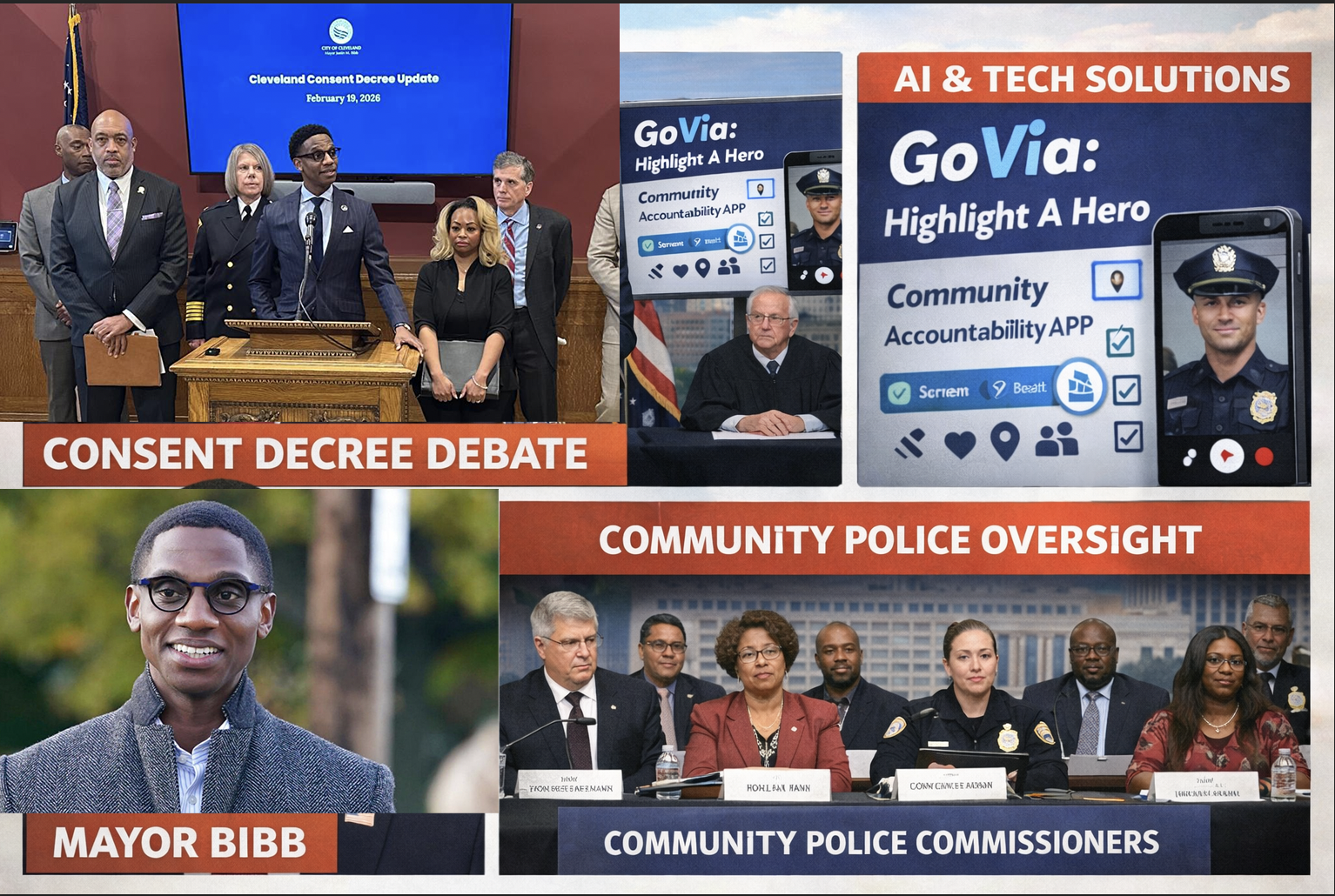
GoVia Highlight A Hero – a community police safety app looks to Tanzania as a place to build technology, legal-access innovation and opportunity for a new generation
By Georgio Sabino III, Founder/CEO, GoVia Highlight A Hero
There is a bigger idea behind bringing GoVia Highlight A Hero – a community police safety app to Tanzania. It is not simply about introducing another mobile application. My vision is to help build a community in Tanzania around technology, education, legal access, public safety, entrepreneurship and jobs.
GoVia is being developed around a simple question: What would happen if technology could bring people, attorneys, mental-health professionals, communities and law enforcement into a better conversation during a police encounter?
The GoVia concept is to give a person experiencing a police encounter access to integrated technology that can connect the individual by video with an attorney and, when appropriate, a mental-health professional while the encounter is taking place. The system is also intended to document and preserve information about the encounter, subject to applicable law, consent and privacy requirements.
The purpose is not to replace police officers or the courts. It is to create another layer of communication, documentation and support.
But Tanzania represents something larger for GoVia.
The Goal Is to Build a Community, Not Just Sell an App
My biggest goal for Tanzania is community development through technology.
I want GoVia to work with Tanzanians to build something that belongs in the Tanzanian technology and employment ecosystem. That means looking beyond software development and asking a much larger question:
What jobs and businesses can we create when a community is given the opportunity to participate in building the technology?
Tanzania already has a national policy framework pointing in this direction. The government’s Digital Economy Strategic Framework 2024–2034 identifies digital infrastructure, digital skills, innovation, inclusion and digital financial services among its major pillars. The framework also calls for collaboration among government, private industry, academia and civil society.
That makes the conversation about GoVia bigger than GoVia.
The opportunity is to ask Tanzanian students, graduates, professionals, entrepreneurs and workers:
What can we build together?
Creating Opportunities for Tanzanian Students
GoVia’s proposed Tanzanian community could create pathways for students to gain experience while they are still in college.
Potential areas include:
- Software engineering
- Mobile-app development
- Artificial intelligence
- Cybersecurity
- Cloud computing
- Data science
- Geographic information systems
- Telecommunications
- Digital media
- Video production
- Graphic design
- User-experience design
- Customer support
- Business development
- Sales
- Marketing
- Social-media management
- Translation and localization
- Legal research
- Paralegal services
- Public-policy research
- Community outreach
- Mental-health technology support
- Training and education
- Human resources
- Accounting and finance
- Operations
- Project management
- Entrepreneurship
- Research and development
These should not be presented as guaranteed GoVia jobs today. They represent potential employment, internship, apprenticeship and entrepreneurship categories that could develop as GoVia establishes operations and partnerships in Tanzania.
That distinction matters.
A responsible technology company should not promise thousands of jobs before the business model, financing, regulatory approvals and customer demand exist. The goal should instead be to create a structure where employment can grow as the company grows.
Tanzania Already Has the Foundation
Tanzania does not need to wait for another country to tell it that its young people can participate in the digital economy.
The Tanzanian ICT Commission says its mission includes developing digital infrastructure, empowering local talent, encouraging ICT investment and creating an environment for technological advancement. It also identifies education, ICT innovation and infrastructure as areas where stakeholders can participate.
The government’s Digital Tanzania Project has similarly focused on connectivity, digital public services, ICT skills, job creation and innovation. The project has specifically identified improving digital and professional ICT skills among youth and entrepreneurs as an objective.
Tanzania’s communications regulator has also promoted digital clubs from early education through university and supports innovation initiatives in the communications sector.
That creates an important opportunity for GoVia:
Instead of building a technology company in Tanzania and importing all of the talent, GoVia can explore building with Tanzanian talent.
Modernizing the Police Encounter
The public-safety component remains central.
GoVia Highlight A Hero – a community police safety app is designed around the idea that a police encounter can become complicated very quickly.
A citizen may be frightened.
An officer may not know the person’s circumstances.
A person may have a disability or mental-health concern.
A language barrier may exist.
A person may not understand what is legally required of them.
An officer may be concerned about safety.
GoVia’s proposed model is to introduce communication and professional support into that environment.
Depending on Tanzanian law and the circumstances of the encounter, a GoVia user could potentially initiate communication with an attorney or qualified mental-health professional through the platform.
The objective is not to interfere with legitimate police work. It is to create a mechanism through which communication, documentation and professional assistance can occur when appropriate.
Public Defenders, Legal Aid and GoVia
There is an important legal distinction that GoVia must respect as it enters Tanzania.
The United States commonly uses the terminology “public defender.” Tanzania’s legal system has a broader legal-aid structure involving advocates, lawyers, paralegals and legal-aid providers. Tanzania’s Legal Aid Act, 2017 regulates and coordinates legal aid services for indigent persons and recognizes paralegals.
The Legal Aid Regulations also specifically address people in police custody. They provide mechanisms for people in custody to access legal aid and require police-station and prison authorities to facilitate meetings with advocates, lawyers or paralegals.
That is significant for the GoVia conversation.
GoVia does not need to begin by claiming that Tanzanian law already provides a right to an attorney during every police encounter. It does not.
Instead, the question should be:
Can Tanzania develop a carefully designed legal and technology pilot that expands early access to legal assistance while respecting legitimate police powers and existing law?
That is a much stronger and more legally defensible proposal.
The Case for Early Legal Assistance
Tanzanian courts have recognized the importance of legal representation.
In Maganga So Udugali v. Republic, the Court of Appeal discussed section 310 of the Criminal Procedure Act, which provides an accused person a right to be defended by an advocate in qualifying criminal proceedings. The decision also illustrates an important limitation: the existing statutory right to representation should not automatically be interpreted as creating a universal right to counsel during every police stop.
Other Tanzanian and African human-rights jurisprudence provides additional support for access to counsel in serious criminal matters.
In Benyoma v. United Republic of Tanzania, the African Court on Human and Peoples’ Rights held that the right to defence under Article 7(1)(c) of the African Charter includes circumstances in which indigent people facing serious charges should receive free legal assistance where the interests of justice require it.
That does not prove that GoVia’s proposed real-time attorney model is already required by Tanzanian law.
It does something more useful.
It establishes a legal foundation for discussing how access to counsel can be improved.
GoVia’s proposed policy question is therefore not simply, “Give everyone a lawyer whenever police approach.”
The better question is:
Can Tanzania create a voluntary, legally defined, technology-supported mechanism for early legal assistance that does not obstruct lawful police activity?
That question deserves research by Tanzanian lawyers, legal-aid organizations, police leadership, policymakers, universities and civil-society organizations.
Affidavits and Digital Evidence
Another area where GoVia sees potential is documentation.
A police encounter can become a legal dispute months or years later. Memories change. Witnesses disappear. Video may be incomplete. Documents can be lost.
GoVia’s broader platform concept includes the ability to preserve encounter-related information and support affidavits and other legal documentation.
But again, technology cannot simply declare a recording to be legally admissible.
Tanzanian lawyers would need to determine how digital recordings, electronic documents, affidavits, metadata, chain of custody, authentication, privacy and data-protection requirements apply.
This is precisely why GoVia wants to work with large law firms, Tanzanian legal-aid organizations, universities and government stakeholders.
The lawyers should help design the legal architecture.
The technologists should build the system.
The community should help determine whether it actually works.
The Mental-Health Connection
The attorney is only one part of the concept.
Some police encounters involve people experiencing mental-health crises, cognitive disabilities, developmental disabilities, trauma or other circumstances that may affect communication.
GoVia’s proposed video connection with a qualified mental-health professional is intended to provide another professional resource when appropriate.
But this area requires particularly careful development.
Mental-health professionals cannot simply be treated as emergency substitutes for police, hospitals or emergency medical services. Telehealth licensing, privacy, informed consent, clinical responsibility, emergency protocols and data protection must be addressed before deployment.
The objective should therefore be professional support and de-escalation, not pretending that an app can solve every crisis.
Building Tanzanian Jobs Around the Technology
This is where I want the GoVia vision to become much larger.
Imagine a Tanzanian GoVia operation where young people can enter through different doors.
One student might learn cybersecurity.
Another might become a software developer.
Another might work in artificial intelligence.
Another might study law and work in legal technology.
Another might become a video producer.
Another might work in customer service.
Another might build relationships with police departments.
Another might work with universities.
Another might help communities understand their legal rights.
Another might create local-language educational content.
Another might become an entrepreneur who builds a completely new company around technology developed through the GoVia ecosystem.
That is the community I want to build.
Tanzania’s Digital Economy Strategic Framework specifically emphasizes digital literacy and skills development, innovation, local content and collaboration between government, academia, business and civil society.
GoVia wants to explore how its own growth can fit into that larger national objective.
The Internet Infrastructure Question
High-quality connectivity will matter.
GoVia is a video-based platform. Video communication with attorneys and mental-health professionals requires reliable connectivity, appropriate bandwidth, secure infrastructure and sufficient device access.
Tanzania is already investing in digital connectivity. The Digital Tanzania Project was designed to expand high-quality internet access and strengthen the infrastructure needed for digital public services and economic development.
Therefore, rather than beginning with a promise that Tanzania immediately needs “6G” or “10G” everywhere, GoVia should begin with a more practical question:
Where does the existing network infrastructure support reliable GoVia services, and where must additional investment occur?
Future 5G, 6G, fiber, data centers, cloud infrastructure and higher-speed networks may become part of the long-term opportunity.
The immediate requirement is simpler:
Reliable, affordable and secure connectivity where people actually need the service.
GoVia’s Tanzania Community Model
I envision the beginning of a Tanzanian GoVia community involving:
Students
Learning technology, law, business and entrepreneurship.
Universities
Providing research, internships, laboratories and innovation programs.
Law firms
Helping develop legal frameworks, contracts, privacy policies, legal-aid models and litigation support.
Legal-aid organizations
Helping determine how technology can improve access to counsel.
Police and public-safety organizations
Testing whether technology can improve communication and documentation without obstructing lawful duties.
Mental-health professionals
Helping design appropriate telehealth and crisis-support protocols.
Technology companies
Supporting connectivity, cybersecurity, cloud services and infrastructure.
Government agencies
Addressing regulation, digital infrastructure, employment, innovation and public services.
Entrepreneurs
Building businesses around the growing ecosystem.
The Tanzanian community
Testing the concept, identifying problems and helping determine what GoVia should become.
This Is Bigger Than GoVia
My ambition is not for Tanzanians simply to become customers of an American technology company.
I want to explore whether GoVia can become a community-building platform in Tanzania.
That means creating local talent.
Creating professional opportunities.
Creating internships.
Creating businesses.
Creating partnerships.
Creating technology.
Creating research.
Creating legal innovation.
And eventually creating sustainable employment.
The National Audit Office of Tanzania reported in April 2026 that Tanzania continues to face gaps in the availability, distribution and coordination of legal-aid services.
That makes this conversation even more important.
Technology alone cannot solve access to justice.
But technology combined with lawyers, government, universities, telecommunications companies, mental-health professionals and communities may create new ways to address problems that have existed for generations.
Our Invitation to Tanzania
GoVia is growing, but we know that growth requires partnerships.
We are looking for Tanzanians who want to help build.
We are looking for students who want experience.
We are looking for lawyers who want to explore legal technology.
We are looking for law firms willing to examine the legal questions.
We are looking for universities willing to conduct research.
We are looking for technology professionals who can build.
We are looking for entrepreneurs who see opportunities we have not yet considered.
We are looking for public-safety professionals who will challenge our assumptions.
And we are looking for government and community leaders willing to ask whether a new technology model can be developed responsibly.
We are not saying that GoVia has every answer.
We are saying that we have a starting point.
And we want to build the next chapter with the Tanzanian community, not simply for the Tanzanian community.
The greatest GoVia opportunity in Tanzania may ultimately not be the application itself.
It may be the people who learn, work, innovate and build businesses around it.
That is the community I want to help create.
A factual note on the GoVia proposal
The strongest version of this vision requires several issues to be tested rather than assumed:
- Jobs: GoVia can propose internships, training and employment pathways, but actual job numbers should depend on financing, contracts and operating scale.
- Legal access: Tanzania’s existing legal-aid framework supports access to legal assistance in defined circumstances, including for people in custody. It does not establish the universal real-time attorney-at-every-police-stop model GoVia is proposing. That would require legal analysis and potentially policy or legislative changes.
- Police operations: Any pilot should define when an attorney or mental-health professional can participate without interfering with lawful police duties.
- Privacy: A system recording police encounters would require careful treatment of personal data, security, consent, retention and access.
- Mental health: Telehealth and crisis intervention require qualified professionals and appropriate clinical protocols.
- Connectivity: The immediate objective should be reliable connectivity rather than assuming that 6G or 10G is necessary for every deployment.
- Evidence: GoVia should measure outcomes through a controlled pilot rather than assume that the technology will reduce conflict, misconduct or legal costs. Those outcomes need to be demonstrated with data.
Tanzania’s own digital strategy calls for collaboration among government, private industry, academia and civil society, making a multi-stakeholder pilot a logical structure to investigate these questions.