Part I: The Morning of July 7, 2026
The surveillance footage is grainy but unmistakable.
At 5:59 a.m., Lorenzo Salgado Araujo walks out of his Houston home, climbs into his white work van, and pulls out of the driveway. It’s a Tuesday morning like any other—the 52-year-old Mexican national, a homebuilder who had spent 35 years in the United States, is heading to pick up his crew and drive them to their latest job site. He is close to finally obtaining his work permit. He is a husband, a father, a job creator for dozens of men who also wanted the American dream.
Less than an hour later, he is dead.
New surveillance footage obtained by CNN shows what happened next. Unmarked black SUVs—federal vehicles without apparent law enforcement markings—begin pursuing Salgado Araujo’s van. The footage captures at least two ICE officers running after the white van. Other unmarked vehicles join the pursuit.
Then, the shooting.
The Department of Homeland Security offered its version immediately: Salgado Araujo had “attempted to evade arrest” and rammed an ICE vehicle, and an officer “fired his weapon in self-defence”. He was taken to the hospital, where he died.
But there was a problem. Salgado Araujo was not the intended target of the operation. DHS later admitted the stop was initiated because agents saw “a white van with an individual who resembled the target” of an operation they had been surveilling.
A case of mistaken identity that cost a man his life.
Part II: “It’s Not Adding Up”
The witnesses told a different story.
Three men who were in the van with Salgado Araujo when he was shot have challenged the ICE account. Their attorney, Hugo Balderas-Ibarra, told reporters that “at no point was there ever an agent standing in front of the vehicle nor was an agent ever placed in the line of danger. That is simply false”.
Investigators are saying the official account isn’t adding up. Harris County District Attorney Sean Teare, whose office is conducting a parallel review, said federal officials are not cooperating or sharing evidence—including refusing him access to the van at the center of the incident. He urged anyone who witnessed the shooting to come forward, saying Salgado Araujo’s family “deserve the truth”.
U.S. Representative Christian Menefee accused DHS and ICE of “lying” by misleading the public. “Instead of answers and accountability,” four Democratic Congress members wrote in a letter to DHS, “DHS and ICE released a statement echoing the same stories we have heard before”.
The agents involved were not wearing body cameras. No video evidence has been made public to support the agency’s claim that Salgado Araujo “weaponized his vehicle”. This despite the fact that after two American citizens were shot and killed in Minneapolis earlier in 2026, former Homeland Security Secretary Kristi Noem promised the department would “rapidly acquire and deploy” body cameras to officers around the country.
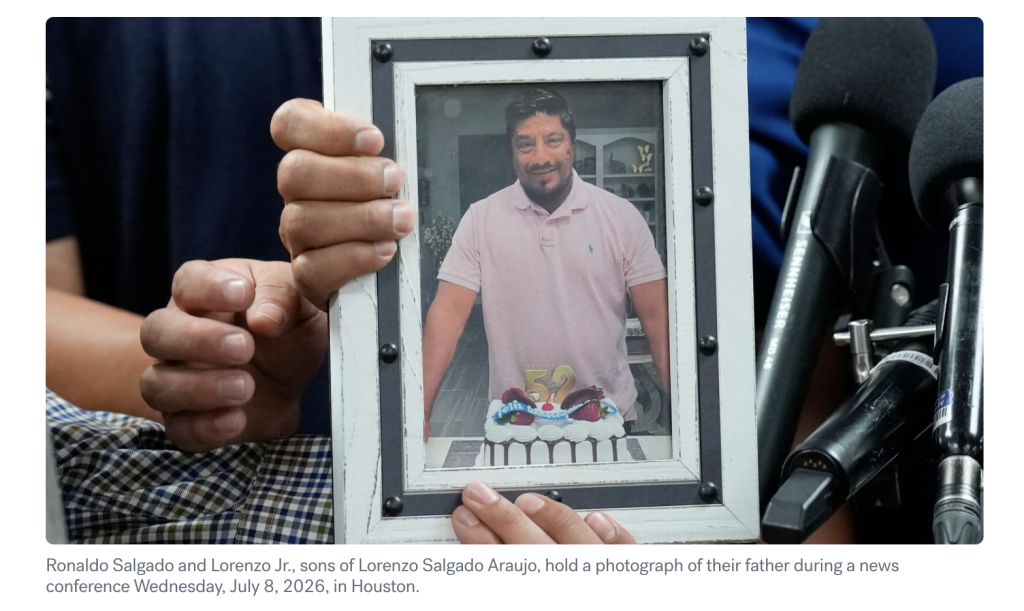
Ronaldo Salgado, the victim’s son, only learned what happened after seeing a video posted on social media—his father on the ground next to the white van. “I recognized him immediately, not from his appearance, but from his voice, crying for help as he lay on the street, bleeding out,” Salgado said, choking back tears.
“He did not deserve to die,” his son said. “He did not deserve to be reduced to a headline of Mexican man shot and killed by ICE”.
Part III: The Minnesota Template
Leaders have drawn direct parallels between the Houston shooting and the killings in Minneapolis.
In January 2026, two American citizens were fatally shot by federal immigration agents in Minneapolis within weeks of each other.
First came Renee Nicole Macklin Good, a 37-year-old mother of three, shot by ICE agent Jonathan Ross on January 7 while driving her SUV. Her family hired the same law firm that represented George Floyd’s family to conduct a civil investigation. A private autopsy later showed Good was shot at least three times. Federal officials described the shooting as self-defense while state and local officials dismissed the federal narrative.
Then came Alex Pretti, a 37-year-old ICU nurse at the Minneapolis VA Health Care System, shot and killed by a Customs and Border Patrol agent on January 24. Video from multiple angles showed immigration agents firing multiple shots at Pretti. He was a U.S. citizen with no criminal convictions. Federal officials labeled him a “domestic terrorist” to “assassinate his character,” according to the Minnesota House and Senate People of Color and Indigenous Caucus.
In both cases, the same pattern emerged: federal agents offered a justification of self-defense. Witnesses disputed the official account. Body camera footage was absent. Families were left demanding answers.
In a letter to DHS, four Democratic Congress members urged the department not to forget the cases of Renee Good and Alex Pretti. The parallel was unmistakable: unmarked federal vehicles, disputed accounts, deadly force, and families left grieving without transparency.
Part IV: GoVia Highlight A Hero
This is where GoVia Highlight A Hero enters the story.
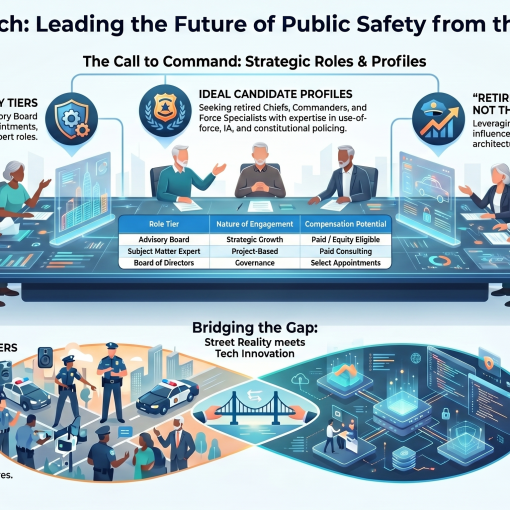
GoVia is a community-centered police safety app designed to foster transparency, accountability, and safety during law enforcement interactions. But its scope is broader: it functions as a real-time civil rights safeguard for marginalized individuals—particularly immigrants and communities of color who too often feel unseen, unheard, and unprotected.
How It Works:
When a person is pulled over or approached by law enforcement—including ICE—they can open the GoVia app and immediately connect to:
- Civil rights attorneys and immigration lawyers who can join via video or audio to remind officers of clients’ rights
- Mental health professionals trained in crisis de-escalation
- Real-time documentation tools that record audio, video, and officer behavior—creating a legally admissible evidentiary record
The app is built on constitutional principles. The Sixth Amendment guarantees the right to counsel; GoVia makes that right accessible in the moment, not after formal charges are filed. Under the Fifth and Fourteenth Amendments, immigrants—documented or not—are entitled to due process and equal protection. GoVia helps ensure those rights are not violated in practice.
For ICE encounters specifically, GoVia can:
- Archive warrantless entries or misconduct in real time
- Allow family members to locate detainees via emergency alerts
- Document language barrier violations or unlawful entry during raids
“Highlight A Hero is not just a brand—it’s a stance: that every encounter between police and the public should be safer, more transparent, and more human for everyone involved”.
The platform also allows communities to nominate officers for outstanding conduct, track achievements, and share success stories publicly—fostering positive recognition and balanced narratives. It’s built for accountability, one encounter at a time.
Part V: What Could Have Been Different
Imagine the morning of July 7, 2026, if Lorenzo Salgado Araujo had had access to GoVia Highlight A Hero.
As the unmarked black SUVs began pursuing his van, he could have opened the app. Within seconds, a civil rights attorney would have been notified—joining via video or audio to remind the officers of his rights and de-escalate the situation. A mental health professional would have been available to help manage the fear and confusion. The encounter would have been documented in real time, creating an evidentiary record that could have been presented to investigators.
The officers would have known they were being recorded. The witnesses—the three men in the van—would have had legal support immediately, not while being pressured to sign self-deportation papers as civil rights organizations have alleged.
The family would not have had to learn about the shooting from a social media video. They would have had an immediate legal team advocating for transparency and accountability from the very first moment.
“GoVia creates a scalable, tech-enabled version of these protections—embedding legal safeguards at the point of contact”.
Part VI: A Hero’s Legacy
Lorenzo Salgado Araujo spent 35 years in the United States building a life. He built homes. He built a family. He was “a husband, a father and a job creator for dozens of men who also wanted the American dream”. He was close to obtaining legal status when he was killed.
His death—like the deaths of Renee Good and Alex Pretti in Minneapolis—exposes a system where federal agents operate in unmarked vehicles without body cameras, where official accounts are disputed by witnesses, where families are left to fight for the truth.
GoVia Highlight A Hero offers a different path. It’s not about choosing sides between “pro-police” and “pro-community”—it was designed because that binary is false. It’s about ensuring that every encounter is safer, more transparent, and more human for everyone involved.
Ronaldo Salgado’s words echo beyond his own grief: “He did not deserve to die”.
No one does.
In the fight for accountability, transparency, and justice, GoVia Highlight A Hero is a tool—a digital lifeline that can turn a moment of fear into a moment of protection. It’s a way to ensure that the next Lorenzo Salgado Araujo, the next Renee Good, the next Alex Pretti, doesn’t become another headline.
It’s a way to highlight a hero—not after the tragedy, but before it.
“Highlight A Hero was never about choosing sides between ‘pro-police’ and ‘pro-community.’ It was designed because that binary is false. Every encounter between police and the public should be safer, more transparent, and more human for everyone involved.” — GoVia Highlight A Hero