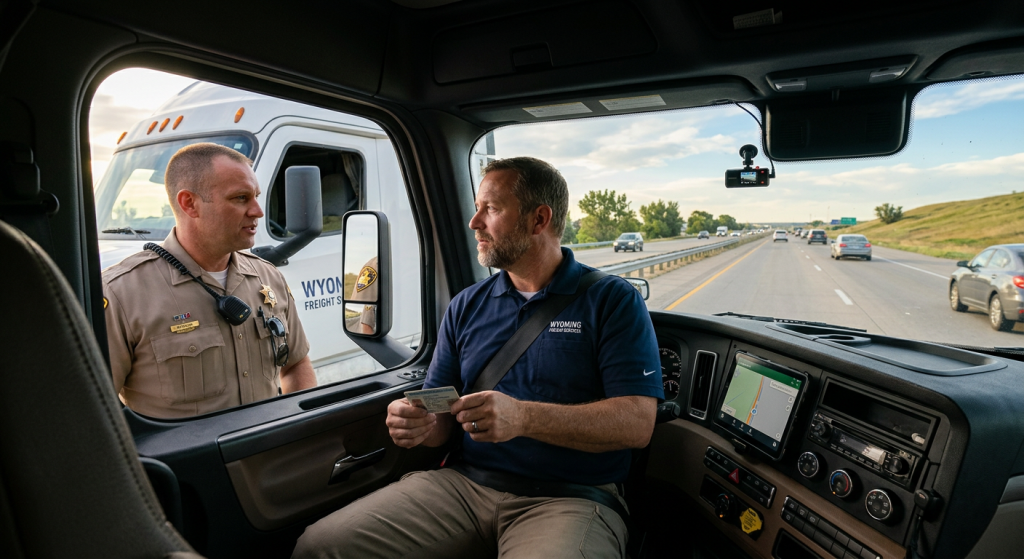
The Hidden Vulnerability in Everyday Life
Most adults go years—sometimes decades—without a police encounter. No traffic stops, no citations, no confrontations. It is easy to assume that life will continue that way. But the reality is that police encounters are not limited to the driver who runs a red light or the person pulled over for a broken taillight.
Adults need GoVia for what they do not see coming.
A fender bender on the highway. A multi-vehicle collision involving a commercial truck. A dispute over who is at fault when property is damaged and bodies are injured. These moments arrive without warning, and in their aftermath, the difference between justice and injustice often comes down to one thing: evidence. And what you can prove!
The Problem with “He Said, She Said”
In the chaos following an accident, memory fragments. Adrenaline surges. Stories shift. What one person recalls as a green light, another remembers as red. By the time police arrive and reports are filed, the narrative has already begun to harden—often in ways that bear little resemblance to what actually happened.
Worse still, police accident reports are frequently inadmissible in civil court. Courts have consistently held that uncertified police reports constitute inadmissible hearsay, particularly when the officer did not witness the accident firsthand. In California, Vehicle Code section 20013 explicitly precludes accident reports from being used as evidence in any civil trial. A statement recorded in a police report involves two levels of hearsay and cannot be relied upon to establish liability.
This leaves victims and defendants alike in a precarious position. The official record—the document most people assume will tell the truth—may be legally worthless when it matters most.
GoVia changes this.
By capturing video evidence in real time, GoVia eliminates the ambiguity. No longer is it one person’s word against another’s. The camera does not forget. It does not embellish. It does not have a stake in the outcome. It simply records what happened, preserving the critical moments that determine liability, damages, and justice.
Protecting What Matters Most: Your CDL and Your Livelihood
For the millions of Americans who hold a Commercial Driver’s License (CDL), the stakes are exponentially higher. A CDL is not just a license—it is a career. It is the credential that enables a person to feed their family, pay their mortgage, and build a future.
One accident can end all of that.
Federal regulations require CDL holders to notify their employer within 30 days of any traffic conviction. Employers are required to maintain driver qualification files and investigate the safety performance history of every driver they hire, including accident records spanning the previous three years. A single at-fault accident can appear on a driver’s record, trigger employer scrutiny, and in some cases, lead to termination.
But the greater danger lies in what the driver cannot control—the other party’s account of events. If a CDL driver is involved in an accident and the other driver provides a false or misleading statement to police, the CDL holder’s career can be damaged before they have an opportunity to defend themselves. Without video evidence, the driver is left to argue against a narrative that may have already been accepted by law enforcement, insurers, and employers.
GoVia gives CDL holders the ability to tell the story as it happened. Video evidence captured at the scene, encrypted and uploaded to GoVia’s cloud, is preserved for chain of custody in the court system. It cannot be lost, overwritten, or excluded from prosecution or grand jury proceedings. It is the driver’s insurance policy against false accusations and distorted accounts.
Why Employers Need GoVia
For companies that employ CDL drivers—whether a small fleet of five trucks or a national carrier operating thousands—the stakes are equally high.
Employers need to know what, who, where, how, and why.
When one of their vehicles is involved in an accident, employers face immediate and often cascading consequences:
- Liability exposure. Under the legal doctrine of respondeat superior, an employer can be held liable for the actions of an employee acting within the scope of their employment. If a driver causes a crash while working, the company can be sued alongside—or instead of—the driver. Trucking companies typically carry $750,000 to $5 million or more in commercial liability coverage, making them attractive targets in litigation.
- Negligent hiring and retention claims. Federal regulations require motor carriers to verify CDL credentials, review motor vehicle records, investigate safety performance history, and maintain complete driver qualification files. A company that fails to properly screen a driver—or that keeps a driver with a history of violations on the road—can be held liable for negligent hiring or negligent retention. These claims can expose the company to punitive damages far beyond the cost of the accident itself.
- Cargo and supply chain disruption. A semi-truck carrying perishable goods, hazardous materials, or time-sensitive freight is not just a vehicle—it is a mobile supply chain. An accident can delay deliveries, destroy cargo, and damage customer relationships. Employers need immediate, accurate information to assess the damage, notify stakeholders, and begin recovery.
- Regulatory compliance. The FMCSA requires employers to retain accident information and report DOT-recordable accidents through the FMCSA portal. Failure to comply can result in fines, penalties, and damage to the company’s Compliance, Safety, Accountability (CSA) score—which in turn affects insurance premiums and business opportunities.
GoVia provides employers with real-time visibility into accidents involving their vehicles. Through the platform, employers can access video evidence, attorney consultations, and incident documentation as events unfold. This enables them to:
- Determine liability quickly and accurately
- Protect themselves against frivolous lawsuits
- Comply with regulatory reporting requirements
- Preserve evidence before it is lost or overwritten
- Demonstrate due diligence in hiring and supervision
For both large and small companies, GoVia is not just a safety tool—it is a risk management imperative.
The Rabbit Hole of Negligence
Negligence is the legal framework that governs most accident liability. At its core, negligence is the failure to exercise reasonable care—the kind of care that a prudent person would exercise in similar circumstances.
But negligence in the context of commercial driving is far more complex than a simple mistake.
Negligence per se occurs when a driver violates a statute or regulation, and that violation causes harm. Courts have held that violation of a traffic regulation usually constitutes negligence as a matter of law. This means that if a driver ran a red light, failed to yield, or violated hours-of-service rules, the driver—and potentially their employer—may be automatically liable for any resulting harm.
But the negligence rabbit hole goes deeper:
- Negligent hiring occurs when a company fails to properly vet a driver before putting them on the road. If a trucking company hires a driver with a history of DUIs, license suspensions, or crash involvement, and that driver causes an accident, the company can be held directly liable.
- Negligent retention occurs when a company becomes aware of a driver’s dangerous behavior but keeps them employed anyway. Repeated speeding tickets, failed roadside inspections, or complaints from dispatch can all trigger negligent retention liability.
- Spoliation of evidence occurs when evidence is destroyed, hidden, or not preserved. Trucking companies often deploy rapid response teams to crash scenes to control and eliminate evidence before victims can preserve it. Black box data can be overwritten in as little as 30 days, and dash cam footage may disappear within 24 to 72 hours. When a company destroys evidence after receiving notice of a claim, courts may impose sanctions, allow adverse jury instructions, or even dismiss the company’s defenses.
GoVia disrupts this cycle. By capturing and preserving evidence at the moment of the incident, GoVia ensures that critical data is not lost to routine overwrites, intentional destruction, or the passage of time. The platform creates an immutable record that can be used to establish liability, defend against false claims, and hold negligent parties accountable.
A Solution for Safety, Transparency, and Justice
GoVia is not merely an app. It is a paradigm shift in how we approach police encounters, accidents, and the pursuit of justice.
For the adult who never expects to need it, GoVia provides peace of mind. For the CDL holder whose career depends on a clean record, GoVia provides protection. For the employer whose bottom line depends on risk management, GoVia provides clarity. And for the legal system that depends on evidence to deliver justice, GoVia provides reliability.
No longer will adults be left to navigate the aftermath of an accident alone, relying on fading memories and inadmissible reports. No longer will CDL drivers be defenseless against false accusations. No longer will employers be left in the dark when their vehicles are involved in incidents.
GoVia brings attorneys and mental health professionals into the moment—not hours or days later, but when it matters most. It provides real-time support, real-time evidence, and real-time accountability.
Modernizing police encounters is not just about technology. It is about ensuring that every adult—whether behind the wheel of a passenger car or a commercial truck—has access to the tools they need to protect themselves, their livelihoods, and their futures.
GoVia: Highlight a Hero. Because every adult deserves a fair chance to tell their story.
Summary: GoVia: Accountability and Peace of Mind in Police Encounters
The provided text describes GoVia, a digital platform designed to record and preserve video evidence during traffic accidents and police interactions. The service addresses the legal unreliability of police reports and the vulnerability of commercial drivers who risk losing their livelihoods due to false accusations or missing data. By utilizing cloud-based encryption, the system ensures a secure chain of custody for footage that can be used to establish liability and defend against negligence claims. Both individual motorists and large fleet employers benefit from this real-time documentation, which provides immediate access to legal consultations and regulatory compliance tools. Ultimately, the platform seeks to modernize the pursuit of justice by replacing subjective memories with an immutable visual record.