How Susan Collins’ $70 Billion Blank Check Funded a Week of Terror—and Why “GoVia Highlight A Hero” May Be the Only Shield Left
BIDDEFORD, Maine / HOUSTON, Texas — At 7:17 a.m. on July 13, 2026, a home security camera captured the sound of five gunshots撕裂 the morning quiet of a residential Biddeford street. Five rounds. Five trigger pulls. One life extinguished.
The man behind the wheel was Johan Sebastián Durán Guerrero, a 26-year-old Colombian national, a father, a husband, a veterinary clinic worker who delivered packages in the afternoons to support his three-year-old daughter. He was authorized to work in the United States. He was not the target of ICE’s operation.
Six days earlier, 1,800 miles away in Houston, Lorenzo Salgado Araujo—a 52-year-old Mexican builder who had lived in the U.S. for 35 years, a father of three—was shot dead by an ICE officer while driving a work crew to a construction site. He, too, was not the target.
Two Latino men. Two wrong addresses. Two funerals. One agency. One week.
And one senator who voted to give that agency $70 billion.
I. THE SHOOTINGS: A PATTERN OF “MISTAKES”
The official narrative shifted like sand beneath a tide.
In the Houston case, ICE claimed Salgado “tried to run over an agent”. But the three men who were with him—his brother and two coworkers, now detained in an immigration facility—tell a different story: the shots came from the sides of the truck, they say. Salgado never tried to hit anyone.
In Maine, the Department of Homeland Security initially told Senator Angus King that Durán Guerrero was the subject of an arrest warrant and had “weaponized” his vehicle. Hours later, DHS Secretary Markwayne Mullin called back with a correction: the victim was not the target. The agency then issued a sanitized statement claiming an officer “fearing for public safety” opened fire when the vehicle “attempted to flee”.
But the evidence tells a damning story. A CBS News investigation obtained photographs showing four bullet holes through the driver’s side of Durán Guerrero’s windshield. A home security camera captured the moments after—ICE agents approaching the car, the wounded man still conscious, heard saying “I tried to stop”. Another surveillance video shows an ICE SUV pinning Durán Guerrero’s car before officers pulled his body onto the pavement.
“It’s something that’s horrific,” witness Daniel Boucher told CBS News. “You never forget that. You never forget the attitude of the ICE officers, too. And the ICE officer that shot him was in shock.”
The officers had no body cameras. No independent record of what happened. No accountability. Just a grieving widow, a three-year-old in Bluey pajamas screaming “you took her dad”, and an agency that has now killed at least nine people since President Trump’s renewed deportation campaign began.
II. “BLAME THE VICTIM”: THE POLITICAL PLAYBOOK
The pattern is as old as state violence itself. When the state kills, it blames the dead.
ICE’s defense in both cases was identical: the drivers were dangerous. They fled. They threatened officers. They left the agency no choice.
Never mind that neither man was the target. Never mind that Salgado had no criminal record. Never mind that Durán Guerrero was legally authorized to work in the U.S.. Never mind that both were simply going about their daily lives—one driving to a construction site, the other making deliveries to support his child.
This is the “blame the victim” playbook in its purest form: Kill first, then justify. Shoot first, then claim self-defense. Execute first, then ask questions later.
Colombian President Gustavo Petro, in a scathing social media post, called the shooting a “targeted killing at the hands of the U.S. government” and accused ICE officers of treating Durán Guerrero as “an inferior being without rights”.
He wasn’t wrong.
III. SUSAN COLLINS’ $70 BILLION BLANK CHECK
This is where the blood becomes political.
Senator Susan Collins—the sole Republican senator from New England, chairwoman of the Senate Appropriations Committee, facing a difficult re-election in a state that voted for Kamala Harris—cast the deciding vote to provide $70 billion over three years to ICE and Border Patrol.
She did this after ICE activity had already surged in Maine earlier this year during what critics called “Operation Catch of the Day”. She did this after detailed reporting documented ICE’s “abductions” and the “devastating local impact on Mainers”. She did this on a party-line vote after a months-long shutdown of the Department of Homeland Security.
And now, two men are dead.
“Senator Collins wrote the blank check to allow these officers to conduct themselves in the way that they have in Maine in the first place, and she’s the one who’s poured resources into it,” Representative Alexandria Ocasio-Cortez told The Independent. “And just because now that there’s live footage of the atrocities that she has enabled, doesn’t make it better than preventing them from happening in the first place.”
Collins has attempted to claim credit for ICE’s subsequent decision to temporarily halt traffic stops—a decision that came only after the second killing. “I discussed that possibility with the Secretary of Homeland Security and urged him to proceed,” she said.
But as Ocasio-Cortez noted: “I mean, they’re just trying to cover for the fact that what they are doing shouldn’t be allowable in the first place.”
The blood is on her hands. The question is whether Maine voters will remember in November.
“I think this is a nail in the coffin for Susan Collins,” said Paige Loud, one of the Democratic candidates vying to replace her.
IV. THE OUTRAGE: MAINE ERUPTS
Maine is not a state that erupts easily. But it is erupting now.
Hundreds gathered outside the ICE detention facility in Scarborough. More than 85 protested outside Bangor City Hall. Demonstrators marched through Biddeford chanting “ICE out of Maine”. A candlelight vigil honored the dead.
“These people are killers and they must leave our state now,” organizer Todd Chretien told the crowd outside the Scarborough facility. “The fact that they are hiding today means that they know they are guilty.”
Charles Currier, a Navy veteran who drove from New Hampshire with his wife and young son, put it even more starkly: “The oath I took when I joined the United States Navy was to protect and serve against all enemies, foreign and domestic. These ICE agents are killing personnel in the street; that is a domestic terrorist. That is the only way to describe this—it has to stop.”
Rev. Dr. Jody Cohen Hayashida of Multifaith Justice Maine captured the grief and rage: “We are grieving, but we are not just grieving. We are also raging because we know that this harm has been intentionally inflicted. We know that this harm is absolutely avoidable.”
Protesters marched to Collins’ office, demanding answers. Democratic Senate candidates called for abolishing ICE. The Maine Immigrants’ Rights Coalition and Presente! Maine issued a joint statement calling the killing “devastating, enraging, and unacceptable”.
The question echoing through the streets: How many more must die?
V. “WHAT DO YOU HAVE TO HIDE?”: THE DWIGHT DAVIS CHALLENGE
Enter Dwight Davis.
In the midst of this crisis, Davis has posed two questions that cut to the heart of the matter—questions that every elected official, every ICE agent, every bureaucrat who enabled these killings must answer:
“What do you have to hide?”
“What are you afraid of?”
These are not rhetorical questions. They are challenges to a system that operates in shadows—a system that kills without body cameras, that changes its story after the fact, that refuses to disclose law enforcement tactics, that treats human lives as collateral damage in a political project.
What does ICE have to hide? The truth about what happened in Houston. The truth about what happened in Biddeford. The truth about the other seven killings since January 2025.
What are they afraid of? Transparency. Accountability. The kind of oversight that would have prevented these deaths.
VI. GOVIA HIGHLIGHT A HERO: THE DIGITAL SHIELD
This is where GoVia enters the story—not as a solution to what has already happened, but as a bulwark against what will happen next.
GoVia Highlight A Hero is a community-police safety app designed to promote transparency, accountability, and trust during law enforcement interactions. At its core, it allows citizens to document encounters in real-time, rate their experiences, and—crucially—“highlight a hero” by recognizing officers who conduct themselves with professionalism and respect.
But it is more than a ranking system. GoVia integrates sentiment analysis to identify escalation risks before they unfold. It provides real-time connectivity to legal and mental health professionals. It allows attorneys to serve as neutral third-party witnesses during encounters. It turns a smartphone into a digital legal shield.
“GoVia’s Highlight A Hero system represents a paradigm shift in police accountability,” the platform’s developers explain, “leveraging attorneys as both mediators and witnesses”.
In the context of what happened in Maine and Texas, GoVia’s mission takes on urgent new meaning. If Durán Guerrero had been able to activate the app—to document the encounter, to connect to legal support, to create an independent record—his family might have answers instead of just grief. If the officers had known they were being recorded, they might have exercised more restraint. If the system had been designed for accountability from the start, these killings might never have happened. Dwight Davis agrees.
Davis puts it bluntly: “GoVia is what’s keeping your family safe—no matter if you’re Black, Brown, or poor White. This is going to protect Asians, Muslims, Latinos. This is what’s keeping you safe.”
He’s right.
Because here’s the uncomfortable truth: The victims of state violence are not random. They are disproportionately Black, Brown, immigrant, poor whites. The system that killed Salgado and Durán Guerrero is the same system that has killed countless others—a system that operates with impunity, that blames the victim, that hides behind claims of “public safety” while creating terror in the communities it claims to protect.
GoVia is not a panacea. It cannot bring back the dead. It cannot undo Senator Collins’ vote. It cannot reform an agency that has killed nine people in 18 months.
But it can create a counterweight. It can document what happened. It can hold officers accountable. It can give families the truth they deserve. It can shift the balance of power from the state to the citizen. But it can help police too! It’s two-fold.
“GoVia could keep you safe,” Davis insists. And in a country where the state has shown it cannot be trusted to keep its own citizens safe, that promise is not just appealing—it is essential. For police it provides accountability and trust. America wants this from our officers.
VII. THE ROAD AHEAD: ACCOUNTABILITY OR MORE BLOOD?
The week of July 7-13, 2026, will be remembered as a turning point—or as just another week in America’s long, bloody history of state violence against immigrants and people of color.
The choice is ours.
Senator Collins faces re-election. Her vote for $70 billion in ICE funding is now a political liability. Her Democratic opponents—Troy Jackson, Nirav Shah, Paige Loud, and others—are already using the shooting to demand accountability. The question is whether voters will follow through.
ICE has temporarily halted traffic stops per Trump request. But temporary halts are not reform. Body cameras are still not mandatory. The officers who killed Salgado and Durán Guerrero are still on leave, not charged. The system remains intact.
GoVia Highlight A Hero offers a different path—one built on transparency, accountability, and community power. It is not a replacement for systemic reform, but it is a tool that citizens can use right now to protect themselves, to document abuse, to demand justice.
As Davis asked: “What do you have to hide?”
As Davis asked: “What are you afraid of?”
If the answer is nothing, then transparency should be easy.
If the answer is everything, then we already know why these killings happened—and why they will keep happening until we demand more.
GoVia’s Take: THE BLOOD ON OUR HANDS
Two men are dead. Two families are grieving. Two communities are in mourning.
Lorenzo Salgado Araujo was a father of three who had lived in the U.S. for 35 years. He was going to work.
Johan Sebastián Durán Guerrero was a father of a three-year-old girl. He was making deliveries.
Neither was a criminal. Neither was a threat. Neither was the target.
They were just Latino. Just immigrants. Just in the wrong place at the wrong time.
And Senator Susan Collins wrote the check that paid for the bullets.
The question before us is not whether we can bring them back. We cannot. The question is whether we will let it happen again.
GoVia Highlight A Hero is one answer—a digital shield, a community safety net, a tool for transparency in a system built on secrecy.
But the real answer is political. It is electoral. It is the ballot box.
Maine voters will have their say in November. The question is whether they will remember the sound of five gunshots on a quiet Biddeford morning—and the senator who made it possible.
“This is what’s keeping your family safe,” Davis says of GoVia.
But the truth is, we shouldn’t need an app to keep us safe from the state. We shouldn’t need technology to document what should be self-evident: that killing innocent people is wrong, that blaming the victim is obscene, that accountability is not optional.
We shouldn’t need GoVia.
But we have it. And in a country where the state has become a threat to its own people, we should use it.
What do you have to hide?
What are you afraid of?
The answers will determine whether the next victim’s family gets justice—or just another funeral.
Reporting contributed from Biddeford, Maine; Houston, Texas; and Washington, D.C. Additional sources: Associated Press, BBC News, CBS News, EFE, Reuters, The Independent, Bangor Daily News, Portland Press Herald, Maine Public, and investigative documents from the Department of Homeland Security Office of Inspector General.
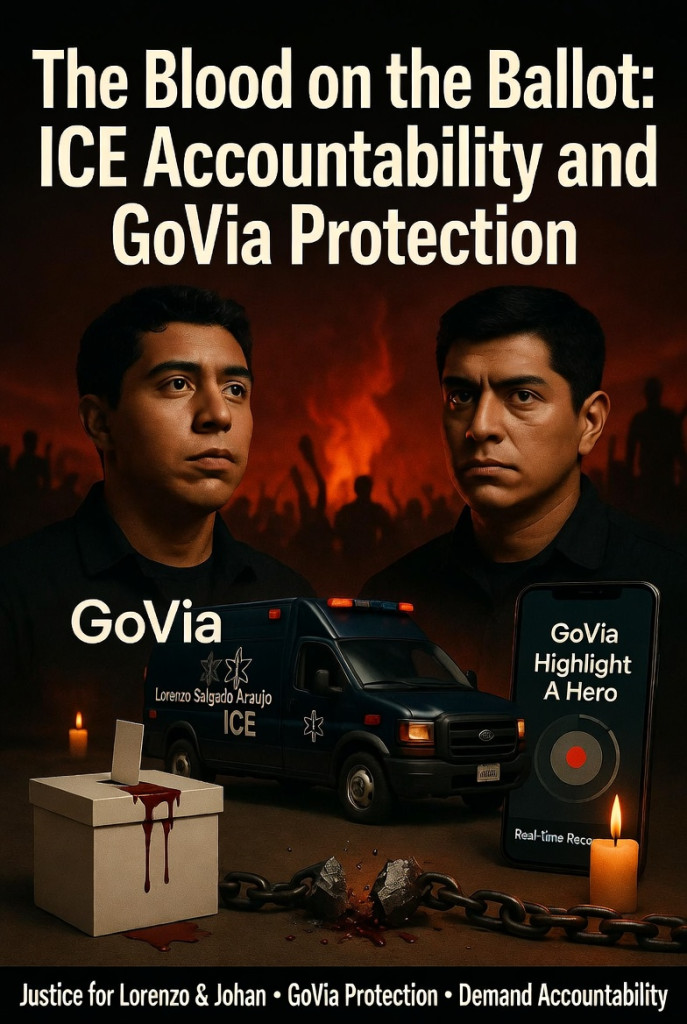
The Blood on the Ballot: ICE Accountability and GoVia Protection
1 source·Jul 15, 2026
The provided text examines the fatal shootings of two non-targeted Latino men by ICE officers during a single week in 2026. It highlights the contradictory accounts between official government statements and witness testimony, specifically regarding the deaths of Lorenzo Salgado Araujo and Johan Sebastián Durán Guerrero. The author criticizes Senator Susan Collins for her role in funding the agency with a $70 billion appropriation, linking political decisions to the lack of law enforcement accountability. Furthermore, the source introduces GoVia Highlight A Hero, a mobile application designed to provide a digital shield through real-time documentation and legal connectivity. This technology is presented as a necessary tool for transparency and safety in communities facing increased state violence. Ultimately, the narrative serves as a call for electoral accountability and systemic reform in the wake of these tragedies.