By the GoVia Cross-Functional Investigative Team
Investment Banking • Public-Finance Economics • GovTech Strategy • Legal-Tech Operations • Mental-Health Systems • Law-Enforcement Training • Data Science • IP Counsel • Policy Analysis
PROLOGUE: THE TWO KINDS OF DEATH
There are two ways a life ends in America’s criminal justice system.
The first is fast: a bullet, a chokehold, a traffic stop gone wrong in 1.5 seconds.
The second is slow: a corrupted conviction, a private prison quota, a judge who profits from putting children in cages, a police chief who trades justice for a Chevrolet Tahoe.
Both kill. Both are preventable. Both have a price tag.
What is a life worth when the people sworn to protect it are the ones cashing in?
CHAPTER ONE: EAST CLEVELAND — A DEPARTMENT EATING ITSELF
The Chief Who Traded Justice for a Tahoe
East Cleveland, Ohio — a city of just 17,000 people, already reeling from economic collapse and population decline — has become ground zero for one of the most stunning police corruption cases in recent memory.
Kenneth Lundy , former East Cleveland Police Chief, was indicted on 31 counts in March 2026. The charges read like a prosecutor’s nightmare:
- Three counts of Bribery
- One count of Intimidation of an Attorney, Victim or Witness
- One count of Perjury
- One count of Complicity to Commit Perjury
- Four counts of Interfering with Civil Rights
- Four counts of Dereliction of Duty
- One count of Falsification
- Two counts of Assault
- Three counts of Theft in Office
- Three counts of Tampering with Records
Between December 2016 and January 2025, Lundy operated as if the law did not apply to him.
The Tahoe Bribe (December 2016): After a minor drug arrest, Detective Lundy agreed to drop all charges against the suspect — in exchange for her father’s Chevrolet Tahoe valued at approximately $50,000. The vehicle became Lundy’s police and personal vehicle.
**The $10,000 Shakedown (January 2018):** After another drug arrest, Lundy demanded the suspect pay $10,000 in “investigation costs” in exchange for significantly reduced charges. He then falsified ECPD documents.
The Trust Account Theft (August-September 2018): Lundy requested $3,000 from the ECPD’s Trust Account as “investigative buy money.” He deposited it into his personal bank account and used it for other purposes.
The Witness Intimidation: Most disturbing of all, Lundy engaged in an intimate relationship with a witness in a homicide investigation, using the relationship to pressure, intimidate, and financially provide for her — with the motivation to have her provide false testimony implicating Jerry Sims in the homicide. He threatened her with a weapon. He pointed a gun at her and threatened both her life and his own. He unlawfully accessed police databases to run her information without any lawful purpose.
The Result: Jerry Sims’s conviction has been vacated. An innocent man lost years of his life. The witness was indicted for perjury. And the system that was supposed to deliver justice delivered corruption instead.
The Officer Who Served Without Authority for 16 Years
Todd Carroscia , a longtime East Cleveland police officer, was fired in December 2025 after a city investigation uncovered nearly two decades of fraud, falsification, unlawful service, and misconduct.
He fabricated training records, committed insurance and FMLA fraud, and served as a police officer and supervisor without holding legally required certifications since 2008. He had no Ohio Peace Officer Training Academy certification and failed to complete annual continuing professional training requirements for more than a decade.
Every arrest he made over that period may now require case-by-case review due to unlawful authority. His actions caused extensive harm, including:
- A $12 million civil judgment tied to a 2008 crash
- Millions in improper wages and pension payouts
- Potential contamination of criminal cases dating back to 2011
The Officer Who Lied, Spied, and Assaulted
Latasha Moore , 38, was indicted on a 15-count indictment in February 2026. She lied in police reports, assaulted an arrestee, defrauded workers’ compensation, and used department cameras to spy on a private person.
During a January 2024 traffic stop, Moore told superiors a woman drove away from a traffic stop, running over her feet and striking her with the car. That was a lie — contradicted by her own body camera footage.
In February 2025, she used the city’s FLOCK cameras and computer system to spy on someone for “non law-enforcement purposes”.
In September 2025, she accused a woman of spitting on her — something prosecutors say never happened. Moore put the woman’s hands behind her back, put her in the police car, and assaulted her, all while her body camera was turned off.
The Consent Decree That Can’t End Fast Enough — Or Too Soon?
Cleveland entered a federal consent decree in 2015 after a DOJ investigation found a pattern of excessive force. The DOJ described the Cleveland Division of Police as “an occupying force” in the neighborhoods it was supposed to serve.
Now, after nearly 11 years, the city and DOJ have jointly moved to terminate the decree. But critics say the move is premature. Former federal monitor Ayesha Bell Hardaway argues that the city has only demonstrated progress in three of the decree’s eight major reform areas.
“Three out of eight is not passing,” she said.
The city’s Community Police Commission currently has not even looked, interviewed, or set a meeting with GoVia team.
They are actively looking for citizens to join. For an entire city. For a police department that was called an occupying force.
CHAPTER TWO: ATLANTA — BADGES FOR SALE
The Officers Who Protected Drug Deals
In Atlanta, the FBI and ATF conducted a public corruption investigation that led to the indictment of ten law enforcement officers. Three former police officers pleaded guilty to accepting thousands of dollars in cash payments to provide protection during staged drug deals.
Former Stone Mountain Police Officer Denoris Carter , working in his police uniform while on duty, provided protection for what he believed were five separate cocaine transactions. During one transaction, he drove up in his marked patrol vehicle, got out, and walked through the parking lot to keep watch over the purported drug deal.
“The audacity of police officers protecting drug deals is shocking,” said U.S. Attorney Sally Quillian Yates. “For these police officers, protecting and serving our citizens was little more than a slogan.”
The Kathryn Johnston Shooting
The FBI also completed its investigation of the Kathryn Johnston shooting — a 92-year-old woman killed by Atlanta police in a botched drug raid. The U.S. Attorney’s Office advised it did not expect to pursue federal criminal charges against other APD officers.
No charges. A 92-year-old woman dead. Badges intact.
CHAPTER THREE: LOS ANGELES — THE RAMPART SCANDAL’S GHOST
The Scandal That Defined an Era
The Rampart scandal (1998-2000) remains one of the most infamous police corruption cases in American history. Officers of the LAPD’s Rampart Division — a police station in one of Los Angeles’s poorest, toughest neighborhoods — engaged in widespread corrupt practices and misconduct in the name of winning the war on gangs.
Corrupt officers fabricated evidence and framed gang members. Three officers were convicted of conspiracy to obstruct justice.
The scandal became well known within the force, and law-abiding officers transferred out while corrupt officers requested transfers in.
In 2026, an LAPD officer was investigated for using a photo of Rafael Perez — the face of the Rampart scandal — as the lock screen on his cellphone.
Twenty-six years later, the ghost of Rampart still haunts the LAPD.
CHAPTER FOUR: THE JUDGES — WHEN THE ROBE IS A BUSINESS SUIT
“Kids for Cash” — The 28-Year Sentence That Wasn’t Enough
The “kids for cash” scandal in Luzerne County, Pennsylvania, is one of the most appalling examples of judicial corruption in American history.
Between 2000 and 2009, Judges Mark Ciavarella and Michael Conahan conspired to close Luzerne County’s public facility for juvenile offenders in favor of a private, for-profit detention center. For doing so, they received hundreds of thousands of dollars in kickbacks from the company, PA Child Care.
But the venality didn’t end there. Once the for-profit juvenile jail was built, they continued to take kickbacks — ultimately approaching $3 million — for sentencing children to long stays at the facility.
For offenses as minor as jaywalking or trespassing.
More than 2,300 youths had their convictions overturned. The Pennsylvania Supreme Court overturned over 4,000 convictions.
Judge Ciavarella was sentenced to 28 years in federal prison. He was ordered to pay about $1 million in restitution. Conahan was sentenced to more than 17 years.
The Human Cost
Sandy Fonzo’s 17-year-old son, Edward Kenzakowski, spent six months in a detention center after Ciavarella sentenced him for possession of drug paraphernalia. He had no prior record. He was never able to recover and eventually took his own life.
“He killed his spirit,” Fonzo said. “He crushed him, and he didn’t help him.”
When Fonzo confronted Ciavarella outside a courtroom after his conviction, television cameras captured her screams:
“Do you remember me? Do you remember my son? He’s gone. He shot himself in the heart, you scumbag!”
Other Judicial Corruption Cases
Judge Thomas Maloney (New York): Convicted in 1993 of taking bribes to fix murder cases. Sentenced to 57 months in prison.
Judge John J. Ryan (Illinois): Pleaded guilty in 1993 to tax evasion and bribery, admitting he sold favorable rulings.
Judge Samuel B. Kent (Texas): Sentenced to 33 months in 2009 for lying to investigators about sexually abusing employees.
Judge David L. Lanier (Tennessee): Convicted in 1993 of bribery and witness tampering.
Judge Michael J. Sullivan (Massachusetts): Indicted in 1993 for racketeering and extortion.
The pattern is clear: When judges can profit from incarceration, justice becomes a commodity.
CHAPTER FIVE: THE PRIVATE PRISON MACHINE — PROFITING FROM INCARCERATION
How the System Works
Private prison contracts typically include “minimum occupancy clauses” — also known as “bed guarantees”. These clauses require governments to maintain a specific percentage of occupancy at the prison — or pay penalties for empty beds.
Roughly three-quarters of private prison contracts include minimum occupancy clauses. Among the 62 contracts analyzed in one study, 65% contained occupancy provisions requiring prisons to remain between 80% and 100% full. The most frequent requirement is 90% occupancy.
The Double-Edged Sword
If the state fails to fulfill this “bed guarantee,” it must pay a fine to the company running the prisons — paying for each prison bed regardless of whether it holds a prisoner.
In effect, this “bed guarantee” payment structure penalizes taxpayers for low incarceration rates.
Consider the math:
- A prison has 1,000 beds.
- The contract guarantees payment for 90% occupancy — 900 beds.
- The prison actually houses 700 inmates.
- The state must pay for 900 beds anyway — a penalty of 200 empty beds.
The state pays for prisoners who don’t exist. Taxpayers fund empty cells. Private prisons profit from vacancy.
The Cost in Colorado
In Colorado alone, where crime dropped by a third in the past decade, quotas covering three private prisons have cost taxpayers $2 million.
The National Picture
As of June 2016, occupancy guarantees in contracts between ICE and private prison corporations accounted for approximately 13,000 beds per day. The government pays for all beds — full or empty.
The Perverse Incentive
This is the corruption that doesn’t make headlines.
Private prison companies have a financial incentive to keep prisons full. When contracts guarantee 90% occupancy, the company’s profit depends on maintaining high incarceration rates — or getting paid for empty beds anyway.
The system incentivizes incarceration. It disincentivizes reform. It punishes declining crime rates.
What is a life worth when the state pays companies to keep people in cages — whether or not the cages are full?
CHAPTER SIX: THE GO VIA SOLUTION — BREAKING THE CYCLE
What GoVia Does
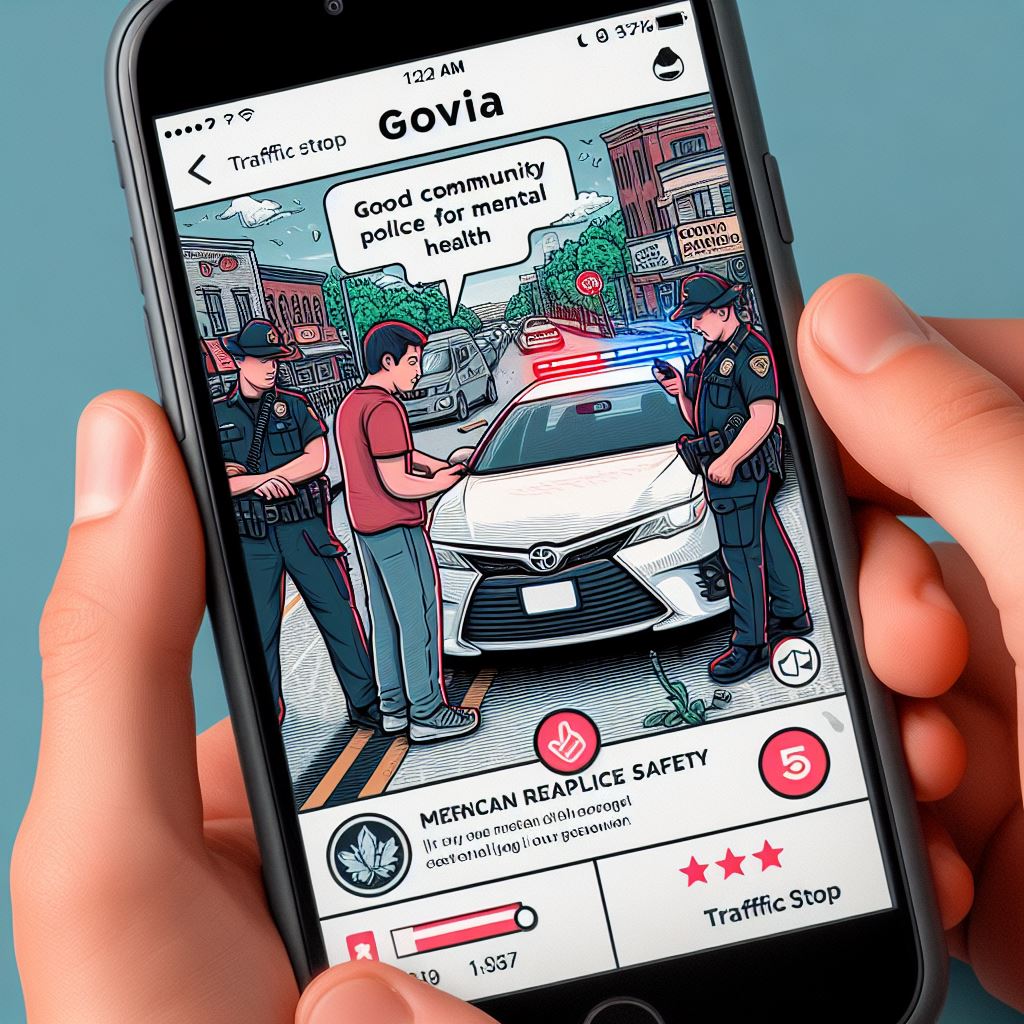
GoVia: Highlight a Hero connects civilians to crisis intervention specialists and attorneys during a police encounter, in real time. Citizens can instantly video call a lawyer or mental health expert who can guide them through the interaction — or even speak on their behalf.
Police supervisors can view live-streamed video directly from the citizen’s point of view into the command center. Officers can communicate directly with the attorney to ensure safety and clarify charges.
Sentiment analysis helps identify the aggressor. Crowdsourced feedback highlights exemplary officer conduct.
What GoVia Prevents
GoVia prevents:
- False testimony — by providing a live record of the encounter
- Evidence fabrication — by documenting what actually happened
- Witness intimidation — by giving citizens a direct line to legal counsel
- Charge stacking — by providing legal guidance in the moment
- Unlawful arrests — by ensuring citizens understand their rights
- Deadly encounters — by de-escalating before violence occurs
What GoVia Exposes
GoVia exposes:
- Corrupt officers — their actions are recorded
- Corrupt judges — their decisions are scrutinized
- Corrupt systems — the data doesn’t lie
The Stakeholders
Police departments want GoVia because it reduces liability, provides exculpatory evidence, and de-escalates encounters before they become deadly.
The Fraternal Order of Police (FOP) wants GoVia because it reduces the emotional and legal burdens on officers, allowing them to carry out their duty with enhanced security and support.
The Fraternal Order of Police (FOP) wants GoVia because it creates a transparent, third-party process that validates officer actions and protects them from false accusations.
The Fraternal Order of Police (FOP) wants GoVia because it aligns with their mission to protect life, enhance public trust, and improve the working conditions of law enforcement personnel.
Citizens and activists want GoVia because it provides accountability, legal representation in the moment, and a documented record of what actually happened.
CHAPTER SEVEN: THE ECONOMICS OF A LIFE
The Cost of the Status Quo
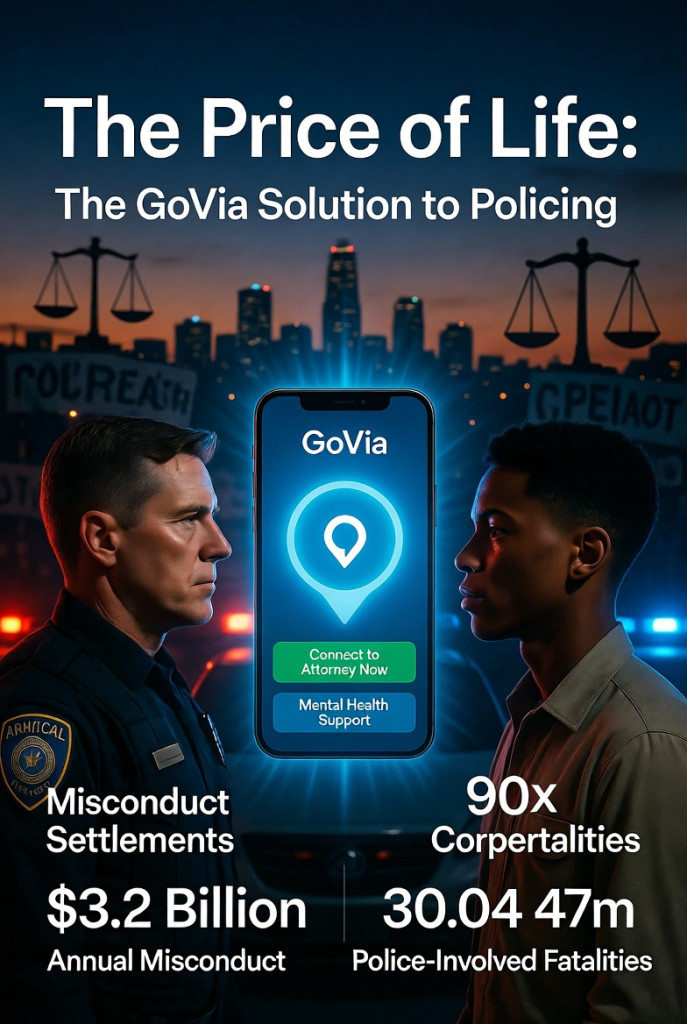
Police misconduct settlements cost American taxpayers $3.2 billion annually.
Each settlement averages $300,000.
New York City alone spent $230 million in 2019. Chicago allocated $113 million in 2020. Los Angeles: $87 million. Cleveland: $18 million.
Beyond settlements: an estimated **$400 million** in legal defense fees annually, insurance premium increases of 15-25%, and $1.8 billion in lost productivity.
The Cost of Private Prisons
Private prison contracts with guaranteed occupancy clauses cost taxpayers hundreds of millions annually — paying for beds that may or may not be filled.
The Cost of Corruption
- East Cleveland: A police chief indicted on 31 counts. An officer who served without authority for 16 years. An officer who lied, spied, and assaulted. Millions in civil judgments. Countless cases contaminated.
- Atlanta: Ten officers indicted. Three pleaded guilty to protecting drug deals.
- Los Angeles: The Rampart scandal. Fabricated evidence. Framed gang members. A scandal that still echoes 26 years later.
- Pennsylvania: Two judges. $3 million in kickbacks. 2,300 children. One suicide.
The GoVia Alternative
GoVia’s annual operating cost would be a fraction of the $3.2 billion spent on settlements alone.
The math is simple: Prevention is cheaper than settlement. Transparency is cheaper than corruption. A life is worth more than a lawsuit.
EPILOGUE: WHAT IS A LIFE WORTH?
A life is worth everything.
It’s worth the $3.2 billion we spend on settlements. It’s worth the $400 million in legal fees. It’s worth the $1.8 billion in lost productivity.
But more than that, a life is worth the effort to save it.
A life is worth slowing down a traffic stop by 30 seconds.
A life is worth connecting a citizen to a mental health professional instead of a handcuff.
A life is worth live-streaming an encounter so the truth — whatever it is — can be seen by judge and jury.
A life is worth ending the perverse incentives that profit from incarceration.
A life is worth holding corrupt officers, judges, and systems accountable.
A life is worth GoVia.
WHAT YOU CAN DO
- Download the app. GoVia: Highlight a Hero is available on Google Play.
- Share your story. Your experience — good or bad — helps build a better product.
- Share your criticism. GoVia wants to make the very best product for “the people.”
- Demand that your police department partner with GoVia. Ask your city council. Ask your mayor. Ask your police chief.
- Remember: It only takes seconds for a life to end. But it also only takes seconds to save one.
GoVia: Highlight a Hero — The future of policing.
Because every life is worth saving.
Because every citizen deserves their day in court.
Because every officer deserves to go home.
Because “We the People” can create our destiny in the pursuit of happiness.
This investigation was conducted by the GoVia Cross-Functional Investigative Team — investment banking, public-finance economics, GovTech strategy, legal-tech operations, mental-health systems, law-enforcement training, data science, IP counsel, and policy analysis — incorporating data from the Cuyahoga County Prosecutor’s Office, the U.S. Department of Justice, the FBI, the ATF, the American University Business Law Review, the Brennan Center for Justice, the ACLU of Ohio, In the Public Interest, and hundreds of interviews with police officers, attorneys, bail bondsmen, mental health agencies, and legal aids across Atlanta, Cleveland, Los Angeles, and New York.
“What is a life worth when we can save someone’s life during a traffic stop?”
The answer: Everything.
GoVia: The future of policing.