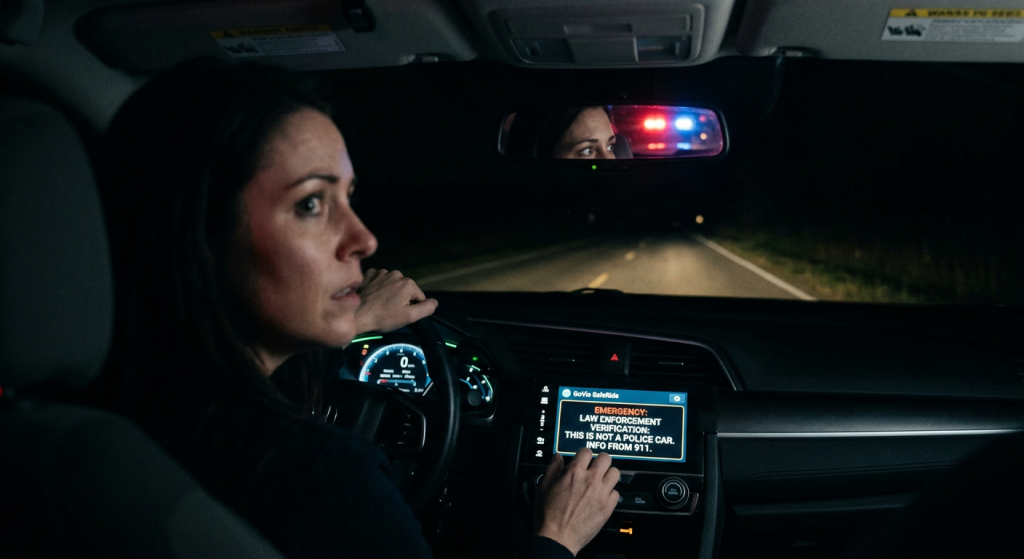
Example How GoVia works:
The blue and red lights flashing in Elena Vance’s rearview mirror didn’t bring a sense of security; they brought a tightening in her chest. It was 11:42 PM on a deserted, unlit stretch of Interstate 20. She was miles from the nearest exit, driving a rental car. GoVia, the nation’s fastest-growing smart-mobility police safety service platform.
Elena knew the risks. As an investigative journalist for The Vanguard, she had spent the last three months tracking a disturbing national trend: criminals using Amazon-bought police lights and thrift-store tactical gear to pull over lone drivers on dark highways.
Instead of pulling over onto the pitch-black shoulder, Elena tapped the glowing “GoVia SafeRide” icon on her dashboard screen.
“GoVia Emergency Support, this is Marcus. I see you’re in motion on I-20. How can I help you?” “Marcus, there’s an unmarked gray sedan flashing emergency lights behind me,” Elena said, her voice steady but urgent. “It’s pitch black out here. Can you verify if this is a legitimate police officer?”
“Initiating law enforcement verification now, Elena. Keep driving at a safe, steady speed. Do not pull over yet.”
On the other end of the line, Marcus wasn’t just a passive dispatcher; he was an emergency systems specialist at GoVia’s operations center. Within three seconds, GoVia’s software pinned Elena’s exact GPS coordinates and cross-referenced them with local law enforcement dispatch CAD (Computer-Aided Dispatch) feeds. Simultaneously, Marcus pinged the local county sheriff’s department via a direct digital bridge.
“Elena,” Marcus’s voice returned, calm and authoritative. “Local dispatch has no record of a traffic stop or an active unit at your coordinates. I am patching you directly through to the county 911 operator right now through our integrated system. Do not stop the vehicle.”
“Understood,” Elena said, her heart hammering. “I’m heading toward the Oasis Service Station at Exit 42. It’s well-lit.”
“Perfect strategy,” Marcus replied. “I have updated the 911 operator with your destination. A real local deputy is en route to meet you there. I am staying on the line, and your GoVia vehicle’s external cameras are now streaming live video to our secure server.”
Five minutes later, Elena pulled into the bright, camera-lined parking lot of the service station. The unmarked sedan followed her in, but as soon as the driver saw the brightly lit storefront and a marked sheriff’s cruiser tearing into the lot from the opposite entrance, the predator sped away. Thanks to GoVia’s automated exterior (flock) camera upload, the vehicle’s license plate was captured in high-definition, leading to an arrest less than forty-eight hours later.
The Deep Dive: Transforming Smart Mobility Into a Safety Shield
Elena’s experience wasn’t a stroke of luck; it was the blueprint for a massive safety overhaul she exposed in her follow-up investigative report. GoVia’s initiative to bridge the gap between professional service and technology and public emergency services represents a paradigm shift in driver safety.
By analyzing the vulnerabilities of nighttime driving and isolated encounters, tech-forward mobility platforms can implement specific, life-saving safety structures:
- The 911 Blue-Ribbon Verification Loop
When a user triggers an emergency alert regarding a police encounter, the platform shouldn’t just call 911—it should act as a data conduit.
- Real-Time CAD Integration: By partnering with regional 911 hubs, the platform’s backend automatically checks active police dispatch logs against the vehicle’s exact telemetry.
- Safe-Zone Routing: If an officer cannot be immediately verified, the in-car navigation automatically reroutes the driver to the nearest pre-certified “Safe Zone”—such as a 24-hour police precinct, a well-lit fire station, or a designated, heavily monitored commercial lot.
- Dispatcher Mediation: The platform keeps a three-way recorded line open between the driver, the platform’s safety hero, and the public 911 dispatcher, ensuring the driver is protected from “fleeing or eluding” charges while trying to reach a safe, lit area.
- Visual and Audible External Alerts
When a high-risk unverified stop is in progress, the vehicle itself can communicate the driver’s intent to cooperate safely to the pursuing officer.
- Automated Hazard & Exterior Communication: The vehicle’s digital displays or hazard sequences can flash a specific rhythm, signaling to a legitimate officer: “I am aware of you, I am on the phone with 911, and I am proceeding to a lit area.”
- Predictive Speed Management: The vehicle can automatically lock its cruise control to exactly 5 mph under the speed limit, proving the driver is not attempting a high-speed escape, but rather looking for a safe harbor.
- Ambient Threat Detection and “Black Box” Streaming
Safety features shouldn’t wait for a crisis to activate; they should anticipate it.
- Flashing Light Recognition: Using rear-facing cameras and machine learning, the vehicle can detect the specific frequency of emergency stroboscopes. If the lights are detected on a dark road, the car can proactively prompt the driver: “We detect emergency lights. Would you like to verify this officer or locate the nearest lit Safe Zone?”
- Incident Perimeter Recording: The moment an unverified stop begins, all external cameras (dashcams, side-mirror cameras, and backup cameras) switch to high-bitrate, tamper-proof cloud streaming, ensuring that whatever happens next is permanently documented outside the vehicle.
By turning the car from a passive machine into an active, protective guardian, platforms like GoVia can ensure that no driver ever has to choose between the fear of a predator and the fear of a police misunderstanding on a dark highway.