
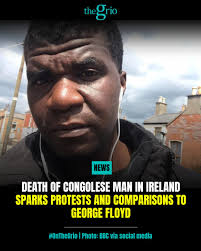
On a busy shopping street in central Dublin, a man lay face-down on the pavement for nearly five minutes. Bystanders filmed. Voices rose. No one intervened in time. By the moment Irish police arrived, Yves Sakila—35, Congolese-born—was unresponsive. Within hours, he was dead. Within days, the footage had circled the world, igniting protests and a familiar, unresolved question: when restraint becomes fatal, who is held accountable—and how consistently?
This is not only a story about Ireland. It is a test case in a broader, transnational struggle over policing, private security power, and the fragile architecture of accountability.
The Incident: Minutes That Matter
According to reporting from international outlets and verified witness video, Sakila was pursued on May 15, 2026, by private security personnel outside Arnotts department store on Henry Street over an alleged shoplifting incident. He was restrained on the ground, face-down. One guard appears, in footage, to place weight on or near his head or neck.
Medical and use-of-force experts have long warned that prone restraint—especially with pressure applied to the upper back or neck—can restrict breathing and lead to cardiac arrest. The U.S. Department of Justice and multiple European oversight bodies have issued cautions or restrictions on such tactics. In Sakila’s case, the restraint lasted several minutes. When Gardaí arrived, he showed no signs of responsiveness and was later pronounced dead at a hospital.
Authorities in Ireland have opened a full investigation. No final determination of cause of death has yet been publicly confirmed as of this writing, pending autopsy and inquiry findings.
A Viral Pattern: When Video Becomes Evidence—and Pressure
The footage—fragmented, shaky, visceral—triggered immediate comparisons to the 2020 killing of George Floyd in Minneapolis. Those parallels are not merely symbolic. They point to a recurring pattern: prolonged restraint, visible distress, delayed intervention, and the decisive role of citizen video in shaping public accountability.
Research underscores the power—and limits—of such footage. A 2023 study published in Nature Human Behaviourfound that viral videos of police violence significantly increase public awareness and protest activity but do not consistently lead to legal accountability without institutional follow-through. In the United States, Mapping Police Violence reports that fewer than 2% of officers involved in fatal incidents are charged with a crime. Comparable consolidated statistics across the European Union are harder to obtain, reflecting fragmented oversight systems and varying legal standards.
Private Security, Public Power
Sakila’s death also exposes a less scrutinized reality: private security personnel often exercise quasi-policing authority in public-facing spaces.
- In the European Union, the private security workforce is estimated to exceed 1.6 million personnel—larger than the combined number of police officers in several member states.
- Oversight frameworks vary widely. Training requirements, use-of-force protocols, and accountability mechanisms differ not only across countries but sometimes within them.
- In Ireland, private security is regulated by the Private Security Authority, but enforcement of standards—especially in dynamic, public encounters—relies heavily on after-the-fact review.
The critical question is whether systems designed for theft prevention are equipped to handle high-risk physical interventions without escalating harm.
Protest, Diplomacy, and a Demand for Answers
In Dublin, hundreds gathered in the days following Sakila’s death, demanding transparency and accountability. Protesters cited systemic bias and excessive force. The involvement of the Democratic Republic of Congo’s foreign minister—who traveled to Ireland to meet officials and Sakila’s family—elevates the case into the realm of diplomatic concern.
This mirrors a broader trend: deaths in custody or during restraint increasingly transcend national boundaries, becoming matters of international human rights scrutiny. Organizations such as Amnesty International and the UN Human Rights Office have repeatedly called for independent investigations in cases involving potential excessive force.
The Accountability Gap
Across jurisdictions, three recurring gaps emerge:
- Time-to-Intervention: Even when distress is visible, there is often no immediate protocol enforcement to reposition or release a restrained individual.
- Fragmented Oversight: Police, private security, and regulatory bodies operate under different standards, complicating unified accountability.
- Evidence Integrity: Video exists, but it is decentralized, often incomplete, and not systematically integrated into official review processes.
These gaps create a narrow window in which fatal outcomes can occur—and a wide space in which responsibility becomes diffuse.
Where “GoVia Highlight A Hero” Fits
The GoVia Highlight A Hero concept sits at the intersection of these failures: visibility, verification, and real-time accountability.
If implemented with rigor, a system like GoVia could function not as protest alone, but as infrastructure—bridging the gap between incident and evidence, between witness and institution.
Consider a practical model:
- Real-Time Incident Capture: Verified, time-stamped video uploads from bystanders, secured with geolocation and metadata integrity to preserve evidentiary value.
- Decentralized Witness Network: Multiple vantage points aggregated into a single incident file, reducing reliance on a single, possibly ambiguous clip.
- Automated Risk Flags: AI-assisted detection of high-risk restraint positions (e.g., prone restraint exceeding a threshold duration such as
seconds), triggering alerts to oversight bodies or emergency services.
- Chain-of-Custody Protection: Blockchain or equivalent audit trails ensuring footage cannot be altered post-upload, addressing common legal challenges.
- Public Transparency Layer: A controlled, privacy-compliant interface where confirmed incidents can be reviewed by journalists, civil rights groups, and policymakers.
This is not hypothetical technology; components of it already exist in fragmented forms across body cameras, civilian apps, and digital evidence systems. The innovation lies in integration—and in independence from the agencies being scrutinized.
From Protest to Infrastructure
Historically, reform follows exposure. The Rodney King beating in 1991, George Floyd in 2020, and now Sakila in 2026—each case forced institutions to confront practices long documented but rarely addressed with urgency.
The question is whether exposure alone is enough.
If GoVia positions itself as a global civic infrastructure—rather than a campaign—it could shift the dynamic:
- From reactive protest to proactive monitoring
- From isolated footage to structured evidence
- From local outrage to coordinated, cross-border accountability
In practical terms, this would mean partnerships with legal aid organizations, integration with investigative newsrooms, and alignment with international human rights standards.
The Unfinished Question
Yves Sakila’s final minutes are now part of a global archive of recorded restraint deaths—cases where the camera arrived before accountability did.
Whether his case leads to systemic change will depend less on the outrage it generates and more on the systems that follow it.
The footage made the world watch. What comes next will determine whether watching is where justice ends—or where it finally begins.


