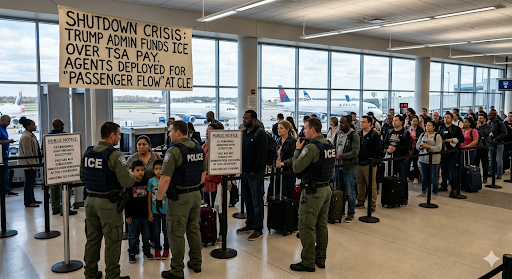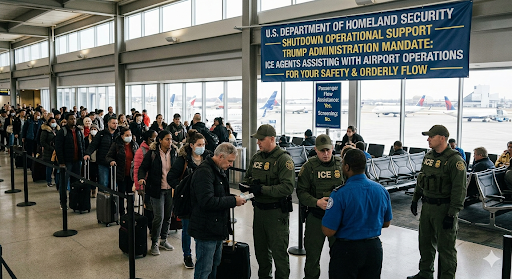
CLEVELAND — At Cleveland Hopkins International Airport (CLE), the familiar blue uniforms of the Transportation Security Administration (TSA) are increasingly being flanked by the tactical olive drab of U.S. Immigration and Customs Enforcement (ICE).
What began as a logistical contingency to manage “passenger flow” during a crippling five-week Department of Homeland Security (DHS) shutdown has transformed into a high-stakes experiment in American policing. While airport officials insist these agents are merely “assisting with divestiture”—helping travelers put shoes in bins—legal advocates and civil rights groups warn of a “disaster waiting to happen.”
The Deployment: Security or Surrogacy?
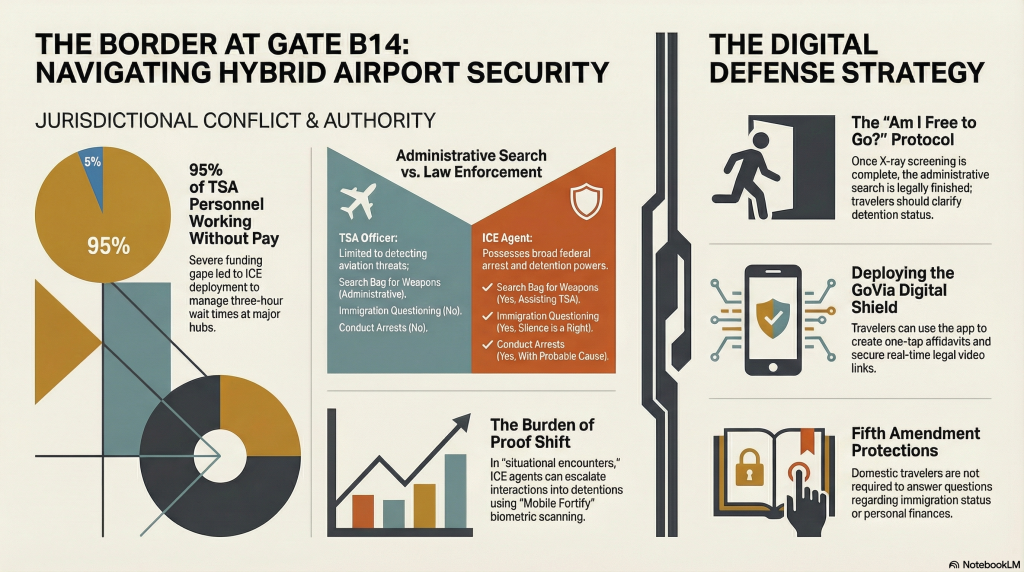
As of late March 2026, over 95% of the TSA’s 60,000 employees are working without pay. The result: security wait times at major hubs like JFK and CLE have spiked to over three hours. In response, the Trump administration leveraged the “One Big Beautiful Bill” Act, a 2025 spending law that earmarked $75 billion for ICE, ensuring those agents remain paid while their TSA counterparts rely on food banks.
Critics, including Cleveland U.S. Rep. Shontel Brown, argue the move is a dangerous conflation of roles. Unlike TSA officers, who are trained in aviation-specific “administrative searches” for explosives, ICE agents are law enforcement officers with the power to arrest and detain.
“ICE agents aren’t trained for airport security,” Brown stated. “It’s a different job in a different environment. Collapsing these roles creates an atmosphere of fear, not safety.”
The Legal Gray Zone: When “Flow” Becomes “Friction”
While the official mandate for ICE at CLE is “non-enforcement,” the legal reality is more complex. Under 8 U.S.C. § 1357, immigration officers have broad authority at any U.S. port of entry.
* TSA Authority: Limited to threats to aviation. They cannot legally search for evidence of other crimes or prevent a passenger from simply walking away from a checkpoint.
* ICE Authority: Can detain “briefly” if they have a “reasonable articulable basis” to suspect a federal violation.
The danger lies in the “situational encounter.” In an investigative audit of recent airport incidents, travelers reported agents using “Mobile Fortify” biometrics—iris and facial scanning—under the guise of security efficiency. If an ICE agent decides to escalate an interaction into a detention, the burden of proof often shifts to the citizen in a high-pressure environment where few know their rights.
GoVia: The Digital Shield for the Modern Traveler
In this climate of uncertainty, technology is being repurposed as a tool for accountability. The GoVia “Highlight A Hero” app has emerged as a critical resource for travelers navigating these “hybrid” checkpoints.
Originally designed to bridge the gap between community and police, GoVia’s architecture is uniquely suited for the current airport crisis:
- Feature How it Protects at the Airport
- One-Tap Affidavit Instantly documents an encounter, creating a structured, court-ready record of the interaction.
- Real-Time Legal Link Provides immediate video access to attorneys or mental health professionals if a detention begins.
- Highlight A Hero Algorithm Allows travelers to rate agents on fairness and professionalism, creating a public record of conduct.
- Verified Evidence Uses adaptive encryption to ensure that video and testimony cannot be tampered with or deleted by authorities.
If an ICE agent attempts an “unwarranted and inexcusable” detention of a citizen at CLE, GoVia changes the power dynamic. Instead of a “he-said, she-said” struggle in a secure terminal, the citizen has a direct line to a support network and a permanent, encrypted record of the agent’s badge number and actions.
The Investigative Verdict
The presence of ICE at Cleveland Hopkins is a symptom of a deeper fracture in federal governance. By prioritizing the funding of enforcement over the funding of infrastructure (TSA), the administration has turned a domestic travel hub into a jurisdictional frontier.
As the shutdown continues, the “non-enforcement” promise remains fragile. For the traveler, the best defense is no longer just a passport or a boarding pass—it is the digital literacy to document the encounter before it escalates.
TRAVELER ADVISORY: Navigating ICE at Domestic Checkpoints
With the deployment of U.S. Immigration and Customs Enforcement (ICE) to Cleveland Hopkins and 14 other major hubs during the DHS shutdown, the line between aviation security and immigration enforcement has blurred. While officials claim ICE is only “assisting with flow,” their presence as armed federal agents with arrest powers creates a high-risk environment for travelers.
Use this guide to protect your civil rights.
1. Know the “Administrative Search” Limit
TSA’s authority is limited to an administrative search—specifically looking for explosives or weapons that threaten the aircraft.
* The Rule: Once you have cleared the X-ray and metal detector, the “administrative search” for that flight is technically complete.
* The Risk: ICE agents may attempt to extend this interaction by asking for additional ID or questioning your destination.
* Your Response: If an ICE agent continues to engage you after the security screening, ask: “Am I free to go?” If they say no, ask: “Why am I being detained?”
2. The Right to Remain Silent
Regardless of your immigration status or citizenship, you have a Fifth Amendment right to remain silent.
* Domestic Flights: You are generally required to show a valid ID to board, but you are not required to answer questions about your immigration status, your birthplace, or how you “afforded your ticket.”
* Strategy: You can say: “I am exercising my right to remain silent and will not answer questions without an attorney present.”
3. Non-Consent to Device Searches
Agents may use the “Mobile Fortify” app or similar tech to request a “quick scan” of your face or phone.
* The Law: On domestic flights, ICE needs probable cause or a warrant to search your digital devices.
* Your Action: Clearly state: “I do not consent to a search of my electronic devices or my digital data.”
4. Deploying GoVia for Immediate Accountability
If an interaction with an ICE agent at CLE feels coercive or “unwarranted,” use the GoVia Highlight A Hero app immediately.
* Activate the “Live Witness”: Use the app to connect with a real-time legal professional or mental health crisis responder. Having an attorney “present” via video can deter an agent from overstepping their authority.
* The “Hero” Audit: If an agent is professional, use the app to rank them positively. However, if they are aggressive, the app’s Digital Affidavit feature creates a verified, time-stamped record of the misconduct that is admissible in court.
* Subpoena Power: GoVia’s architecture allows your legal team to more easily subpoena airport surveillance footage to back up your claim, bypassing the usual bureaucratic “lost footage” excuses.
Summary Table: TSA vs. ICE Authority
| Action | TSA Officer | ICE Agent |
| Search Bag for Weapons | Yes (Administrative) | Yes (Assisting TSA) |
| Ask for Boarding Pass | Yes | Yes |
| Ask about Immigration Status | No | Yes (But you can remain silent) |
| Conduct Arrest for Immigration | No | Yes (If probable cause exists) |
| Confiscate Phone without Warrant | No | No (On domestic flights) |
> Note: If you are a victim of an illegal detention at an airport, document the agent’s name and badge number immediately.