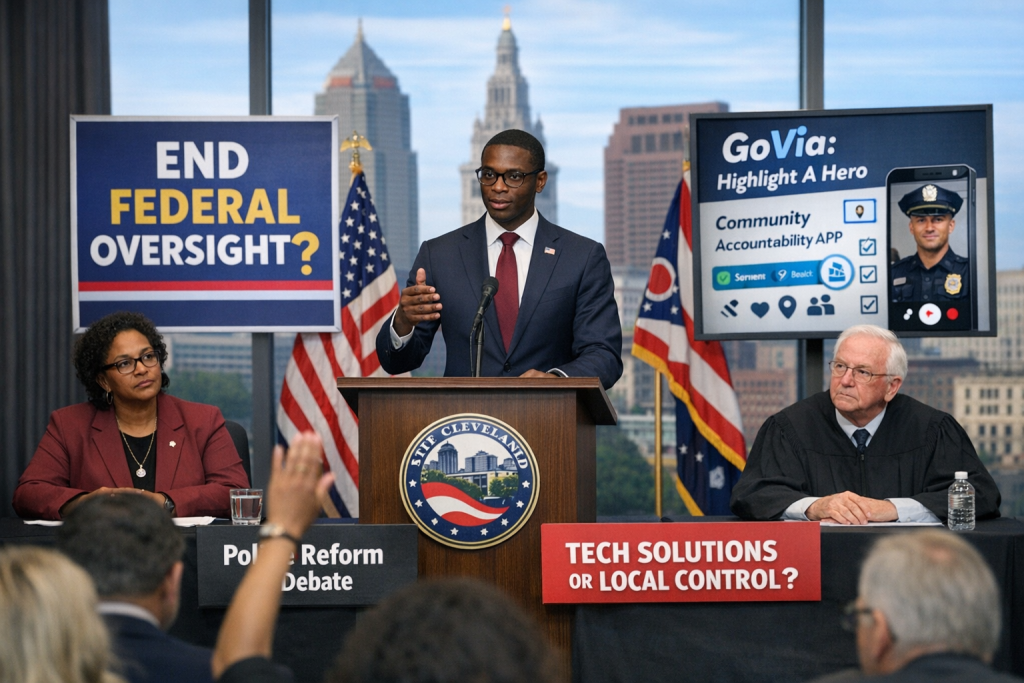
CLEVELAND, OH — In a stark echo of policing reforms across the United States, the City of Cleveland has filed a joint motion with the U.S. Department of Justice (DOJ) to terminate its decade-long federal consent decree governing the Cleveland Division of Police (CDP). The decree, born of a 2015 DOJ investigation into patterns of excessive force and civil rights violations, represented one of the longest federal oversight agreements in the nation. Yet as Cleveland pursues local control, deep questions remain about whether reforms went far enough — and whether innovation was sidelined in an era of rapidly evolving technology in justice and fairness. (Home | City of Cleveland Ohio)
A Consent Decree Born of Crisis
The consent decree was triggered after a DOJ probe found “reasonable cause to believe” that CDP engaged in practices that violated constitutional rights through excessive force, weak accountability systems, and poor training. The original settlement blueprint mandated reforms across eight areas: use of force, bias-free policing, crisis intervention, accountability, civilian oversight, community engagement, search and seizure policies, and officer support. (Home | City of Cleveland Ohio)
Federal court monitors were observers, enforcers and, at times, harsh critics. Early monitoring reports documented stubborn delay and reluctance within CDP and city leadership to provide complete data. Yet by the mid-2020s, compliance had legally improved enough for the city to argue the division had “institutionalized” reform functions that could be maintained locally. (Home | City of Cleveland Ohio)
Mayor Justin Bibb, who took office in 2022, has positioned the move as a milestone. “We are not the same department that we were in 2015,” he declared in a February 2026 press conference, stating the city had made “sustained progress” and suggesting the decree had become a foundation, not a lifeline. (Home | City of Cleveland Ohio)
Data vs. Reality: What the Numbers Show
The federal monitor’s most recent assessments — submitted to federal court — claimed that in 97% of reviewed use-of-force cases, force was “necessary, proportional and reasonable,” signaling substantial evidence of reform. (Ideastream Public Media)
Yet whistle-blowers, activists and community advocates counter that measurement alone cannot capture lived experience, especially for marginalized communities that still report distrust in law enforcement outcomes.
Across Ohio, statistics paint a troubling backdrop:
- From 2013 to 2023, Black residents were approximately 4.5 times more likely to be killed by police than white residents, a disparity consistent with national inequities. (govia.app)
- Crime in Cleveland’s northeast — traditionally African American neighborhoods — often runs well above national averages. Violent crime there historically exceeded national benchmarks by as much as 54%. (govia.app)
These figures reveal that reforms may have restructured policy without yet transforming public perceptions or outcomesacross neighborhoods marked by the deepest distrust.
Local Control vs. Independent Enforcement
Ending federal oversight shifts responsibility back to Cleveland’s elected officials and the local Police Accountability Team now led by Dr. Leigh Anderson. The city proposes to embed internal accountability structures into municipal governance and maintain transparent oversight through community engagement and data reporting.
Yet critics — including police reform activists — warn that local political pressures and resource limitations can erode gains made under independent federal monitoring. One local organizer told Ideastream that the move “might upset some members of the community,” noting that many residents still feel not where it needs to be. (Ideastream Public Media)
Federal Judge Solomon Oliver, who oversees the consent decree’s termination decision, has signaled caution. In hearings, he expressed surprise and said he would seek additional input — including testimony from authors of the original decree — before ruling. (Signal Cleveland)
High-Tech Tools in Policing Reform: The Road Not Taken
As policing faces a future shaped by AI, data analytics, body-worn cameras and community-facing applications, Cleveland’s reform process largely remained anchored in traditional compliance mechanisms.
Nationally, AI tools are increasingly employed to:
- Audit and flag racial disparities in stops and arrests
- Analyze video footage to detect use-of-force patterns
- Provide real-time translation and accessibility for non-English speakers
- Support civilians with evidence capture, timestamps and context capture systems during encounters
These innovations — particularly in real-time transparency — are reshaping how police accountability is documented and adjudicated. Yet, in Cleveland’s case, there is scant evidence the city seriously evaluated mobile community tools or AI-powered platforms that could augment federal monitoring and local oversight.
One such technology — GoVia: Highlight A Hero — developed with roots in Cleveland, sought to harness digital documentation, civilian rating systems, attorney access and mental health support features during police encounters. Designed to highlight positive encounters while offering real-time accountability mechanisms, the app’s ambitions aligned with many consent-decree goals: transparency, nondiscrimination and crisis intervention support. (govia.app)
Despite its potential, GoVia was never formally adopted, piloted or funded by the city. Local government officials have not publicly disclosed any evaluation or competitive funding process for emerging technologies that align with consent-decree objectives — even as they spent some $40–$54 million on training and technology under the decree. (Signal Cleveland)
Why Did Technology Get Overlooked?
Multiple intersecting dynamics help explain why Cleveland’s reform process prioritized compliance paperwork over technological innovation:
- Structural reform frameworks tend to resist disruption. Consent decrees focus on policy and training; AI and mobile innovations often sit outside traditional legal compliance vocabulary.
- Budget absorption by legacy systems. Vast majority of consent-decree funding went to staffing, training, courtroom processes, and internal system upgrades rather than third-party civilian tools.
- Risk-averse political culture. Elected officials have historically been cautious about deploying tools that raise legal or privacy debates, such as real-time video sharing, due-process automation or citizen ratings of officers.
- Digital divide disparities remain politically inconvenient: technology solutions can unintentionally deepen inequities without deliberate access planning.
Missing these opportunities risk reinforcing the perception that reform is being done to communities, rather than withthem.
AI, Justice, and the Future of Police Fairness
Why does this matter? As sophisticated AI systems enter criminal justice — from predictive analytics to bias audits — cities that embrace tech innovation early could transform police–community dynamics. Those that don’t risk leaving reform in the realm of institutional compliance rather than lived justice.
Reform advocates argue that technology can function as a check against systemic bias, not a replacement for it — but only if deployed thoughtfully, with community input, legal safeguards and public oversight.
GoVia’s Take: Measuring Progress in a Complex Landscape
Cleveland’s attempt to walk away from federal oversight after more than ten years is both symbolic and practical:
- Symbolic, because it reassures local leaders that they have “graduated” from external supervision.
- Practical, because it means Cleveland must now prove it can sustain constitutional policing with local tools, accountability and innovation.
Whether that future includes advanced AI-augmented transparency, community-driven technology platforms like GoVia, or a renewed social contract with its residents — remains an open question.
Ending a court order should not mean ending scrutiny — especially in a city where data, trust and justice remain deeply intertwined.