An Investigative Report on the Emotional Wounds of Police Encounters — and the Technology That Could Finally Heal Them
By the GoVia Investigative Desk
ATLANTA — The flashing blue light appears in the rearview mirror. For 50,000 Americans every day — more than 20 million each year — this is the moment the world narrows to a point of terror.
For a 16-year-old Black boy in Atlanta, it’s the moment his mother’s voice echoes in his head: Keep your hands visible. Don’t make sudden moves. Say “yes, sir.”
For a 24-year-old Latino man in Los Angeles, it’s the moment his chest tightens, his palms sweat, and his mind races through every video he’s ever seen of encounters that ended in caskets.
For a poor white teenager in Cleveland, it’s the moment he realizes that the system he was told would protect him sees him as just another problem to be managed.
This is America. This is what Black America has been living with for generations at the hands of local police. And until now, there has been no safety net in that moment — no attorney, no mental health professional, no witness to ensure that fear doesn’t become fatality.
Enter GoVia: Highlight A Hero — a patented community police safety system that brings real-time legal and mental health support directly into the split-second of a police encounter. With over 32,500 users worldwide, GoVia is not just an app. It is a referendum on whether police accountability can be made visible, immediate, and ordinary.
PART ONE: The Unseen Wound
The Psychology of the Stop
The data is chilling. Men reporting a high number of lifetime police stops have three times greater odds of current PTSD symptoms compared with men who do not. Young adults who experience unfair stops show significantly higher levels of psychological distress, depression, and anxiety. Approximately 33% of youth reporting in-person police stops have been exposed to officer gunpoint during those stops.
“Youth-police contact is increasingly acknowledged as a stressor and a racialized adverse childhood experience that can undermine youths’ mental health,” researchers at Johns Hopkins University have documented.
The trauma doesn’t end when the officer walks away. It embeds itself in the nervous system. It shapes how young people see themselves, their communities, and their country. It becomes the lens through which they view every future encounter with authority.
“When you allow racial disparity and institutional inequity to affect one part of the country, eventually it’s coming back to get everyone,” warns anti-racism educator Tim Wise. “For people of color — especially African Americans — the idea that racist cops might frame members of their community is no abstract notion, let alone an exercise in irrational conspiracy theorizing.”
Wise has spoken bluntly about the asymmetry of expectations: “We are asking more of average citizens than the police. Police should not have to think before acting, but the person they are attacking should…it’s lunacy, truly.”
PART TWO: The Price We All Pay
$3.2 Billion and Counting
The financial cost of police-related misconduct is staggering. Cities and states collectively face more than $3.2 billion in police-related misconduct payouts — a cost paid not only in dollars but in trauma, distrust, and lives disrupted.
In New York City alone, the tab for police misconduct settlements has reached **nearly $800 million since 2019**. The city settled **1,044 police misconduct lawsuits in 2025** — the fourth straight year with settlements exceeding $100 million.
Los Angeles Mayor Karen Bass has focused on community-led safety approaches, launching programs like Summer Night Lights at 42 locations in communities most impacted by violent crime. Her administration has invested in hiring 510 new officers while simultaneously expanding community-based prevention. Yet even as homicides drop — a 19% citywide decrease, the lowest on record in 60 years — the underlying trauma of police encounters persists.
Atlanta Mayor Andre Dickens, sworn in for a second term in January 2026, has pointed to “smart policing” strategies and noted that youth-related crime decreased by 56% through community initiatives. But the city’s FY2026 budget allocates nearly 20% more funding to the Atlanta Police Department — a familiar pattern where safety is defined by enforcement, not by the lived experience of feeling safe.
New York City Mayor Zohran Mamdani has taken a different approach, launching an Office of Community Safety to reduce the role of police in responding to mental health emergencies. “Officers have to handle 200,000 mental health calls a year,” Mamdani said. “That is not a system that is working.” Backers of his plan say police often escalate “triggers” confrontations with people in emotional distress.
But the investment gap tells a deeper story. Between 1971 and 2021, the share of city budgets devoted to policing grew by 19% while the share devoted to social services shrank by 12%. Research suggests that education spending efficiently and durably reduces crime with fewer negative externalities than policing.
The question is not whether we spend enough on safety. The question is whether we are spending on the right kind of safety.
PART THREE: Caught in the Middle
The Great Person and the Unruly Child
In every police encounter, there is a figure we rarely discuss: the Great Person — the citizen who is doing everything right. They have a job. They pay taxes. They follow the rules. They are driving home from work, walking to the store, or simply existing in a public space.
Yet they are caught in the middle of a system that too often treats them as a suspect first and a citizen second.
Between the unruly child — the young person whose defiance or fear reads as disrespect — and the officer whose training, stress, and bias shape every decision, the Great Person is the one who pays the emotional price. They are the one whose children watch them being handcuffed for a broken taillight. They are the one whose trauma becomes the family’s trauma, passed down like an inheritance no one asked for.
“This company “GoVia is for both parties,” said Georgio Sabino III, founder and CEO of GoVia. “If we can slow down the interaction and de-escalate, we can have a conversation. It’s fear and tension that create the threat of life and death.” “We can build something that helps, protects and feels safer.”
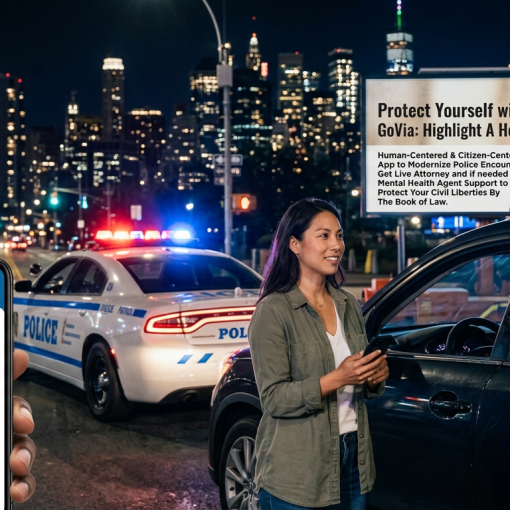
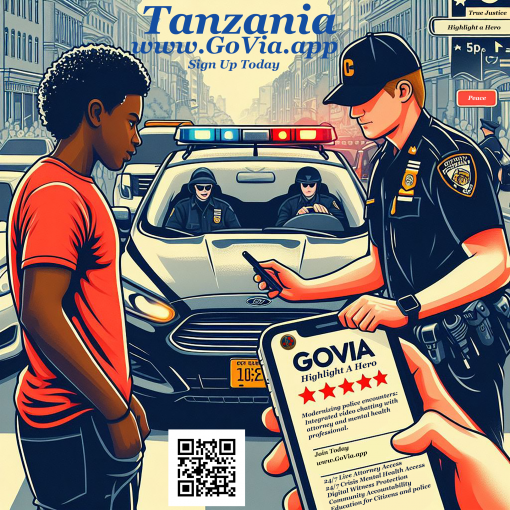
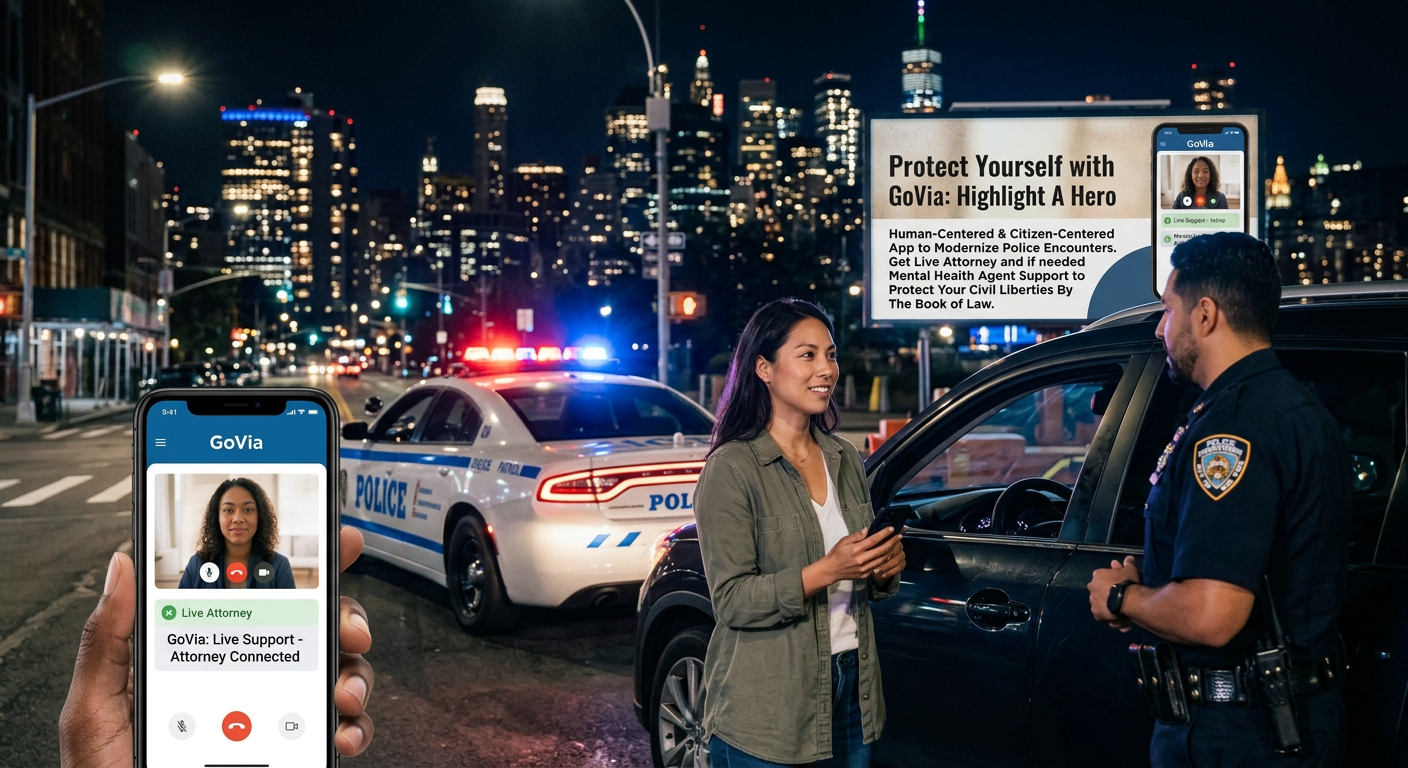
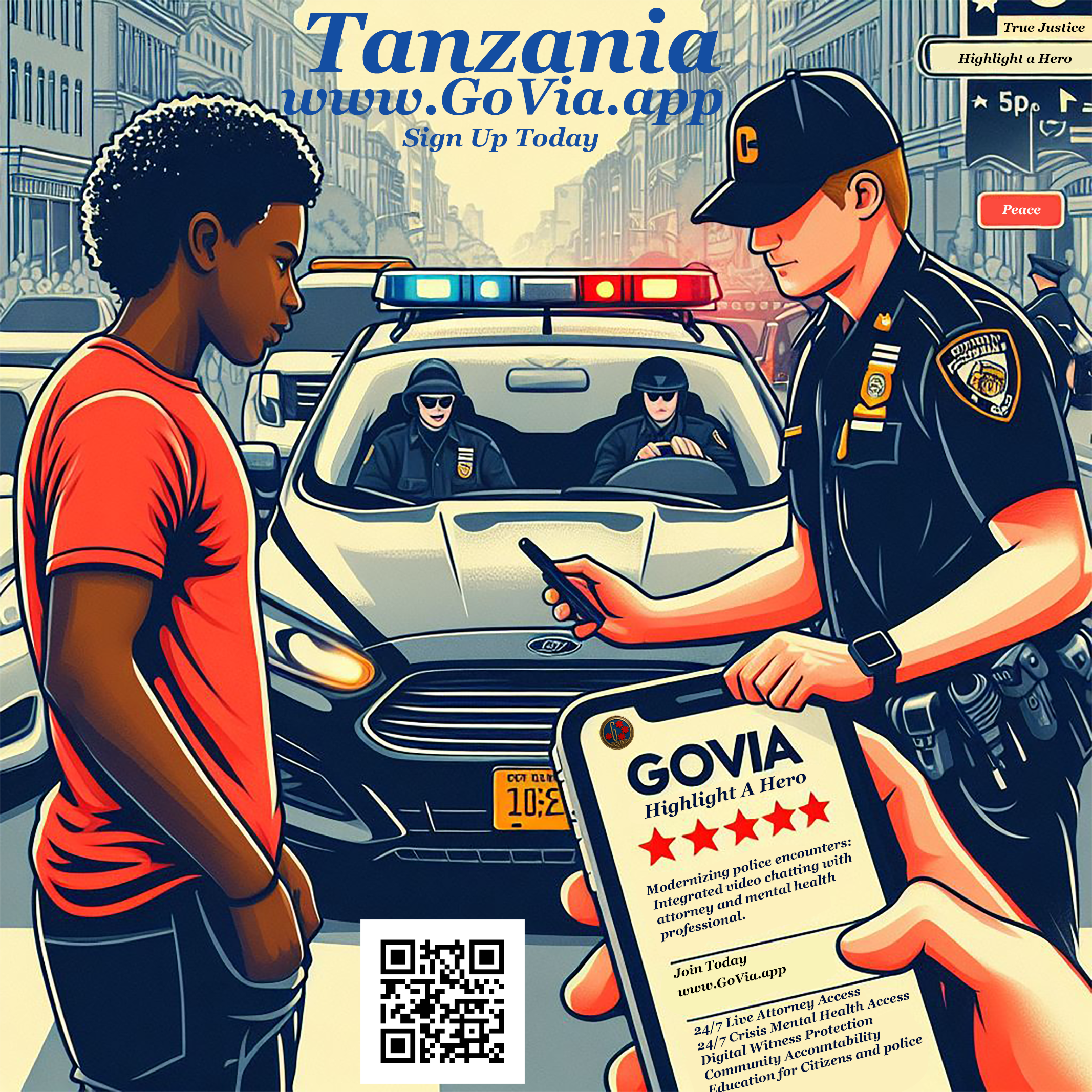
GoVia’s approach is rooted in this understanding. When a user activates the app during a traffic stop or street encounter, a licensed attorney and a mental health specialist join the livestream instantly. GoVia’s education and professionalism kicks in to ask our clients/citizens/end-users to be deescalated for the police officer. The Zoom/Facetime call is recorded, stored, secured but going to the courthouse as evidence and property in real time. Their presence is professional, calm, and evidence-based — reducing the possibility of escalation and ensuring that both the citizen and the officer act within best practices.
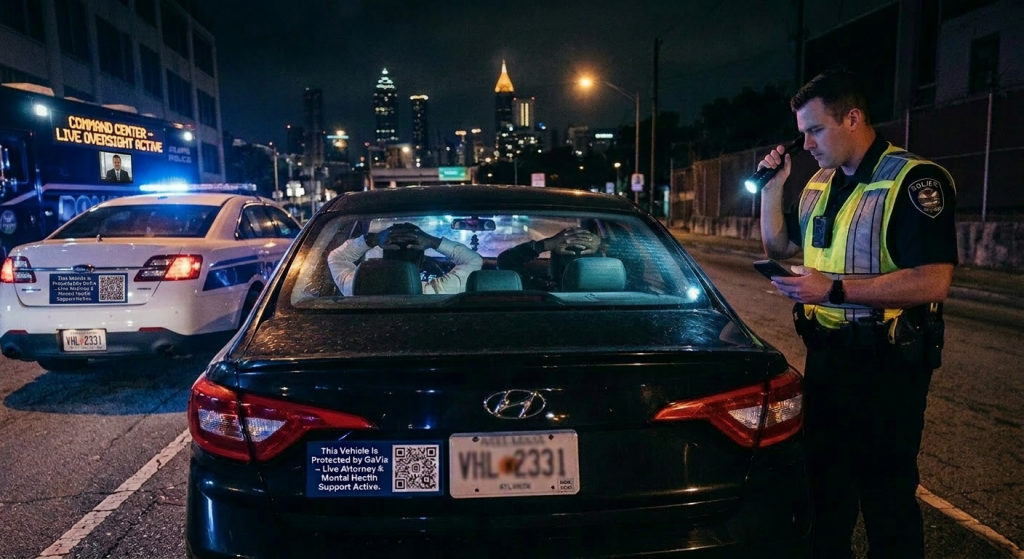
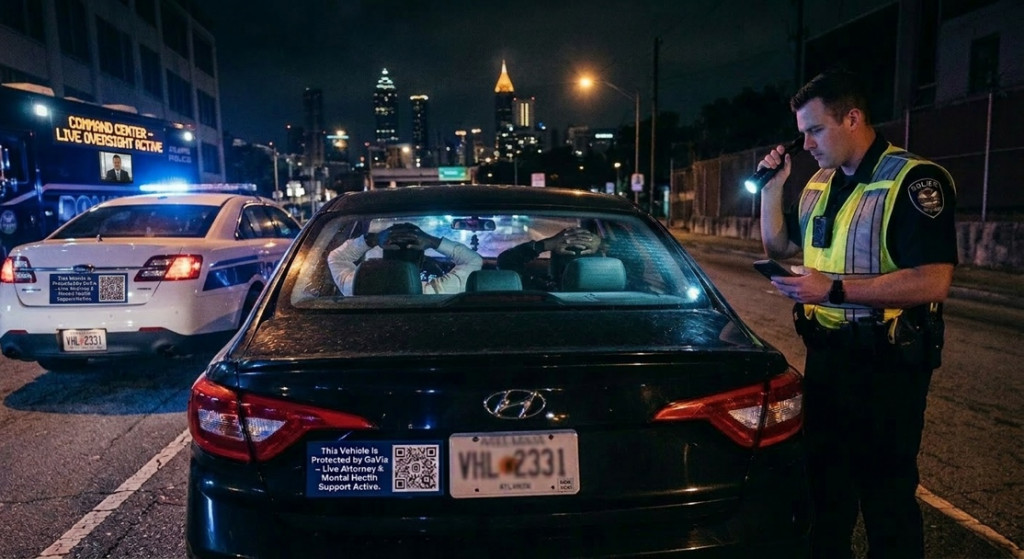
Each GoVia user receives a vehicle bumper sticker reading: “This Vehicle Is Protected by GoVia – Live Attorney & Mental Health Support Active.” This early warning isn’t confrontational — it’s professional. Officers are informed immediately that this is a protected interaction with legal and mental-health oversight. The Vehicle has a “secured QR code” the police officer can scan and join-in on the Zoom while the driver and passengers are 10-2 either on the steering wheel and or over their heads (GoVia’s Education Program). If a supervisor is needed the Zoom link can/will be sent to the command center in real-time to be on a split screen for the executive team can witness live.
PART FOUR: The Hero We Need
Highlighting What Works
One of GoVia’s most innovative features is the ability to recognize officers who exemplify great policing. Too often, the national narrative only captures the worst moments. But across the country, thousands of officers resolve difficult situations with patience, empathy, and professionalism.
GoVia allows citizens to publicly acknowledge those moments. An officer who de-escalates a tense encounter. An officer who helps a struggling family. An officer who listens before acting. Those officers can be recognized as “Highlighted Heroes.”
“GoVia is the future of community safety,” said Dr. George C. Fraser, global leadership icon. “When we connect the dots — technology, justice, and empowerment — we create real change.”
The platform was not designed to challenge police officers. It was designed to support them. Its mission is simple but profound: help both sides of a police encounter walk away safely.
“GoVia reinforces training with technology that encourages calm, accountable interactions.”
PART FIVE: The Education Deficit
What We Don’t Teach
The underfunded schools. The lack of classes on how to be a citizen. The absence of education about the law and one’s rights within it. These are not incidental failures — they are structural ones.
GoVia’s education program aims to bring civility back to the streets by teaching young people what they were never taught: their rights liberties, their responsibilities, and how to navigate encounters with authority with dignity and safety. The curriculum includes law enforcement training modules, mental health coordination, and the Highlight A Hero recognition program.
But technology alone cannot solve what culture has broken. Investments from all sectors — government, philanthropy, community organizations, and the private sector — are required. We are all emotionally involved.
As President Barack Obama has observed: “There is no doubt that police departments still feel embattled and unjustly accused. And there is no doubt that minority communities, communities of color, still feel like it just takes too long to do what’s right.”
“The elected officials who matter most in reforming police departments and the criminal justice system work at the state and local levels.”
PART SIX: Justice Rolling Down
The Moral Imperative
Dr. Martin Luther King Jr. stood on the steps of the Lincoln Memorial and declared: “No, no, we are not satisfied, and we will not be satisfied until justice rolls down like waters and righteousness like a mighty stream.”
That was 1963. More than six decades later, we are still waiting.
But waiting is not a strategy. Hope is the dream, but we now have the action. GoVia offers is something different: a layer of protection in the moment it matters most. Which is the new plan.
“GoVia was not designed to challenge police officers. It was designed to support them.” Its philosophy is not anti-police; it is pro-accountability. Because GoVia’s motto is We are Pro Police, Pro Citizen and Pro Safety!
The app provides:
- Live-streamed legal support
- Licensed mental-health professionals
- Recorded Zoom sessions during police encounters
- Instant documentation for accuracy and accountability
- A public safety ranking system with an affidavit from citizen highlighting 5-star officers
This is community safety at a new level. This is what it looks like when technology serves justice. This is what it means to protect both the citizen and the officer — not as adversaries, but as fellow humans navigating a system that has failed too many for too long.
GoVia’s Take: The Moment of Choice
The flashing blue light appears in the rearview mirror.
For 50,000 Americans every day, that moment is terror.
But with GoVia, it can be something else: a moment of protection. A moment of accountability. A moment when the system finally works as it should.
“We can never be satisfied as long as the Negro is the victim of the unspeakable horrors of police brutality,” King declared. The same could be said today for Black, Brown, and poor white Americans who face the same fears, the same trauma, the same systemic failures.
This is America. But it doesn’t have to be.
GoVia is proof that change is possible. That technology can serve justice. That we can build a system where everyone — citizen and officer alike — walks away safe.
The question is whether we will invest in that future. Whether we will choose accountability over avoidance. Whether we will finally say: No, no, we are not satisfied.
And we will not be satisfied until every police encounter is a safe encounter.
Until justice rolls down like waters.
And righteousness like a mighty stream.
GoVia: Highlight A Hero is a patented community police safety system serving over 32,500 users worldwide. For more information, visit govia.app.
SOURCES & METHODOLOGY
This investigative report draws on data from Johns Hopkins University public health research, peer-reviewed studies published in Epidemiology and Psychiatric Sciences and the Journal of Adolescent Health, public statements from elected officials in Atlanta, Los Angeles, and New York City, and direct reporting on GoVia’s platform and mission. All statistics are cited from the sources indicated.
This report examines the deep psychological trauma and immense financial costs associated with frequent police stops in American communities. To address these systemic issues, the text introduces GoVia, a specialized platform designed to provide real-time legal and mental health support during law enforcement encounters. The technology utilizes live-streamed oversight and recorded sessions to foster de-escalation and ensure the safety of both citizens and officers. By offering a curriculum focused on rights and responsibilities, the system aims to fill educational gaps regarding civil liberties. Furthermore, the initiative includes a recognition program to highlight exemplary policing and promote professional accountability. Ultimately, the source advocates for a technological safety net that transforms potentially volatile interactions into transparent, protected moments of justice.