By an Investigative Consortium
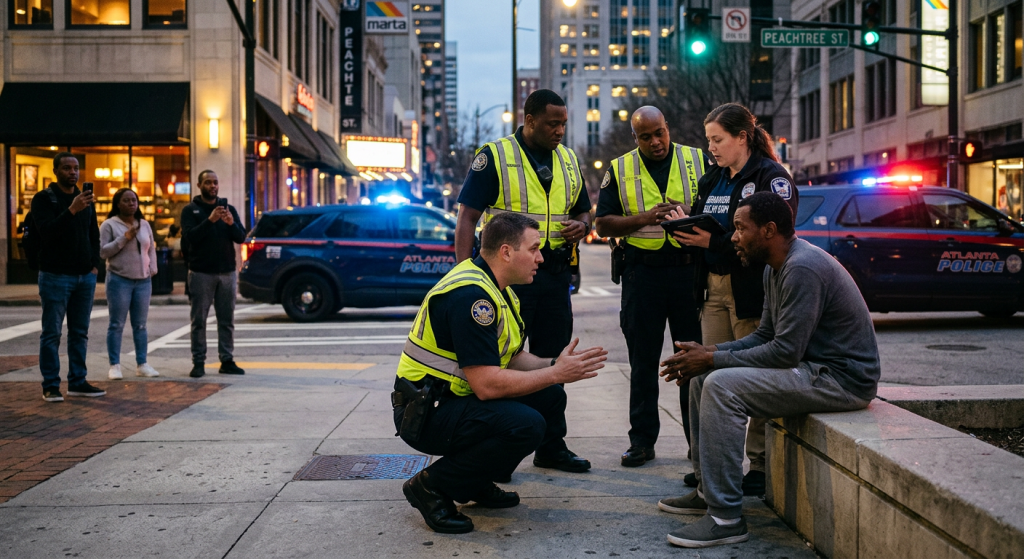
ATLANTA, GA — In the high-stakes theater of American street-level law enforcement, a routine traffic stop or a chaotic distress call can shift from compliance to catastrophe in fewer than sixty seconds.
For decades, the intersection of policing and severe intellectual or developmental disabilities (IDD) has remained one of the most volatile gaps in public safety. In municipal centers from Los Angeles to Cleveland, and across the suburban stretches of Atlanta Georgia, the blueprint for crisis response has relied on an outdated formulation: badge, gun, radio, and an expectation that a patrol officer can double as a clinical psychologist.
Now, a multi-jurisdictional investigative look reveals a quiet but aggressive push by technological disruptors to rewrite this script. At the center of this movement is a novel framework known as GoVia: Highlight A Hero.
Led by founder and CEO Georgio Sabino (GS3), the initiative aims to force a structural shift. By leveraging high-speed mobile architecture, real-time “tele-help-health,” and deep medical record integration, GoVia seeks to inject licensed behavioral health experts directly into active police encounters before forces collide.
Yet, as the platform initiates an aggressive outreach campaign—targeting letters of intent (LOIs) across major regional entities like the Georgia Department of Behavioral Health and Developmental Disabilities (DBHDD), the Cleveland network, and Southern California infrastructure—investigators are asking the critical question:
Can software truly dismantle systemic judicial bias, or does it merely establish a digital proxy in an analog war over civil rights? “We believe so” – GS3
The Scale of the Crisis: An Analytical Reality Check
To understand the mechanics of the GoVia intervention, one must examine the baseline structural failures embedded within the American judicial apparatus.
U.S. Emergency Response & Vulnerable Populations
├── Fatal Police Encounters
│ └── ── 25% of cases involve individuals with severe mental/cognitive conditions
└── Jail Population Realities
└── ── Individuals with IDD/cognitive issues are incarcerated at 3x the civilian rate
- The Incarceration Premium: According to data compiled by the Bureau of Justice Statistics (BJS) and analyzed by Human Rights Watch, individuals with cognitive or developmental disabilities are overrepresented in U.S. jails at roughly three times the rate of the general population.
- The Lethal Margin: Empirical studies by the Treatment Advocacy Center reveal a stark reality: individuals with untreated severe mental illness or profound neurodivergence are sixteen times more likely to be killed during a law enforcement encounter than other civilians.
- The Financial Toll: Municipalities across Cuyahoga County (Cleveland), Los Angeles County, and Metro Atlanta spend millions annually resolving civil rights lawsuits stemming from poorly managed de-escalation cycles.
“The issue is an information deficit,” notes an international human rights investigator specializing in American criminal justice. “An officer arrives on a scene blind. They misinterpret a sensory-induced lack of compliance—such as an autistic individual failing to follow rapid-fire commands—as active resistance. Once that misinterpretation occurs, the escalatory ladder is locked in.”
TruthMode vs. The Street: The GoVia Protocol
The core thesis of GoVia: Highlight A Hero is to establish what developers term a “TruthMode”—a verified, real-time informational ecosystem that strips ambiguity out of a street-level crisis.
When an officer initiates an encounter, the platform alerts the system to the presence of a registered individual with specific behavioral profiles. Instead of relying solely on dispatch, the platform activates a live “tele-help-health” bridge, summoning a dedicated case worker, support coordinator, or emergency clinician to the screen in real-time.
+——————-+ Real-Time Alert +——————–+
| First Responder | ————————> | GoVia Platform |
| (On-Scene) | | “TruthMode” |
+——————-+ +——————–+
|
| Secure Telehealth
v
+——————-+ Bi-Directional FHIR +——————–+
| Hospital EHR | <———————— | On-Call Case |
| (Clinical Record) | | Worker |
+——————-+ +——————–+
For this system to survive the rigorous legal, medical, and operational demands of major city departments, it cannot operate as an isolated smartphone application. It requires absolute interoperability with existing health and municipal databases.
The Technical Backbone: EHR-Ready FHIR/HL7 Integration
The true operational test for GoVia lies in its data integration architecture. Clinical settings rely heavily on Electronic Health Records (EHR) managed by multi-billion dollar ecosystems like Epic and Cerner.
To bridge the gap between a hospital database and a police cruiser, GoVia utilizes a universal framework:
- FHIR (Fast Healthcare Interoperability Resources) APIs: By building on the latest FHIR release profiles, the platform can safely query and transmit real-time behavioral protocols, emergency contacts, and de-escalation triggers directly from clinical charts without violating stringent federal privacy standards.
- HL7 Compliance: Leveraging global HL7 messaging standards ensures the system is plug-and-play compatible with virtually any hospital’s legacy EHR infrastructure across the country.
- Data Security & Privacy: This data pipeline is built to meet strict medical compliance rules, utilizing end-to-end encryption to ensure sensitive diagnoses are only accessible to certified clinicians assisting on the call, protecting civilian privacy rights.
From Coast to Coast: The Tri-Regional Push
The expansion strategy mapped out by Sabino targets three distinct socio-political testing grounds: America’s Midwest industrial core (Cleveland), the sprawling West Coast laboratory (Los Angeles), and the deep South’s civil rights epicenter (Georgia).
[Los Angeles] [Cleveland] [Metro Atlanta]
LACDMH Framework Cuyahoga Network DBHDD Region 3 Hub
│ │ │
└───────────────────────────┼───────────────────────────┘
v
GoVia Interoperable Pilot
1. The Georgia Frontline: DBHDD Region 3
In Georgia, the push is centered on the DBHDD Region 3 Field Office, which governs the core Metro Atlanta footprint: Fulton, DeKalb, Gwinnett, Clayton, Newton, and Rockdale counties. By distributing formal Letters of Intent (LOIs) to these regional hubs, GoVia is positioning itself to latch directly onto existing state-funded NOW/COMP Medicaid waiver networks. The goal is to transform state-assigned Support Coordinators into an on-demand, virtual tactical de-escalation squad.
2. The Cleveland Context: Industrial Crisis Reform
In Cleveland, Ohio, the platform enters a landscape shaped by a long-standing federal consent decree focused on police use of force. Cleveland’s mental health infrastructure and crisis stabilization centers represent an ecosystem desperate for front-end diversion tools. Integrating GoVia here presents a direct case study in whether technology can satisfy federal oversight mandates.
3. The Los Angeles Scale: High-Volume Enforcement
Los Angeles presents the ultimate stress test. The Los Angeles County Department of Mental Health (LACDMH) operates the largest mental health network in the United States. Co-responder models like the Mental Health Alert Teams (MET) exist but are chronically understaffed. GoVia’s scalable, EHR-ready remote system aims to provide the city with a digital force-multiplier.
Fact-Check: Can Tech Mandate Judicial Fairness?
A rigorous investigative assessment requires examining the friction points between technological idealism and real-world deployment. Civil liberty advocates and criminal justice experts express cautious skepticism regarding digital de-escalation tools.
| The Promised Tech Solution | The Grounded Systemic Reality |
| Real-time clinical intervention defuses volatile behavioral health crises instantly. | Connectivity deserts and field dropouts can compromise software reliability during critical moments. 6G will better hand this. |
| FHIR/HL7 EHR integration delivers verified clinical histories directly to the scene. | Deep systemic resistance from legacy municipal IT and medical legal teams slows system adoption. |
| Objective digital profiles eliminate implicit officer bias during active stops. | Unequal distribution of waivers and diagnostic resources leaves low-income communities underrepresented. |
It requires absolute operational buy-in from the city, the state, and the investors funding the architecture. We are committed to the American people to adopt the future of tech.
The Verdict: A Bid for a More Civil Union
The initiative driving GoVia: Highlight A Hero represents a significant departure from standard post-incident judicial reviews. By embedding clinical data architecture into the exact moment of street-level contact, the platform shifts the conversation from assigning blame after a tragedy to preventing the escalation altogether.
As Georgio Sabino distributes his Letters of Intent to institutional partners in Atlanta, Cleveland, and beyond, the project stands as a high-stakes experiment in public-safety reform. If successful, this integration of healthcare standards and municipal enforcement could provide a scalable blueprint for cities nationwide. If stalled by institutional inertia, it will serve as a stark reminder that true systemic change requires more than just clean code and open APIs.
The data pipelines are laid, the EHR systems are ready, and the outreach letters have been sent. The next move belongs to the municipalities.
The convergence of GoVia’s seamless FHIR/HL7 data pipelines with the frontline expertise of DBHDD case workers transforms a sterile medical standard into a literal lifeline on the street. As this tri-regional alliance takes root, it answers President John F. Kennedy’s call to civic duty—“Ask not what your country can do for you—ask what you can do for your country”—by building a more compassionate, civil union, one safe encounter at a time.