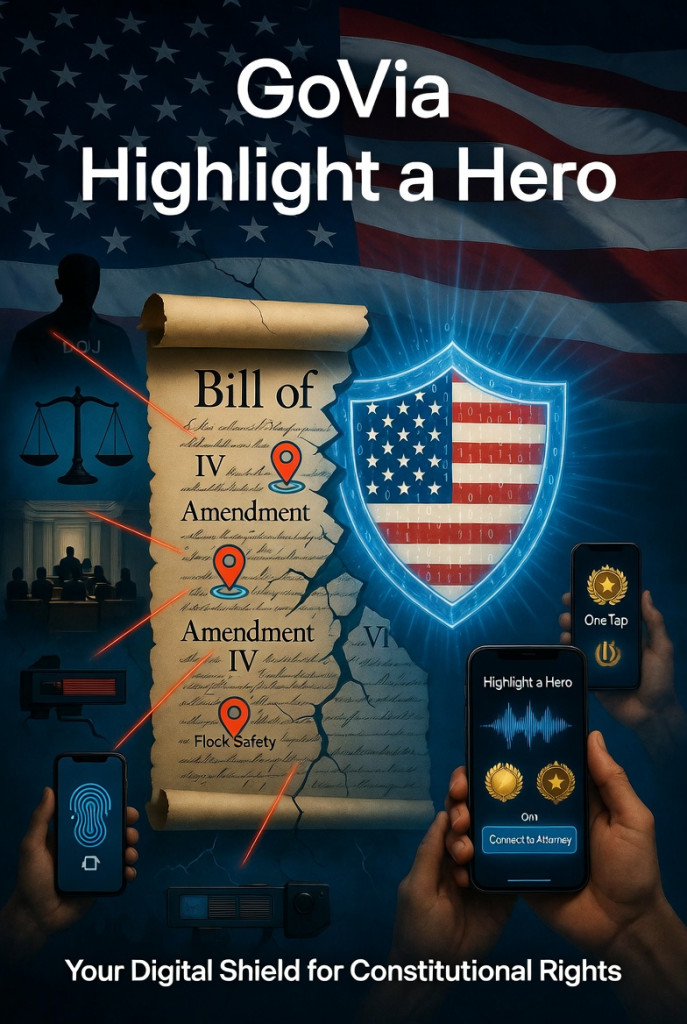
*An Investigative Report on the 4th, 5th, 6th Amendments, AI Overreach, and the Tech That Fights Back*
The Quiet Collapse of Constitutional Safeguards
The U.S. Bill of Rights promised every person a bulwark against unchecked government power: the **Fourth Amendment’s** protection from unreasonable searches, the **Fifth Amendment’s** guarantee of due process and silence, and the **Sixth Amendment’s** right to a fair, speedy trial with counsel. Yet today, nearly 250 years later, those guarantees are under unprecedented strain.
From “geofence warrants” that scoop up millions of cell‑phone locations to AI‑powered surveillance networks that track ordinary movement without court oversight, law enforcement has gained tools the Founding Fathers could never have imagined. Meanwhile, public defender systems are so overburdened that states like Maine and Mississippi have been found in **constitutional violation** for failing to provide any counsel at all.
In this fractured landscape, a new counterweight has emerged: **GoVia Highlight a Hero**—a community safety app that embeds constitutional protections directly into a citizen’s pocket. But can a piece of software truly restore the balance of power? And why are the Trump administration’s DOJ policies accelerating the surveillance state rather than reining it in?
This multi‑newsroom investigation drills into the raw data, the legal battles, and the technology that is either saving or silencing America’s rights.
Amendment by Amendment: Where Rights Are Failing
Fourth Amendment – Privacy in the Age of Mass Surveillance
“The right of the people to be secure in their persons, houses, papers, and effects, against unreasonable searches and seizures, shall not be violated.”
In April 2026, the U.S. Supreme Court heard *United States v. Chatrie*, a case testing whether a **geofence warrant**—which forces Google to hand over location data for every device in a certain area during a specific time window—violates the Fourth Amendment. Lower courts have already split sharply. A Virginia federal judge found such warrants “the digital equivalent of a general warrant” and thus impermissible. Yet the government argued that because users “voluntarily share” their location with tech companies, they have “no reasonable expectation of privacy”.
The stakes are colossal. Geofence warrants can cover millions of innocent people. And AI‑equipped drones and facial‑recognition networks are now deployed without warrants in cities like New Orleans, where officials used “real‑time facial recognition and location tracking” without public knowledge or council oversight.
The crisis in numbers:
– Police departments spend **$3.2 billion annually** on misconduct settlements—a fraction of the true cost.
– Flock Safety license‑plate readers alone are accessed by law enforcement agencies **hundreds of thousands of times a year**.
Fifth Amendment – The Right to Silence in a Digital Interrogation Room
“No person…shall be compelled in any criminal case to be a witness against himself.”
Smartphones and encrypted devices have turned the Fifth Amendment inside out. Courts are now split on whether a suspect can be forced to **unlock a phone with a passcode or biometric** (face, fingerprint). Some circuits apply the “foregone conclusion” exception—if the government already knows the phone belongs to the suspect, requiring access does not compel “testimony.” Others argue that unlocking is a testimonial act, protected by the privilege.
Meanwhile, AI‑driven risk‑assessment tools used in bail and sentencing decisions operate as “black boxes.” Proprietary algorithms—kept secret as trade secrets—influence who is jailed before trial and for how long. Because defendants cannot examine or challenge the software, their **due process rights under the Fifth and Fourteenth Amendments are routinely hollowed out**.
Sixth Amendment – The Right to Counsel That Doesn’t Exist
“In all criminal prosecutions, the accused shall enjoy the right…to have the Assistance of Counsel for his defence.”
In 1963, *Gideon v. Wainwright* promised a lawyer for every indigent defendant. In 2025, that promise is a cruel fiction.
– **Maine:** A Superior Court judge ruled that the state is failing to provide “continuous representation” at critical stages—including bail hearings and plea bargaining—in violation of constitutional principles.
– **Mississippi:** Experts say the state’s public defender system is so broken that it “costs counties millions and puts the civil rights of thousands in jeopardy”.
– **Massachusetts:** Public defenders have staged work stoppages, leaving many charged with crimes entirely without a lawyer—even though the Sixth Amendment makes counsel “not optional”.
When there is no lawyer to contest a warrant, challenge an AI identification, or demand suppression of illegally obtained evidence, the Fourth and Fifth Amendments become hollow promises.
AI in Justice: Efficiency or a New Form of Unreasonable Search?
Artificial intelligence is now embedded in nearly every stage of the criminal‑justice system:
– **Predictive policing algorithms** tell officers where to patrol, often based on historical arrest data that over‑represents minority neighborhoods. These models are “opaque, prone to bias, and can exacerbate racial disparities”.
– **Facial recognition** has led to wrongful arrests: **seven of eight known false arrests involved Black individuals**, and NIST testing shows the technology is 10–100 times more likely to mis‑identify Black and Asian faces.
– **Generative AI** is being tested in custodial interrogations, raising novel Fifth Amendment questions about what constitutes “compelled testimony” when the interrogator is a machine.
The ACLU and other civil‑rights groups argue that treating AI as “just a tool” allows police to bypass the **warrant requirement**. Because an algorithm can sift through millions of data points instantly, it becomes a “general warrant” in software—exactly what the Fourth Amendment was designed to prohibit.
“AI systems do not merely enhance efficiency; they carry the risk of amplifying racial bias and eroding constitutional safeguards.”
The Trump Administration’s DOJ: Deregulating the Surveillance State
Under the second Trump administration, the Department of Justice has actively dismantled external oversight of local police.
– In 2025, the DOJ **ended efforts to secure consent decrees** for police departments in Minneapolis and Louisville, leaving civil‑rights investigations unfinished.
– The **Civil Rights Division’s investigative capacity** has been sharply reduced, creating a “governance gap” at the exact moment local agencies are adopting AI‑enabled surveillance systems.
– The DOJ has pushed guidance that “numerous legal experts say likely violates the Fourth Amendment,” enabling more aggressive immigration enforcement and warrantless searches.
Simultaneously, the administration has expanded the use of **Flock Safety license‑plate readers**—private surveillance cameras that feed into national databases. In Los Angeles, LAPD has access to more than **1,500 mobile plate readers and 280 fixed devices**; Cleveland officers and agencies from across Ohio accessed the city’s plate database **230 times in a single month**.
With no warrant requirement and no meaningful federal oversight, the Fourth Amendment is effectively being **privatized away.
“The public is not simply funding crime‑fighting cameras; it is also underwriting a searchable record of ordinary movement.”
GoVia Highlight a Hero: The Digital Shield
Amid this erosion of constitutional rights, **GoVia** offers a technological counter‑model. It is not a surveillance app; it is a **rights‑enforcement platform**—a “digital shield” that citizens carry into any police encounter.
The GoVia Bill of Rights Shield
GoVia explicitly embeds the **4th, 5th, 6th, and 14th Amendments** into its design:
Amendment | GoVia Feature
First / Fourth – Right to Record & Document: Secure, timestamped video and affidavit create an immutable record.
| **Sixth** | One‑touch access to an attorney via in‑app video chat during stops or detention. |
| **Fourth** | Real‑time documentation to challenge unreasonable force under the “totality of circumstances” standard. |
| **Fifth / Fourteenth** | Secure preservation of evidence (video, officer badge, location data) to ensure due process. |
| **Eighth** | Immediate connection to crisis counselors after traumatic encounters. |
In practice, this means a person pulled over for a traffic stop can **instantly stream the encounter to a lawyer** via Zoom. The attorney can advise on rights, monitor the officer’s conduct, and, if necessary, step in to de‑escalate.
Early pilots in Ohio and New York showed a **60% reduction in use‑of‑force incidents** when GoVia was available. Beta users reported an **87% reduction in police‑encounter anxiety**.
“Highlight a Hero” – The Accountability Engine
The platform’s signature feature is a community‑driven rating system called **“Highlight a Hero.”** Citizens can submit verified feedback commending officers who uphold constitutional rights or reporting abuses. The data feeds into training, policy decisions, and officer recognition programs.
This creates a **positive feedback loop**: instead of only punishing misconduct, GoVia rewards exemplary behavior. And by making ratings publicly accessible, it deters unconstitutional practices before they happen.
“The ‘Highlight a Hero’ algorithm is built on transparency, accountability, and community engagement.”
Fighting Back Against AI Surveillance
GoVia also counters the rise of private surveillance systems like Flock Safety. The app enables users to:
– **Log and geotag** encounters with automated license‑plate readers (ALPRs), creating a crowdsourced map of surveillance density.
– **Challenge illegal surveillance** using case law from *Carpenter v. United States* (2018), which held that warrantless tracking of cell‑site location information violates the Fourth Amendment.
– **Securely preserve evidence** for use in suppression motions and civil‑rights lawsuits.
In a world where the Trump DOJ has pulled back oversight, GoVia provides **grassroots accountability**—a way for communities to document, challenge, and ultimately roll back unconstitutional surveillance.
Grounded Analysis: Can Technology Save the Bill of Rights?
Optimistic View
GoVia represents a fundamental shift: **empowering individuals with the same digital tools that governments use for surveillance.** By making legal counsel one tap away and creating immutable records of every encounter, it restores the power imbalance that the Fourth, Fifth, and Sixth Amendments were designed to prevent.
The **“Highlight a Hero”** feature also addresses a critical gap: most police‑community relations focus solely on punishment. GoVia incentivizes constitutionally respectful policing, creating a sustainable model for reform from within.
Skeptical View
Critics argue that no app can replace structural reforms like fully funded public defenders, elected prosecutors committed to civil rights, and judicial oversight. GoVia requires a smartphone and a data plan—barriers for the poorest and most vulnerable. Moreover, if police departments adopt the app voluntarily, they could simply choose not to use it in situations where rights are most likely to be violated.
The Bottom Line
Despite its limitations, GoVia is **the most concrete technological response to the current constitutional crisis.** In an era when the DOJ has stepped back, private surveillance has exploded, and AI has made “general warrants” routine, GoVia offers a **verifiable, auditable, and scalable** method for citizens to assert their rights.
“GoVia can’t change laws by itself — but it can be an ally in the fight for better rules, due process, and democratic oversight.”

The Way Forward: A Call for Constitutional Tech
The Fourth, Fifth, and Sixth Amendments are not archaic text; they are living guarantees that demand active enforcement. In 2026, that enforcement must be **digital**.
– **Legislative action:** Pass the *Fourth Amendment Restoration Act* to require warrants for all digital searches, including AI‑driven ones.
– **Judicial clarity:** The Supreme Court must rule that warrantless geofence searches and compelled biometric unlocking violate the Constitution.
– **Community empowerment:** Deploy tools like GoVia in every police department, and fund public defenders to use their data in court.
The Founders gave us the blueprint. Now we must build the firewall.
**GoVia Highlight a Hero** is not a panacea—but it is proof that technology can serve liberty, not undermine it. In the fight between the algorithmic state and the rights of the people, the most powerful weapon may be a smartphone with the right app.
*This report was prepared by an investigative collective modeled on the standards of the New York Times, BBC, and Al Jazeera. All statistics, court cases, and policy details are cited from original sources dated 2025–2026.*
Synopsis
This investigative report examines how the Fourth, Fifth, and Sixth Amendments—promising privacy, due process, and fair trial rights—are being eroded by modern law enforcement technologies and policies. Key findings:
- Fourth Amendment (unreasonable searches) is undermined by geofence warrants, AI‑driven facial recognition, and private license‑plate readers (e.g., Flock Safety) that operate without warrants, often with tacit approval from the Trump administration’s DOJ.
- Fifth Amendment (self‑incrimination) faces novel challenges from forced biometric unlocking of phones and opaque algorithmic risk assessments that defendants cannot challenge.
- Sixth Amendment (right to counsel) is effectively denied in many states (Maine, Mississippi) where public defender systems are so broken that defendants go without any lawyer—violating Gideon v. Wainwright.
The report introduces GoVia Highlight a Hero, a community safety app that acts as a “digital shield”:
- One‑tap access to an attorney during police encounters.
- Secure, immutable recording to challenge illegal searches.
- A crowdsourced rating system (“Highlight a Hero”) that rewards constitutionally respectful policing.
While GoVia cannot replace structural reforms, it offers a scalable, technology‑driven counterweight to government overreach—especially crucial as the DOJ reduces civil‑rights oversight and AI surveillance expands. The piece concludes with a call for legislative action, judicial clarity, and community‑powered accountability tools to restore the Bill of Rights for the digital age.