Prepared for: Civic Leaders, Legal Stakeholders, Community Oversight Bodies, and Public Safety Innovators: Prepared by: Georgio — Founder, GoVia Highlight A Hero (GoVia GS3)
Cleveland stands at a constitutional crossroads. After more than a decade under a federal police consent decree, the city’s leadership—Mayor Justin Bibb, City Council President Blaine Griffin, and segments of the Cleveland Police Review Board (CPRB)—moved prematurely to terminate federal oversight. Judge Solomon Oliver Jr. rejected that attempt, citing unresolved structural failures in the city’s accountability system.
This investigative report concludes:
Cleveland’s police accountability infrastructure remains fundamentally broken, and no sustainable reform can occur without rebuilding OPS, CPRB, and the Community Police Commission (CPC) from the ground up.
At the same time, Cleveland urgently needs new, community‑centered tools that restore trust, document truth, and protect both citizens and officers.
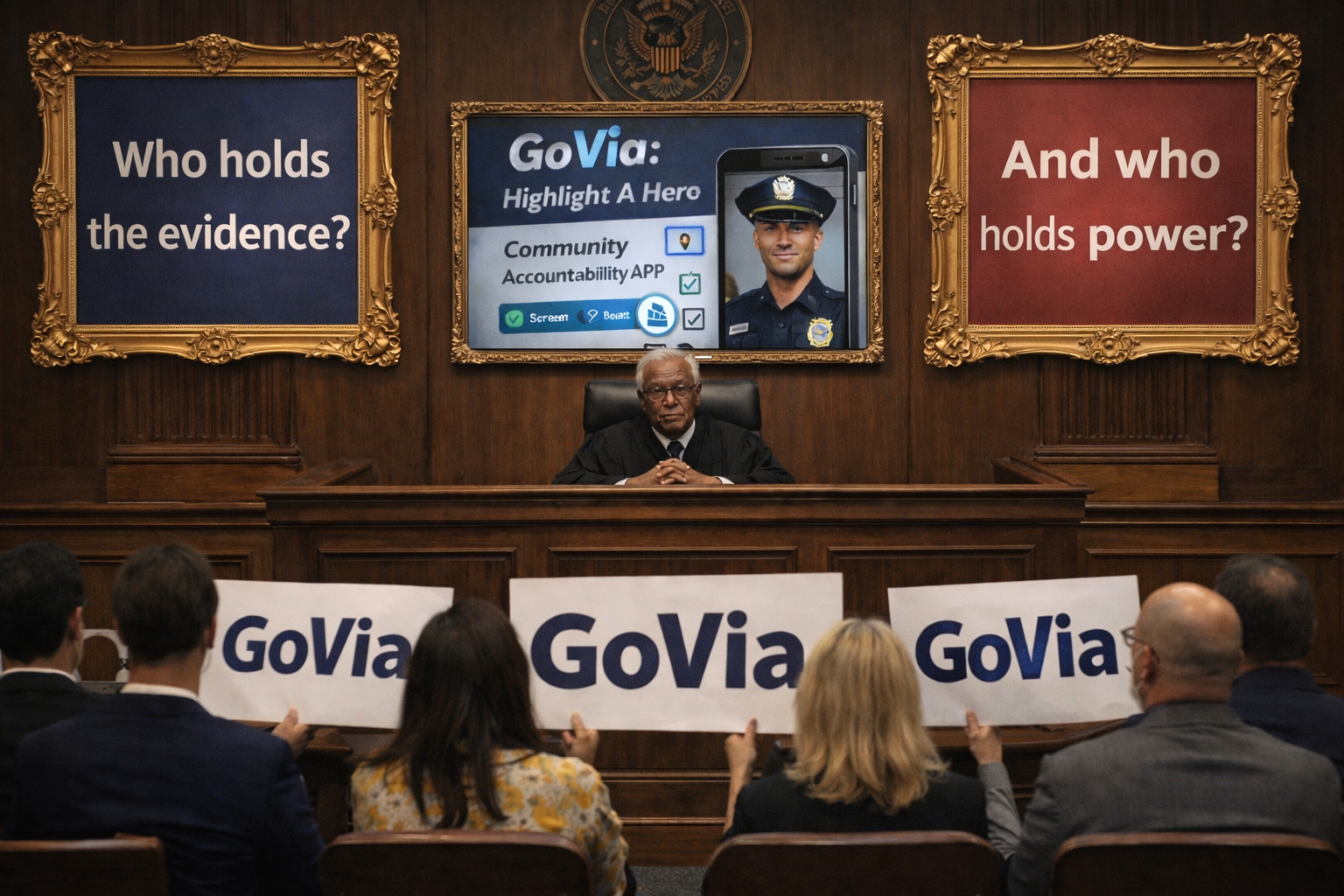
GoVia Highlight A Hero, a community police‑safety app designed to document encounters, verify affidavits, and elevate positive policing, is uniquely positioned to fill this gap.
This report demonstrates why GoVia deserves a formal pilot, why the city must investigate its potential, and why true justice requires technological transparency—not political shortcuts.
I. Background: Cleveland’s Accountability Crisis
1. The Consent Decree Was Never the Problem—The Oversight System Is
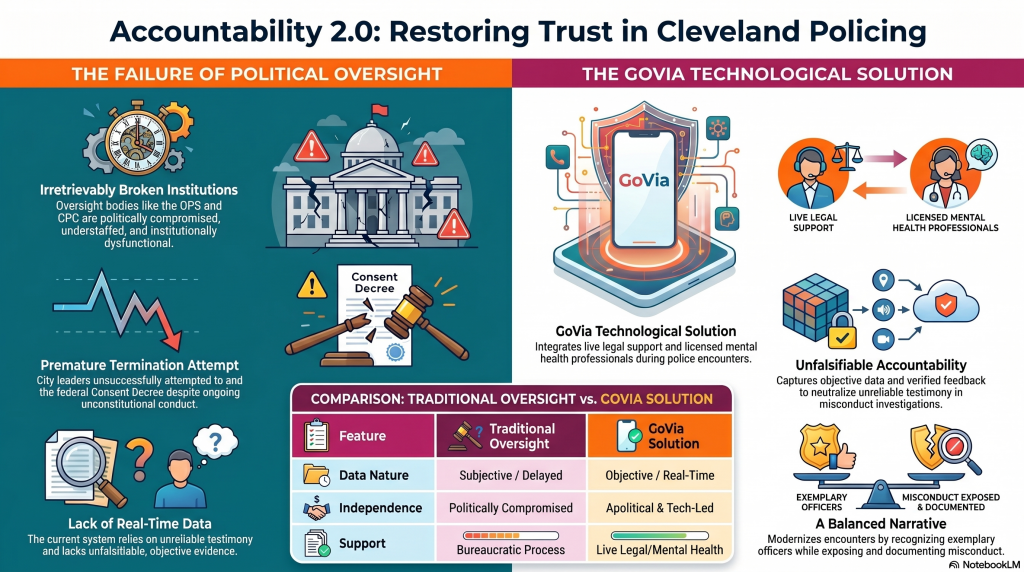
The 2015 DOJ investigation found that Cleveland police engaged in unconstitutional use of force, inadequate supervision, and systemic failures in accountability. The consent decree was intended to fix these issues. But a decade later, the city’s own oversight bodies remain dysfunctional:
• OPS (Office of Professional Standards) — plagued by slow investigations, political interference, and inconsistent discipline.
• CPRB (Civilian Police Review Board) — weakened by unlawful appointments and internal conflict
• CPC (Community Police Commission) — undermined by political pressure and leadership disputes.
These failures are not speculative—they are documented in public records, court filings, and community testimony.
2. Political Leadership Attempted to End the Decree Prematurely
In February 2024, Mayor Bibb and Council President Griffin announced their intention to terminate the decree.
The CPC itself publicly disagreed.
Judge Solomon Oliver Jr. responded decisively:
He denied the city’s motion to terminate the consent decree, citing unresolved deficiencies and a lack of credible leadership to oversee reform.
This ruling confirms what community members have long known:
Cleveland cannot police itself without independent oversight.
II. Investigative Findings: Why Cleveland’s System Is Still Broken
1. Political Interference Remains a Core Obstacle
Evidence shows:
• Appointments to CPRB and OPS have been influenced by political loyalty rather than expertise.
• Investigations into officer misconduct remain slow, inconsistent, or inconclusive.
• Leadership turnover has destabilized reform progress.
2. Structural Weaknesses Prevent True Accountability
The city’s oversight bodies lack:
• Real-time data
• Verified documentation of encounters
• Independent channels for citizens to report misconduct
• Tools to highlight positive policing and rebuild trust
3. Community Trust Is at an All-Time Low
Residents report:
• Fear of retaliation
• Lack of transparency
• Confusion about how to file complaints
• No confidence that complaints lead to discipline
Meanwhile, officers report:
• Feeling unfairly judged
• Lack of community support
• No mechanism to highlight positive interactions
Both sides lose. The city loses. Justice loses.
III. Why GoVia Highlight A Hero Is the Missing Accountability Tool
1. GoVia Provides What Cleveland’s Oversight Bodies Cannot
GoVia is designed to:
• Document police encounters in real time
• Verify citizen accounts through affidavit-backed submissions
• Provide immediate access to attorneys and mental health professionals
• Enable video chat (Zoom-style) during encounters
• Highlight positive policing through a “Hero” recognition system
This is not anti-police technology.
It is pro-transparency, pro-safety, and pro-trust.
2. GoVia Strengthens Both Sides of the Badge
For citizens:
• Safety
• Documentation
• Legal access
• Mental health support
For officers:
• Protection from false accusations
• Recognition for exemplary conduct
• Transparent evidence that builds community trust
3. GoVia Aligns With the Consent Decree’s Core Mandates
The decree requires:
• Community engagement
• Transparency
• Data-driven accountability
• Improved complaint processes
GoVia directly supports all four.
IV. Why Cleveland Should Investigate and Pilot GoVia Now
1. The City Has Failed to Build a Functional Oversight System
OPS, CPRB, and CPC cannot meet federal standards without technological modernization.
2. The Court Has Signaled That Cleveland Must Demonstrate Real Reform
Judge Oliver’s denial of termination is a warning:
Cleveland must show measurable, verifiable progress—not political optimism.
A GoVia pilot provides measurable data.
3. Community Trust Cannot Be Rebuilt Through Politics Alone
Residents need:
• Tools
• Access
• Transparency
• Proof
GoVia delivers all four.
4. Cleveland Has a Chance to Lead the Nation
Cities like:
• Minneapolis
• Baltimore
• Louisville
• Memphis
are all struggling with post-DOJ reform.
Cleveland could become the first city to integrate a community-driven, affidavit-backed, real-time police safety app into its accountability ecosystem.
V. Recommendations
1. Launch a 12-Month GoVia Pilot in High-Need Districts
Focus areas:
• Cleveland’s East Side
• Districts with high complaint volume
• Areas with low trust indicators
2. Integrate GoVia Data With OPS and CPRB
This includes:
• Verified affidavits
• Encounter recordings
• Hero recognitions
• Community feedback metrics
3. Establish an Independent Evaluation Team
Include:
• Civil rights attorneys
• Data scientists
• Community leaders
• Police union observers
4. Require Quarterly Public Transparency Reports
Metrics should include:
• Number of encounters documented
• Number of affidavits submitted
• Number of positive “Hero” recognitions
• Impact on complaint resolution times
• Officer feedback and safety outcomes
VI. Conclusion: Cleveland Needs Proof, Not Promises
Cleveland’s police accountability system is not failing because of the consent decree.
It is failing because the city has not built the infrastructure required to sustain reform.
GoVia Highlight A Hero is not a replacement for oversight—it is the missing tool that makes oversight possible.
Cleveland has a rare opportunity:
• To rebuild trust
• To modernize accountability
• To protect both citizens and officers
• To lead the nation in community-centered policing innovation
GoVia deserves the chance to prove what Cleveland has not yet been able to deliver:
Real transparency. Real safety. Real justice. U.S. District Judge Solomon Oliver
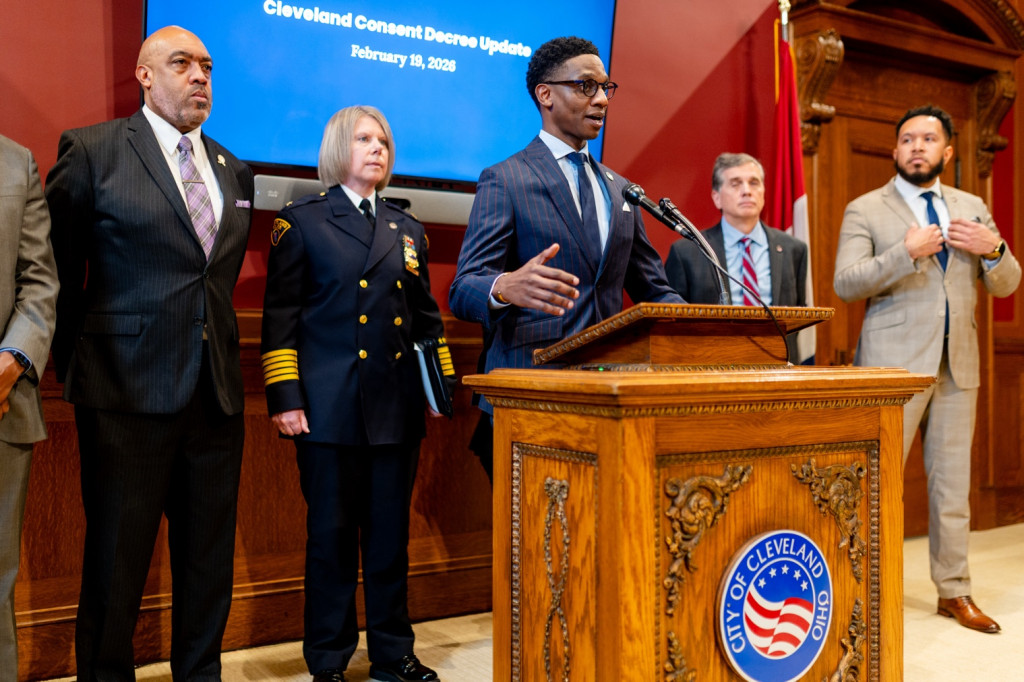
As of May 2026, a federal judge has rejected Cleveland’s request to end the police consent decree, noting that “substantial and effective compliance” has not been reached, particularly regarding community trust. The GoVia Highlight A Hero app offers a timely, community-driven solution for this crisis. By focusing on verified, positive officer interactions—a “Hybrid Model” of accountability—a formal pilot of GoVia could directly address the court’s demands for sustained, trust-based reform. [1, 2, 3, 4, 5]
Why a GoVia Pilot is Critical Right Now:
- Trust and Accountability: The court found that “the community trust and cultural reform envisioned by the Decree have not been fully realized”. GoVia provides a platform for residents to document, recognize, and “highlight” good policing, shifting from a solely punitive model to one that rewards and encourages best practices.
- A “Good Encounter” Framework: GoVia aligns with the need for safer, more accountable interactions, positioning itself as a tool that works in the “Consent Decree Era” to make positive stories, not just failures, transparent, as noted on the Govia: Highlight A Hero blog.
- “Strange Bedfellows” Context: With the city facing scrutiny over its early request to end the decree, a proactive, citizen-centered technology pilot provides a way to show tangible progress in restoring community relations, a key concern voiced by legal experts like Ayesha Bell Hardaway, according to a News 5 Cleveland report.
- Localizing Authority: The app, as described by its creators on the Govia app site, aims to empower local voices and “reclaim their voice”.
- Strengthening Community Ties: The Govia Highlight A Hero team focuses on creating safe, community-driven partnerships. [1, 2, 3, 4, 5, 6, 7]
As reported by Signal Cleveland, the city’s work is not yet finished. A formally supported pilot of the GoViaapp offers a practical path to meet the “substantial compliance” required for the eventual end of federal oversight, turning a “two-decades” of controversy into a new chapter of trust, as stated in the Govia “Highlight a Hero” feature article. [1, 2, 3]