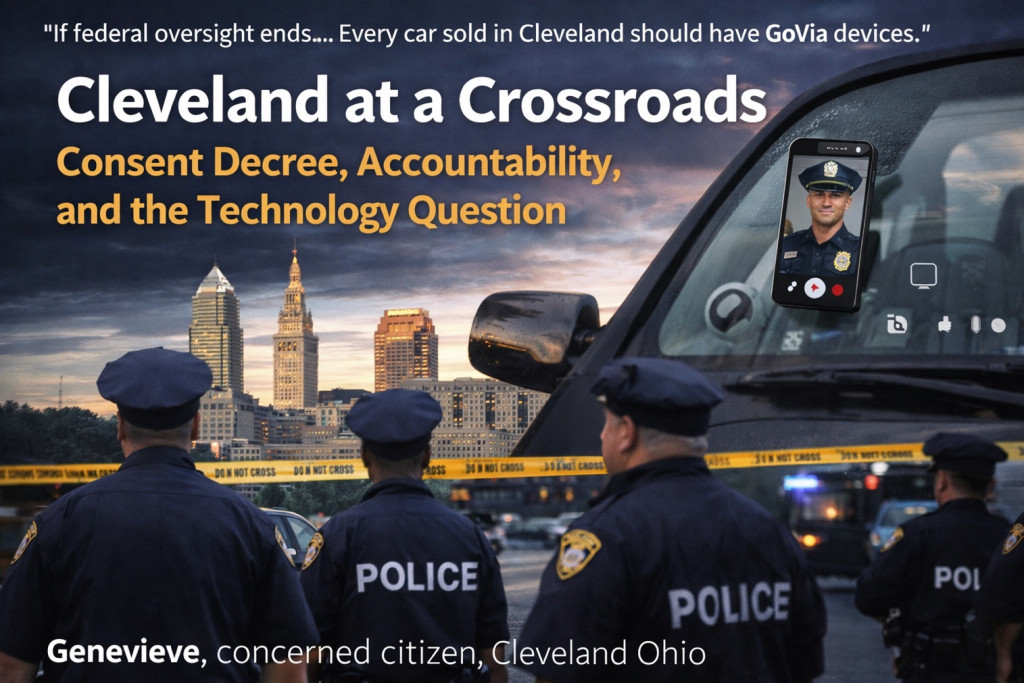
Cleveland is not ready to end federal court oversight of its police, and the court should deny the joint motion to terminate the consent decree because core issues of trust, cooperation with oversight, and community-centered technology have not been solved, only repackaged.
What is happening in Cleveland’s consent decree fight
- The Community Police Commission (CPC) has formally asked Judge Solomon Oliver to let it participate in deciding whether Cleveland’s 11‑year police consent decree should end, citing “animosity” and a “historical lack of cooperation” from City Hall toward oversight bodies.
- The city and the U.S. Department of Justice filed a joint motion to terminate the decree, arguing that reforms—especially on use of force, crisis intervention, and training—are sufficient and “durable.”
- In recent hearings, Judge Oliver has not ruled on termination and called it “very unusual” for one part of the city (the CPC) to oppose another (the mayor and law department) in court, but he acknowledged the commission’s dissatisfaction and noted that the city’s “work was unfinished.”
- The city is using the mere existence of local oversight (CPC, Civilian Police Review Board, Inspector General, Office of Professional Standards) as evidence that federal monitoring can end—even though key oversight bodies say they were excluded from the decision to move for termination and are not yet prepared to function as robust, standalone watchdogs.
This is the backdrop for GoVia Highlight A Hero: a city arguing “mission almost accomplished” while its own community oversight architecture is still fighting just to have a voice in court.
Real-world AI and justice: efficiency without fairness
Across the U.S. and globally, AI in criminal justice is being sold as turbocharged efficiency—faster case management, predictive policing, risk assessments, and digital evidence review.
But the record is sobering:
- Predictive policing systems rely on historical crime data that already reflects over‑policing in Black, Brown, and low‑income communities; when you train an algorithm on biased history, it reproduces that history at machine scale.
- AI tools used in policing and courts can quietly shape patrol deployment, surveillance priorities, and even sentencing or bail recommendations, while their methods remain opaque to defendants, defense counsel, and the public.
- Legal scholars warn that without strong legislative frameworks, standards of explainability, and independent oversight, AI systems will “aggravate injustices” and embed discrimination more deeply into policing and judicial decision‑making.
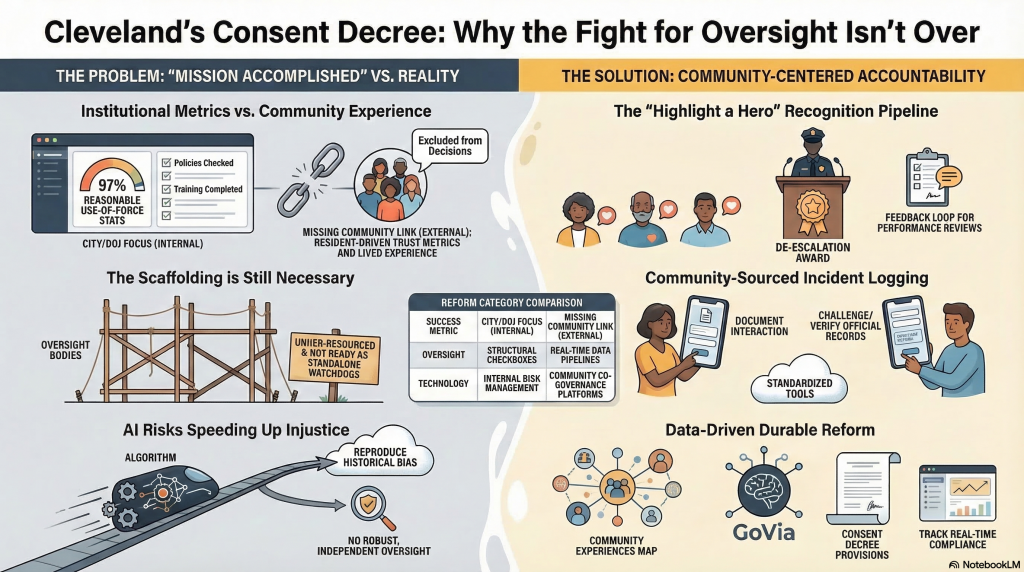
In other words: AI can speed up injustice just as easily as it can streamline paperwork.
Narrative: A city asks to be trusted
The following is written as a GoVia Highlight A Hero blog feature, in an investigative multi‑newsroom tone drawing on the facts above.
“Animosity on the record”: A city divided against itself
On a Wednesday morning in a federal courtroom, Cleveland’s policing future hinged on a word that rarely makes it into legal filings: animosity.
In a motion filed the night before, the Community Police Commission—created under the very consent decree the city now wants to shed—told Judge Solomon Oliver that City Hall’s “historical lack of cooperation” and open animus toward oversight bodies put federal withdrawal at odds with reality on the ground.
The city, standing side by side with the Justice Department, told a different story. They pointed to a monitoring report that found 97% of non‑lethal uses of force were reasonable and proportional, and argued that unconstitutional force was now the exception, not the rule. They highlighted reforms in crisis intervention, policy, and training, and said Cleveland “is not the same department that we were in 2015.”
The mayor has been clear: from his first year in office, he was “working as quickly as I possibly can to get out of” the consent decree. His legal team followed through, filing progress memos and ultimately a joint termination motion that even surprised some observers close to the process.
But the oversight bodies that will inherit the work of transformation were not in the room when the city decided to declare itself ready. The CPC was not told in advance about the plan or invited to the press conference; members of the Civilian Police Review Board say they were also left in the dark.
If the consent decree is a bridge, Cleveland’s leaders are arguing they have reached solid ground. The people charged with watching the bridge’s structural integrity are waving from below, saying they can still feel it sway.
The hidden cost of skipping over community tech
In this moment, the city and DOJ are framing reform as largely internal: policies checked, training modules completed, use‑of‑force statistics improving. The underlying theory is simple—if internal systems are fixed, external oversight can be light.
But the most neglected piece of the ecosystem is external, community‑centered infrastructure: technology that lets residents document, surface, and analyze officer conduct; mechanisms that recognize officers who de‑escalate and build trust; tools that make accountability a two‑way street, not just a disciplinary form inside headquarters.
That’s the lane where GoVia Highlight A Hero lives.
While consultants are being hired to “streamline how the city’s multiple oversight bodies interact,” no one at the podium is talking about how those bodies will meaningfully tap into lived experience, grassroots documentation, or community‑validated positive policing stories at scale.
When the city and DOJ explain why federal monitoring can end, they point to an organizational chart—the CPC, Civilian Police Review Board, Inspector General, Office of Professional Standards. What they don’t point to is a data pipeline between neighborhood reality and official decision‑making.
That omission is not an accident; it’s a choice. And it is exactly why platforms like GoVia Highlight A Hero have not yet been taken seriously enough in Cleveland’s consent decree conversation.
Why didn’t they look at GoVia Highlight A Hero?
There is no official record of the city or DOJ evaluating GoVia Highlight A Hero as part of their readiness calculus, despite its clear alignment with community‑led oversight and officer‑accountability goals.
Based on the public record and the way the termination motion has been framed, several patterns emerge:
- Reform is being measured inward, not outward. The metrics highlighted are internal: policies, training completion, and use‑of‑force percentages, not community‑side reporting, trust metrics, or resident‑driven recognition of positive policing.
- Oversight is treated as a structural checkbox. The city cites the existence of the CPC and other bodies as proof of readiness, even as those bodies themselves say they are under‑resourced, excluded from decisions, and not yet prepared to operate without the consent decree’s scaffolding.
- Technology is framed as risk, not relationship. Public discourse about tech has focused on internal systems and AI‑adjacent risk—data systems, monitoring, predictive tools—rather than platforms that shift power toward community co‑governance of safety.
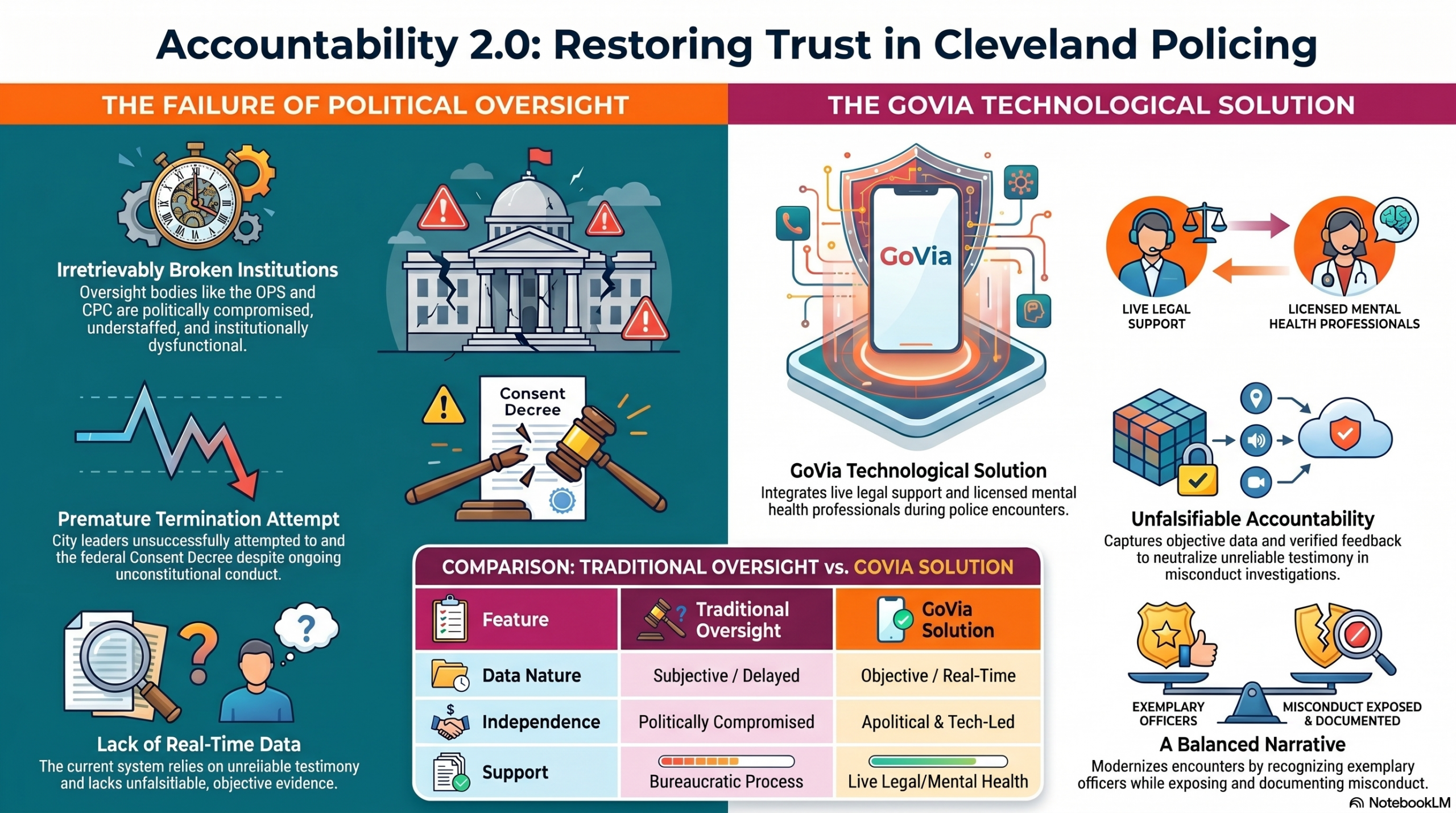
In this context, GoVia Highlight A Hero is disruptive: it doesn’t just measure officers; it recognizes them in public when they do the hard work of trauma‑informed, constitutional policing—backed by community documentation and data analysis. That cuts against a political instinct to control the narrative from the top.
The simplest answer to why GoVia hasn’t been fully brought into the process is that Cleveland’s move to end the decree has been orchestrated inside a small circle of institutional actors—City Hall, DOJ lawyers, and the monitor—while community‑side innovations and even its own oversight bodies have had to fight just to be heard.
GoVia Highlight A Hero: features built for this moment
As an elite, cross‑functional team looking at the design and implementation of public‑safety tech, the key features that make GoVia Highlight A Hero relevant to Cleveland’s next chapter include:
- Community-sourced incident logging and narratives
Structured tools for residents to document interactions with law enforcement—positive, neutral, and negative—using standardized fields, time‑stamping, geo‑tagging, and optional media uploads, creating a civilian‑side dataset that complements, and challenges, official records. - “Highlight a Hero” recognition pipeline
A workflow that lets community members nominate officers and responders for de‑escalation, procedural justice, mental health sensitivity, and restorative actions, with verification layers and tagging that feed into performance analytics and training feedback loops. - Data science and pattern analytics layer
Dashboards that aggregate both community reports and public data (complaints, use‑of‑force summaries, response times) to detect patterns in behavior, precinct culture, and community sentiment, disaggregated by neighborhood, demographic profile, call type, and time. - Trauma-informed and mental health focus
Incident‑logging fields and scoring dimensions that specifically flag crisis‑intervention quality, language used with people in crisis, referral to services, and whether co‑response models (clinicians, peers) were offered or used. - Officer and supervisor feedback loop
Tools for officers and supervisors to see anonymized patterns in community feedback, access curated success stories, and integrate those stories into roll‑call training, coaching, and performance reviews without exposing individual complainants to retaliation. - Policy and consent decree compliance indicators
Mappings between community‑reported experiences and specific consent‑decree provisions or local policies, helping oversight bodies and the public see, in near‑real time, where implementation is working and where it is drifting. - Exportable evidence packets and legal‑tech integration
Secure workflows to generate case‑ready, time‑stamped records for use in internal investigations, civil rights litigation, or administrative hearings, with chain‑of‑custody and tamper‑evident logging. - Civic storytelling and newsroom-ready reports
Narrative‑generation tools that transform aggregate data into periodic, public‑facing reports highlighting exemplary officers and surfacing emerging concerns, designed for collaboration with local media, oversight bodies, and community groups.
GoVia is on the verge of being technically complete this year and is ready to be pitched to the DOJ, the City of Cleveland, and East Cleveland as a community‑side technology asset in any path forward—continued decree, partial step‑down, or future agreements.
If the goal is durable reform, Cleveland needs tools like GoVia that make community experience and officer excellence visible in the same data frame, not just policy PDFs on a city website.
Rebuttal: Why the request to end should be denied
Using the facts now on the record, there are several grounded reasons Judge Oliver should deny, or at minimum delay, termination.
1. Oversight bodies themselves say they are not ready
- The CPC has told the court that ending the decree now will “adversely affect” its ability to oversee policing, citing the city’s lack of cooperation and “animosity” toward it and other oversight entities.
- The city did not meaningfully include the CPC or Civilian Police Review Board in its decision to seek termination, even though it points to their existence as proof that local oversight can carry the load.
If the structures you are leaning on say they can’t carry the weight yet, it is premature to take down the scaffolding.
2. Progress on force does not equal systemic readiness
- The monitor’s report that 97% of non‑lethal force incidents were reasonable is important—but it is a slice of compliance, not a global measure of culture, accountability, or equity.
- Even at the hearing where that statistic was highlighted, the deputy monitor raised concern that the Safety Director had been too lenient in disciplining officers who lied during internal investigations, underscoring persistent weaknesses in accountability.
Ending federal oversight because one set of metrics looks good while critical accountability levers remain soft almost guarantees regression once external pressure lifts.
3. AI and tech risks make robust, trusted oversight more—not less—necessary
- As AI tools and data‑driven systems enter policing, legal scholars and practitioners warn of increased risk of algorithmic bias, opaque decision‑making, and exacerbation of existing inequities in criminal justice.
- Without strong, independent oversight and community‑accessible data tools, AI can accelerate disparities in who is stopped, surveilled, or flagged as “high risk.”
Cleveland is moving toward a more data‑driven public‑safety environment at the exact moment it is asking to shed a federal framework that could impose guardrails on those tools. That is not a recipe for durable trust.
4. Community-centered solutions like GoVia have not been incorporated
- The city’s case for termination leans heavily on internal reforms and a consultant to “streamline” oversight bodies, not on the integration of community‑side technology, trauma‑informed reporting tools, or resident‑driven recognition systems like GoVia Highlight A Hero.
- The consent decree was meant to “repair community trust and protect the constitutional rights of the people of Cleveland,” a task that inherently requires infrastructure that captures and amplifies community voice.
Until platforms like GoVia—designed to operationalize resident experience, highlight positive policing, and generate usable oversight data—are woven into Cleveland’s oversight ecosystem, claims of “durable” reform are incomplete.
5. The process itself undermines the trust the city claims to have rebuilt
- The mayor once campaigned on strengthened oversight under Issue 24, but later shifted toward “retooling” the system and moved quickly toward ending the consent decree, unsettling advocates who feel he has turned away from the oversight he endorsed.
- Even the timing and abruptness of the motion to terminate—filed shortly after behind‑the‑scenes DOJ discussions—raised red flags, with some observers suggesting the mayor had received “bad advice” to move so fast.
A consent decree is not just about metrics; it is about process, transparency, and demonstrating that community voices matter at critical turning points. On that score, Cleveland’s current approach is failing its own test.
A path forward: Keep the decree, center community and data
From an investment‑banker’s risk lens, a premature exit from federal oversight threatens reputational, litigation, and financial risk if abuses resurface. From a public‑finance perspective, the marginal cost of additional years of monitored reform may be dwarfed by the costs of future lawsuits and lost trust. From a govtech and legal‑tech lens, the opportunity cost of not onboarding platforms like GoVia Highlight A Hero is enormous: the city forfeits a chance to build co‑governance infrastructure that could make future oversight less adversarial and more collaborative.
The court has options that do not trap Cleveland in stasis:
- Keep the consent decree in place with explicit benchmarks for integrating community‑side tools like GoVia, strengthening CPC independence, and tightening AI/tech accountability.
- Require a public, data‑rich implementation plan that shows how community reporting, officer recognition, and AI oversight will function after federal withdrawal.
In that future, GoVia Highlight A Hero is not an afterthought; it is part of the city’s core risk‑management and trust‑building architecture—connecting residents, officers, oversight bodies, and data in one shared narrative of safety and accountability.