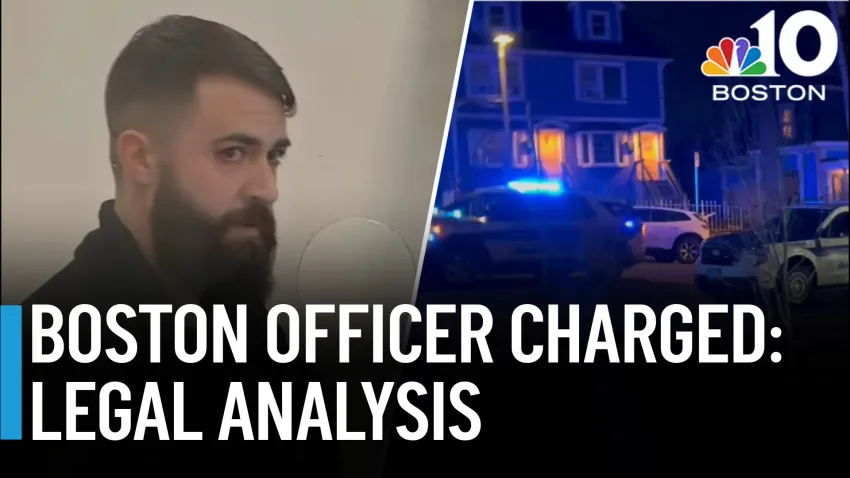
An investigative synthesis: Boston police officer Nicholas O’Malley charged with manslaughter – NBC Boston
I. BOSTON: THE MOMENT BEFORE THE SHOTS
In Boston, a routine response to a reported carjacking escalated into a fatal officer-involved shooting—now at the center of a manslaughter prosecution that could redefine the boundaries of police discretion in high-speed, high-stakes encounters.
Officer Nicholas O’Malley, according to charging documents and defense statements, confronted a suspect seated in a stolen vehicle. Commands were issued. A Taser was drawn. The suspect reversed, striking an unoccupied cruiser, then maneuvered and accelerated forward. O’Malley fired three rounds.
The suspect died. Video
What happened in the fractions of seconds between perceived threat and trigger pull is now the subject of legal, forensic, and public scrutiny.
- Prosecutors’ claim: No objective imminent threat justified deadly force.
- Defense argument: The vehicle was used as a weapon; the officer feared for his life and his partner’s.
The body camera footage remains unreleased, leaving a vacuum filled by competing narratives—a recurring feature in modern policing controversies.
II. THE NATIONAL CONTEXT: DATA VS. PERCEPTION
Across the United States, officer-involved shootings (OIS) remain both statistically rare and politically explosive.
- According to The Washington Post police shooting database, over 1,000 fatal police shootings occur annually in the U.S.
- Vehicles are a documented factor in a subset of these cases, often categorized as “vehicle-as-weapon” incidents, where legal standards remain contested.
- The U.S. Supreme Court, in Tennessee v. Garner, established that deadly force is only justified when a suspect poses a significant threat of death or serious physical harm.
But translating that legal standard into real-time judgment—under stress, uncertainty, and limited visibility—is where cases like Boston fracture into ambiguity.
Research from the Police Executive Research Forum shows that reaction times under threat can be measured in milliseconds, while cognitive processing under stress often lags behind unfolding events.
Body cameras, often seen as neutral arbiters, introduce another layer of distortion. Studies have shown that camera perspective narrows field of view and flattens depth perception, meaning what jurors later see may not reflect what officers perceived.
III. A PATTERN OF EDGE CASES: WHEN FORCE BECOMES CRIME
The Boston case is not isolated—it sits within a broader continuum of use-of-force incidents where legality hinges on timing, proportionality, and restraint.
Kentucky: When the Threat Ends—but Force Continues
Former Kentucky State Trooper Hayden Kilbourne’s conviction illustrates the opposite extreme. After a suspect surrendered—hands raised, lying prone—Kilbourne struck him repeatedly and issued death threats.
- Outcome: guilty plea to 2nd-degree assault and terroristic threatening
- Legal principle: once compliance is achieved, force must immediately cease
Virginia: When Hesitation Could Mean Death
In Fairfax County, February 2026, officers entered a domestic violence scene and encountered a man—later identified as Chhatra Thapa—holding a knife over victims.
Commands were issued. The suspect raised the weapon.
An officer fired five rounds.
Two victims were already dead. The shooting likely prevented further قتل.
- Legal interpretation: textbook justified use of deadly force
- Tactical takeaway: decisive action in imminent lethal threat scenarios
IV. THE FRACTURE POINT: HUMAN LIMITS IN SPLIT-SECOND DECISIONS
These three cases—Boston, Kentucky, Virginia—form a continuum:
| Scenario | Officer Response | Legal Outcome |
| Active lethal threat (Virginia) | Immediate deadly force | Likely justified |
| Surrendered suspect (Kentucky) | Continued force | Criminal conviction |
| Ambiguous threat (Boston) | Deadly force disputed | Manslaughter charge |
The Boston case lives in the gray zone—the most dangerous space in policing.
V. ENTER AI: PROMISE, PERIL, AND PRECEDENT
Artificial intelligence is increasingly entering the justice ecosystem—not as judge (yet), but as analyst, predictor, and observer.
Systems developed by companies like Palantir Technologies already assist in:
- Pattern recognition in crime data
- Predictive policing models
- Real-time intelligence aggregation
Meanwhile, risk assessment algorithms used in courts—such as COMPAS—have faced criticism for racial bias and lack of transparency, as highlighted by investigations from ProPublica.
The central question remains:
Can AI reduce ambiguity—or will it encode and amplify it?
In use-of-force scenarios, AI could theoretically:
- Analyze trajectory, distance, and motion in real time
- Provide threat-level scoring
- Alert officers when deadly force thresholds are not met
But critics warn that reliance on AI in life-or-death decisions risks outsourcing moral judgment to probabilistic systems.
VI. A PREVENTATIVE LAYER: WHERE GOVIA COULD INTERVENE
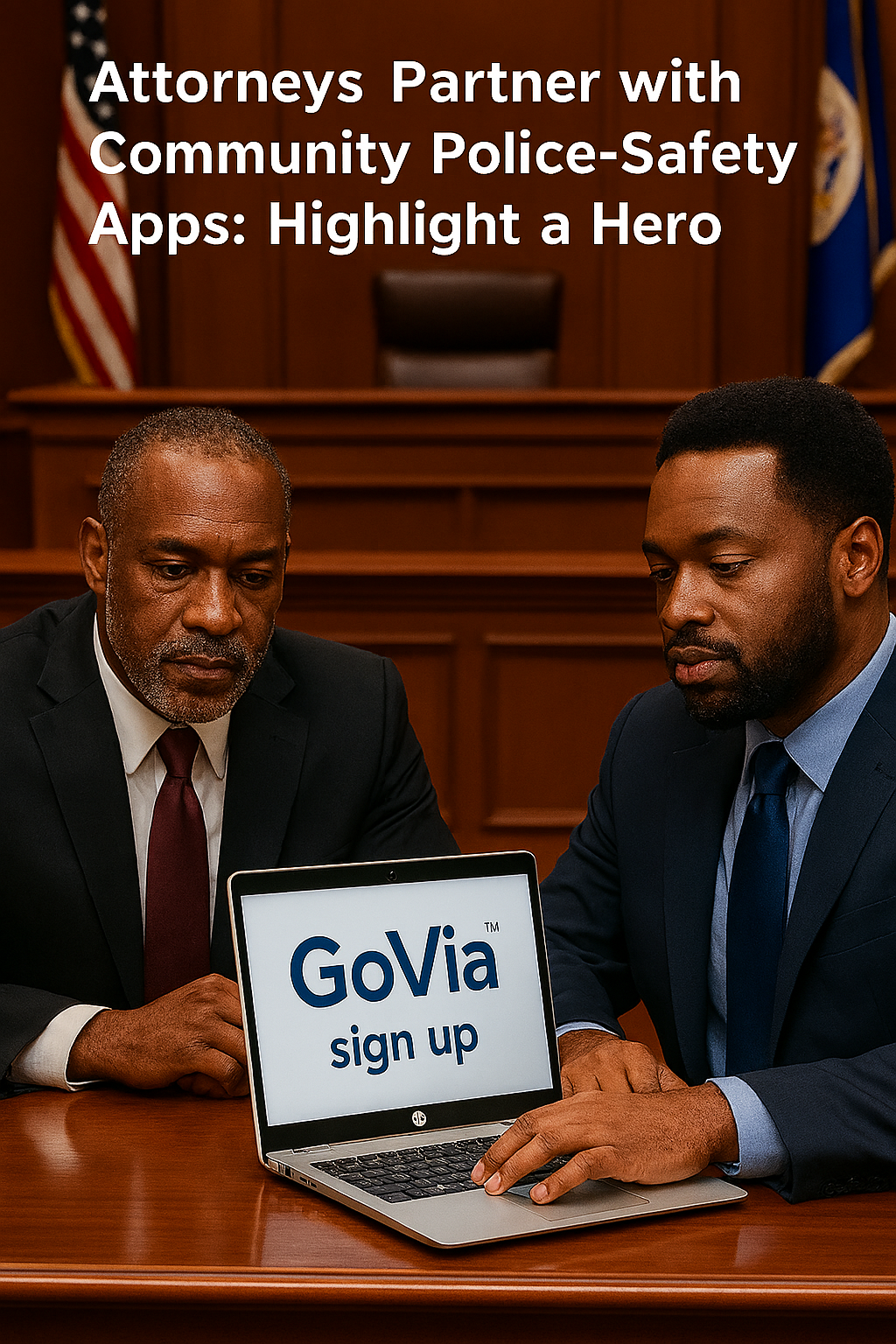
This is where platforms like GoVia Highlight A Hero enter—not as enforcement tools, but as pre-incident stabilizers and accountability frameworks.
In the Boston scenario, several intervention points emerge:
1. Pre-Encounter Intelligence & Risk Signaling
- Real-time flags for stolen vehicle incidents
- Behavioral risk indicators shared across responding units
- Could prepare officers for vehicle-as-weapon scenarios
2. Live Encounter Transparency
- Civilian-side activation: recording + live relay to trusted contacts
- Officer-side integration: synchronized data capture
- Creates dual-perspective evidence, reducing narrative gaps
3. De-escalation Prompts
- AI-assisted reminders during escalation:
- “Maintain distance from vehicle trajectory”
- “Consider repositioning vs. engagement”
4. Post-Incident Evidence Integrity
- Secure, tamper-resistant logs
- Immediate availability to oversight bodies
- Reduces delays like those seen in unreleased bodycam footage
5. Behavioral Feedback Loop
- Training data derived from real encounters
- Identifies patterns of:
- Officer-induced jeopardy
- Premature escalation
- Tactical missteps
VII. THE CORE IDEA: SAFER ENCOUNTERS
At its core, the promise is simple—but urgent:
“Safer encounters with GoVia Highlight A Hero.”
Not by replacing officers.
Not by second-guessing in hindsight.
But by expanding awareness in the moment where everything is at risk.
VIII. THE HARD TRUTH
Even with AI. Even with apps. Even with perfect policy:
There will always be a moment where a human being must decide—
in less than a second—
whether another human being lives or dies.
The Boston case is not just about one officer.
It is about a system that asks individuals to perform near-impossible judgments under irreversible conditions.
IX. WHAT COMES NEXT
If prosecutors succeed, the case could:
- Narrow legal tolerance for vehicle-related deadly force
- Increase criminal liability for split-second decisions
- Accelerate demand for technological safeguards
If the defense prevails, it may reaffirm:
- Broad discretion under perceived threat
- Continued reliance on officer judgment over algorithmic input
Either way, one reality is becoming unavoidable:
The future of policing will not be decided by officers or courts alone—
but by the systems that surround them.
GoVia’s FINAL NOTE
The difference between a justified shooting, a criminal charge, and a saved life is often measured in seconds, perception, and information.
And in that gap, the question is no longer whether technology should play a role—
but how responsibly it will be built, deployed, and trusted.