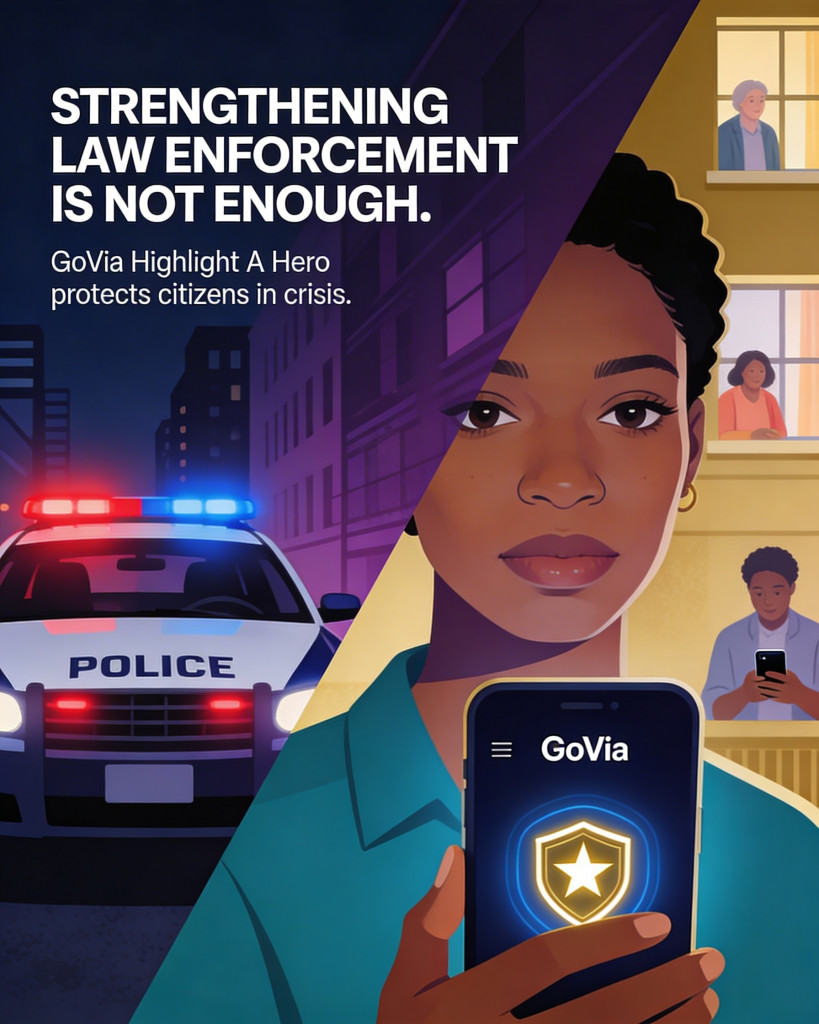
The Trump White House publicly frames “STRENGTHENING AND UNLEASHING AMERICA’S LAW ENFORCEMENT TO PURSUE CRIMINALS AND PROTECT INNOCENT CITIZENS” as a promise of safety through tougher, more protected policing, while real stories on the ground show gaps, delayed help, and deadly outcomes in moments of crisis—exactly the gap a tool like GoVia Highlight A Hero is built to fill.whitehouse+3
What the White House says
The Executive Order “Strengthening and Unleashing America’s Law Enforcement to Pursue Criminals and Protect Innocent Citizens” declares that safe communities rely on a “tough and well-equipped police force” and that the administration is “steadfastly committed” to empowering state and local law enforcement. It directs the Attorney General to expand training, increase officer pay and benefits, strengthen legal protections, push for tougher sentences for crimes against officers, and increase the flow of surplus military equipment to local police. The policy narrative says crime rises when leaders “demonize law enforcement” and impose “legal and political handcuffs,” and that reversing that dynamic—giving police more latitude and backing—will restore safety for “innocent citizens” and small business owners. The White House also touts big-picture statistics, citing sharp drops in violent crime in major cities in 2025 to claim that the strategy is “returning our nation to law and order.”whitehouse+2
What is really happening on the ground
On the ground, ordinary people experience safety not as a White House fact sheet but as a 911 call that may come too late, or bring the wrong kind of help. One powerful example: in New Hampshire, 17‑year‑old Mischa Fay’s family called police repeatedly for help with his deteriorating mental health; on New Year’s Day 2023, officers arrived at their home and within roughly two minutes one officer fired a Taser and a sergeant fatally shot Mischa in the chest. Records show police had been called to that home six times before to deal with his mental health struggles, but despite newer de‑escalation training, the system still turned a plea for help into a fatal encounter. Advocates in that investigation concluded that “police are not supposed to be responding to people in mental crisis,” calling it a public health issue being handled with tools—guns, Tasers, armored vehicles—that too often produce violence instead of care. At the same time, in other cases families describe growing reluctance by law enforcement to even respond to complex mental‑health calls, leaving them to manage violent or suicidal behavior alone when no alternative rapid‑response system exists.mindsitenews+1
Where technology already changes outcomes
When the right tools connect civilians and law enforcement, the results can be dramatically different. Police departments using community‑engagement and tip apps are already seeing that real‑time, citizen‑driven information can solve crimes quickly and build trust. In Panama City, Florida, police used a mobile engagement platform to push a safety alert with images of a suspect in a credit‑card fraud case; anonymous tips poured in through the app and the suspect was arrested within days. In Atlantic City, New Jersey, officers used a similar system to ask for help identifying a shooting suspect; tips submitted through the app helped them track the individual and charge two people with assault and weapons offenses within about 48 hours. A sheriff’s office in Parker County, Texas, reports that tips through its mobile app—dozens of anonymous submissions after a press release—led investigators to locate and arrest a suspect in a string of vehicle burglaries within hours, and then identify and find a second suspect. More broadly, public‑safety app platforms that integrate with police dispatch and records systems are showing that when citizens can report issues instantly from their phones, agencies can respond faster, solve crimes more quickly, and strengthen partnerships with the communities they serve.365labs+1
Why GoVia Highlight A Hero is crucial in this moment
In this administration’s law‑and‑order framework, citizens are mostly spectators—people to be “protected” by empowered officers—yet the real‑world stories show that safety breaks down exactly where the system loses sight of the human being in crisis. GoVia Highlight A Hero flips that script by putting a structured, documented, citizen‑centered channel into the heart of an emergency, so that when a parent, teen, or bystander hits the app, they are not just screaming into a 911 void but sending rich, time‑stamped, shareable context that can shape what happens next. Existing public‑safety tools prove that mobile apps can drive arrests and rapid interventions; a platform like GoVia extends that logic beyond “catch the suspect” toward “keep this person alive,” preserving evidence of what was said and done, flagging when a situation is medical or mental‑health‑driven, and spotlighting officers and neighbors who choose de‑escalation over escalation. In a climate where the federal government is increasing legal shields and military‑style support for law enforcement, communities need a parallel tool that records reality on the ground, rewards genuine heroism, and gives vulnerable people a faster, clearer way to cry out for help and be believed in real time. That is the buzz—and the urgency—around GoVia Highlight A Hero: it is a citizen‑driven safety net that matches this administration’s rhetoric on “protecting innocent citizens” with the practical, lived‑experience infrastructure those citizens have never needed more.whitehouse+5