A Deep-Dive Story of the Tower City Incident, Its Roots in Cleveland’s Troubled History, and the Technology That Could Change Everything
Based on reporting by Carlos Miller, Atlanta Black Star (April 18, 2025), and supplementary research into Cleveland’s consent decree, use-of-force data, and GoVia’s platform capabilities.
Prologue: Saturday at the Mall
Tower City Center sits at the heart of downtown Cleveland, Ohio — a grand old structure of stone and light, anchored by a transit hub and ringed by the kind of stores teenagers love. On a Saturday in March 2025, a young man we’ll call Marcus was there doing what teenagers do: moving through the world, minding his business, dreaming of college, dreaming of basketball.
Marcus was a dedicated student-athlete with good grades and aspirations to attend college. He played on an Amateur Athletic Union basketball team. He was the kind of kid coaches highlight in their programs and teachers hold up as examples. He was not involved in any disturbance. He posed no threat to anyone.
Within thirty seconds, his life would change.
Across the mall, somewhere in the crowd, a confrontation broke out — the kind of chaotic, noisy, swirling scene that security and police navigate routinely in any major American city. Officers responded. In the scramble, a female officer lost her footing and went down. It happens. Bodies move fast, floors are slick, the margin between balance and a fall is razor-thin.
What happened next is what does not happen in a just world.
Responding officers, arriving on the scene with adrenaline running and a colleague on the floor, looked for someone to blame. Their eyes landed on Marcus. One officer — still unidentified in the lawsuit filed by Marcus’s father, Theodore Jenkins Jr. — raised his baton and struck the teenager in the head.
The female officer, still on the ground, immediately tried to correct the record. She told them they had misheard her. Marcus had not tripped her. He had nothing to do with it.
The baton had already fallen.
Marcus suffered a concussion and various musculoskeletal injuries. His future — the grades, the AAU basketball team, the college dream — now runs through a lawyer’s office and a federal court.
Part I: The Lawsuit and What It Alleges
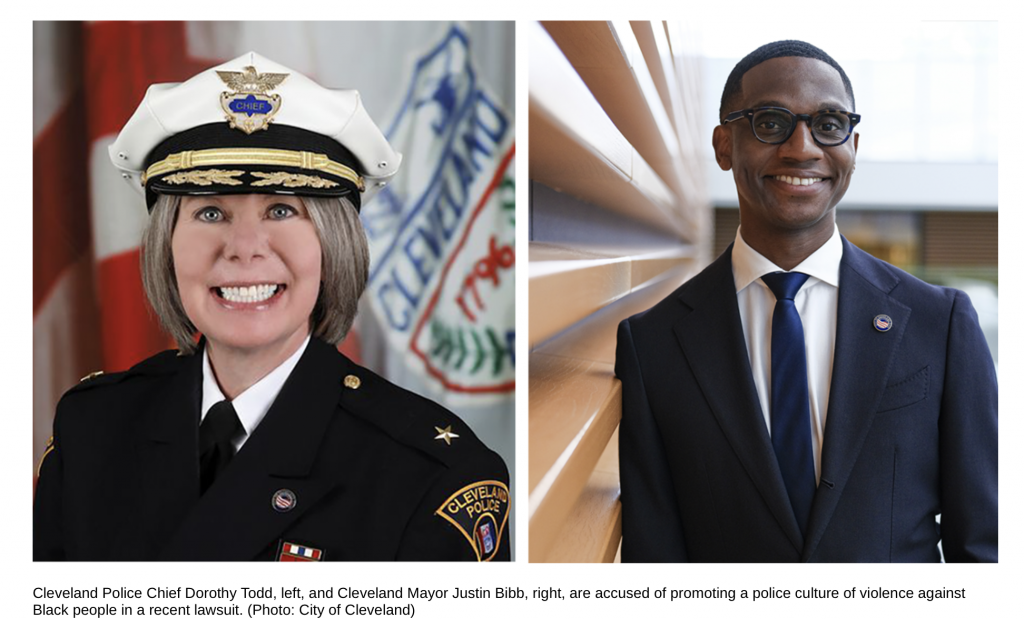
Theodore Jenkins Jr. filed suit in federal court in April 2025, naming Cleveland Police Chief Dorothy Todd and Cleveland Mayor Justin Bibb as defendants, along with the unidentified male officer designated as “John Doe.” The lawsuit alleges not only excessive force but something more systemic and damning: that the Cleveland Division of Police maintains a long-established pattern of using excessive force against Black people, violating their Fourth and 14th Amendment rights.
The lawsuit states plainly: “When Cleveland Police Officers responded to the disturbance, responding officers noticed a female police officer on the ground. Responding officers thought the female officer on the ground said Plaintiff was the one who tripped her. The responding officers then targeted Plaintiff who was not involved and posed no threat to the officers. Defendant John Doe, Cleveland Police Officer struck Plaintiff in the head with a baton even though Plaintiff did not do anything to provoke such a reaction by the officers. Right after Defendant John Doe struck Plaintiff on the head, the female officer informed Defendant that he misheard her and Plaintiff did not trip her.”
The phrase “posed no threat” is doing enormous legal and moral work in that document. It is the through-line of nearly every excessive force case in America — the terrible gap between what an officer perceives in a fraction of a second and the reality of the person standing in front of them.
Part II: Cleveland’s Long Shadow — Ten Years Under Federal Watch
To understand what happened to Marcus, you have to understand where Cleveland has been.
In 2012, a car chase involving sixty Cleveland police officers ended in a parking lot in East Cleveland. Thirteen officers fired 137 shots into a car, killing Timothy Russell and Malissa Williams. Both were unarmed.
Two years later, in November 2014, a Cleveland officer fatally shot twelve-year-old Tamir Rice in a park, seconds after arriving on scene, while he held a toy gun. Tamir never had a chance to raise his hands.
These incidents — and the culture of policing that produced them — triggered a 21-month Department of Justice investigation. The DOJ found “reasonable cause to believe that the CDP engaged in excessive use of force.” The investigation revealed what it called a pattern and practice: not a few bad officers, but structural and operational failures baked into how the department recruited, trained, supervised, and disciplined its members.
In 2015, the city of Cleveland entered into a federal Consent Decree. It required reforms across ten categories: use of force, searches and seizures, crisis intervention, community policing, bias-free policing, officer accountability, and more. A federal judge was assigned to oversee compliance. An independent monitor was hired to audit it. A Community Police Commission was established to give citizens a voice.
Over the decade that followed, the city spent an estimated $54 million on reform efforts. Policies were rewritten. Training programs were rebuilt. Body cameras were deployed. By early 2026, the independent monitor reported that 97% of use-of-force incidents reviewed were deemed constitutional — a remarkable headline number, and a genuine sign of progress.
And yet: in April 2025, a cop in Cleveland struck an innocent Black teenager in the head with a baton because he misheard a panicked officer on the ground.
The lawsuit filed by Jenkins connects those dots explicitly. It accuses city leadership of “promoting a culture of violence within the police department” — a phrase that echoes the original DOJ findings a decade earlier, now surfacing again in a newer case.
Reform advocates have warned this moment would come. “There isn’t a framework put in place,” said Cleveland Police Community Commission Co-Chair Sharena Zayed in February 2026, as the city and Trump administration jointly filed a motion to end the consent decree. “The current oversight structure that’s in place now is not stable enough to sustain whatever progress has been made.”
Brenda Bickerstaff, who has advocated for police reform since her own brother was fatally shot by Cleveland police in 2002, put it more bluntly: she feared officers would revert to “their old ways” without federal oversight.
What happened to Marcus, in March 2025 — while the consent decree was still active, while reforms were technically in place — suggests the old ways were never fully gone. They were waiting in the spaces where adrenaline outpaces accountability, where the gap between a reflex and a right lasts only a single terrible second.
Part III: The Thirty-Second Problem — Why This Keeps Happening
Policing scholars and crisis intervention experts have spent decades trying to understand why incidents like the one at Tower City keep occurring. The answer is not simply “bad cops,” though bad cops exist. The deeper answer lies in the neuroscience of threat response.
When officers arrive at a chaotic scene and see a colleague on the ground, the threat-detection system in the brain fires before conscious reasoning can engage. The amygdala — the part of the brain that processes fear and danger — floods the body with cortisol and adrenaline. Decision-making shortcuts kick in. Confirmation bias accelerates: if someone says “he tripped me,” the mind scans the crowd for a target that matches the threat and locks onto it.
In Marcus’s case, the officer locked onto a young Black teenager. Research consistently demonstrates that racial bias, both implicit and explicit, influences how quickly officers perceive threat in Black males — a phenomenon documented in peer-reviewed studies from Princeton, the University of Denver, and the American Psychological Association.
The thirty-second mistake was not random. It was the product of a system — of adrenaline, bias, inadequate verification processes, and the absence, in that critical moment, of any mechanism to slow the encounter down.
That is precisely the problem GoVia was built to solve.
Part IV: GoVia — The App That Could Have Changed Everything
GoVia: Highlight a Hero is a Cleveland-born community police safety platform developed by Georgio Sabino III through his company GS3 Innovation. It is not a protest app. It is not an anti-police app. Its founder describes it, simply, as being “for both parties.”
“If we can slow down the interaction between the two so both are de-escalated, then now we’re having a conversation,” Sabino told Crain’s Cleveland Business. “It’s fear and tension that creates that threat of life and death.”
The app integrates several tools that, had they been active at Tower City, might have rewritten the story:
AI-Powered Sentiment Analysis: GoVia deploys artificial intelligence to assess the emotional intensity of a police encounter in real time, providing both the citizen and officer with a gauge of how escalated the situation is. In a chaotic mall setting, such a tool could have flagged the rising tension before a baton was raised.
Instant Legal Counsel: The app provides live video chat with on-call attorneys during an encounter. Imagine if Marcus, standing in the crowd, could have opened GoVia and had an attorney appear on his screen — not to threaten or confront the officer, but to calmly assert: “My client was not involved. I am his legal representative, available right now.” That single intervention could have introduced the verification gap that thirty-second decisions lack.
Mental Health Professionals On Call: GoVia also connects users to mental health counselors during encounters. For Marcus — a teenager, suddenly surrounded by officers, accused of something he didn’t do — the presence of a professional voice offering calm guidance (“Keep your hands visible. Speak clearly. Don’t move suddenly.”) could have been the difference between injury and safety.
Law Enforcement Participation: Crucially, GoVia’s platform allows law enforcement to join the live session. This is not a surveillance tool; it is a bridge. If the arriving officers at Tower City had been participating in a GoVia-integrated encounter, a mental health professional or attorney could have entered the conversation and said: “Wait. Verify. Who actually tripped you?” The female officer’s correction — the one that came too late — could have come in time.
Crowdsourced Officer Profiles: The app allows citizens to submit verified, respectful feedback on police interactions through an authenticated system. Over time, this builds a transparent record of how individual officers perform — creating accountability not just after incidents but as an ongoing cultural check.
Evidence-Based Data Collection: Every interaction logged on GoVia generates data that can be analyzed by citizens, organizations, and law enforcement alike. This is the kind of longitudinal record that consent decrees try to create through court-mandated reporting — but GoVia makes it organic, real-time, and community-driven.
GoVia founder Sabino invoked the most painful names in modern American history to make his case: “Imagine if Eric Garner had his phone in his hand and said ‘Hey, GoVia,’ and now an attorney pops up. What if George Floyd had that?”
He could now add a name closer to home, in his own city: What if Marcus had that?
Part V: For the Officers, Too — Why GoVia Protects Police
It would be incomplete — and unfair — to tell this story only from Marcus’s perspective. The officer who struck him with a baton is now the subject of a federal lawsuit. His department is named as a defendant alongside the police chief and the mayor. His name will eventually surface. His career may be over.
And he made his decision in thirty seconds, based on a misheard phrase, in a chaotic crowd.
GoVia’s business partner Nafisah Alim articulated what is perhaps the platform’s most underappreciated feature: it protects officers from themselves.
“Not everyone needs a lawyer,” Alim told Crain’s Cleveland Business. “Some people might need to have that person tell them how to turn themselves in without it escalating, or how to explain to police that, ‘I’m scared and I have a gun,’ or how to explain, ‘I’m drunk, and I’m nervous.’ Having someone there to help you get through your interaction with an officer safely, that’s the point of the app.”
The same logic applies in reverse. An officer who arrives on scene and has a mechanism to pause — even for five seconds — while a third party verifies the situation is an officer who is protected from the catastrophic consequences of acting on bad information.
In a world where GoVia was standard operating procedure in Cleveland, the male officer at Tower City might have heard: “Wait for verification before deploying force. The situation is being assessed.” That officer might have been the one filing a commendation today instead of hiding behind “John Doe” in a federal lawsuit.
GoVia’s crowdsourced rating system, called “Highlight a Hero,” was designed with this in mind. It doesn’t just document misconduct. It elevates officers who do their jobs with integrity, building a public record of excellence that incentivizes the right behaviors. The officers who slow down, verify, de-escalate, and protect — they get highlighted. That is a powerful behavioral incentive that no training manual alone can replicate.
Part VI: Cleveland’s Crossroads — The Consent Decree Ending and What Comes Next
The timing of this story matters. In February 2026, Cleveland and the Trump administration jointly filed a motion to end the city’s consent decree. Mayor Justin Bibb called it “Cleveland’s moment.” The independent monitor’s recent report showed 97% of use-of-force incidents were constitutional. Citizen complaints about excessive force had dropped 55% from 2018 to 2024. Officer injuries fell 40%.
These are real numbers. They represent real change. The consent decree worked — partially, imperfectly, but genuinely.
And yet: the lawsuit over Marcus’s baton strike was filed in April 2025. The incident occurred in March 2025. The consent decree was fully active. The reforms were in place. The training had been delivered.
None of it was fast enough for a teenager in a mall.
The Community Police Commission declared the move to end the decree “premature,” warning that unmet goals remain — including bias-free policing and community engagement assessments — and that without federal oversight, structural drift is inevitable.
This is where technology becomes not a supplement to reform but a continuation of it. GoVia represents exactly the kind of durable, community-embedded accountability infrastructure that can outlast any federal consent decree. Unlike a court order, it doesn’t expire. Unlike a monitoring team, it operates in real time. Unlike training, it doesn’t fade from memory under stress.
GoVia has already built strategic partnerships with police departments and unions across Cleveland, Columbus, and Cincinnati. It has been developed through MIT Solve’s “Reimagine Policing” program, the Startup Law Initiative at Berkeley Law, and the National Science Foundation’s iCorps. It has been piloted on the Case Western Reserve University campus — a few miles from Tower City.
The app exists. The need is proven. The case study has a name, and a concussion, and a college dream deferred.
Part VII: What Justice Looks Like From Here
Marcus’s father filed his lawsuit. The courts will process it. Cleveland will respond. A number may eventually be attached to his son’s suffering, and a check may eventually be written, and the John Doe officer may or may not face consequences.
That is justice as the system defines it.
But there is another kind of justice — preventive, structural, technological — that begins before anyone is hurt. It begins with a community that has decided it will no longer accept thirty-second mistakes as inevitable. It begins with a police department that recognizes de-escalation is not weakness but professionalism. It begins with a teenager who can open an app when he sees a crowd gathering, and have an attorney, a counselor, and a calm third-party voice standing between him and the moment fear becomes force.
GoVia founder Sabino said it simply: “GoVia offers privilege and credibility to all people: Black, brown, white, poor, any folks who don’t have the funds to have an attorney for them in their moment of need.”
Privilege. That word carries weight. In America, the ability to survive a police encounter has long been tied to privilege — the privilege of knowing your rights and being able to assert them, the privilege of having a lawyer’s number in your phone, the privilege of being perceived as non-threatening before you’ve said a word.
GoVia proposes to democratize that privilege. To make it available to every teenager in every mall in Cleveland, Ohio.
Epilogue: The World That Could Have Been
Here is the story that didn’t happen in March 2025, in a world where GoVia was widely adopted:
A disturbance breaks out at Tower City. A female officer loses her footing. She goes down. A nearby teenager — a student-athlete with good grades and a college dream — notices the commotion and, feeling anxious about the approaching officers, opens GoVia on his phone. The app’s AI sentiment analysis registers an elevated stress encounter and connects him to an on-call attorney within seconds.
The arriving officers’ dispatch system, integrated with GoVia’s law enforcement module, pings: Third-party legal representation active in this encounter. Verification recommended before force deployment.
The male officer pauses. The female officer, still on the ground, says: “Not him. He didn’t do anything.”
The teenager lowers his phone. The attorney’s face on the screen says: “You’re okay. This is being documented.”
Marcus goes home that night. He eats dinner. He thinks about basketball practice tomorrow. He goes to sleep.
That world is not science fiction. That world is a prototype, a partnership, and a download away.
Fact-Check Summary
| Claim | Verified Source |
|---|---|
| Incident occurred at Tower City Center, Cleveland | Atlanta Black Star, BIN News, April 2025 |
| Teen suffered concussion and musculoskeletal injuries | Lawsuit as reported by Atlanta Black Star |
| Teen described as student-athlete with college aspirations | Lawsuit as reported by Atlanta Black Star |
| Female officer corrected officers after baton strike | Lawsuit as reported by Atlanta Black Star |
| Defendants include Chief Dorothy Todd and Mayor Justin Bibb | Lawsuit as reported |
| Cleveland CDP under Consent Decree since 2015 | City of Cleveland official website |
| DOJ investigation sparked by 2012 shooting (137 shots, 2 unarmed victims) | City Club of Cleveland, Signal Cleveland |
| 97% of 2024 use-of-force incidents deemed constitutional | Independent Monitor Report, Feb. 2026 |
| Citizen complaints about force dropped 55% (2018–2024) | Signal Cleveland, Feb. 2026 |
| City/Trump DOJ jointly filed to end consent decree, Feb. 2026 | WVXU, Ideastream, Signal Cleveland |
| CPC called move to end decree “premature” | News 5 Cleveland, March 2026 |
| GoVia uses AI sentiment analysis, live legal/mental health support | GoVia.app, MIT Solve, Crain’s Cleveland Business |
| GoVia allows law enforcement to join live sessions | GoVia.app |
| GoVia founder Georgio Sabino III quoted on Eric Garner/George Floyd | Crain’s Cleveland Business, Nov. 2024 |
| GoVia piloted at Case Western Reserve University | Crain’s Cleveland Business, Nov. 2024 |
| GoVia in prototype stage, partnerships with Cleveland/Columbus/Cincinnati police | GoVia.app |
This story was written to inspire action — not despair. The incident at Tower City was real. The suffering was real. So is the technology designed to prevent it. The only question that remains is whether the will to use it is real too.
For more information on GoVia: Highlight a Hero, visit govia.app.
Other: Atlanta Star
The Incident (Verified): A female cop in Ohio tripped and fell during a disturbance at Tower City Center, a Cleveland shopping mall, prompting a male cop to bash a Black teen over the head who had nothing to do with the disturbance. The lawsuit confirms right after the officer struck the teen, the female officer informed the defendant that he had misheard her and the teen had not tripped her.
Cleveland’s History (Verified): The Cleveland Division of Police has been under a Consent Decree since 2015, after a 21-month DOJ investigation determined there was reasonable cause to believe the CDP engaged in excessive use of force. Despite reform progress — 97% of the department’s use-of-force incidents in 2024 were considered constitutional — some police reform activists say the city isn’t ready to be released from federal oversight.
GoVia’s Role (Verified): GoVia deploys sentiment analysis through AI for those involved, allowing each person to gauge emotional intensity, which can help de-escalate a stressful situation, along with real-time connectivity to attorneys, mental health professionals, and other community resources. Most powerfully, GoVia uniquely allows law enforcement to join live sessions to help de-escalate potentially volatile situations in real time.
GoVia protects citizens and shields officers from the catastrophic consequences of thirty-second decisions made on bad information.