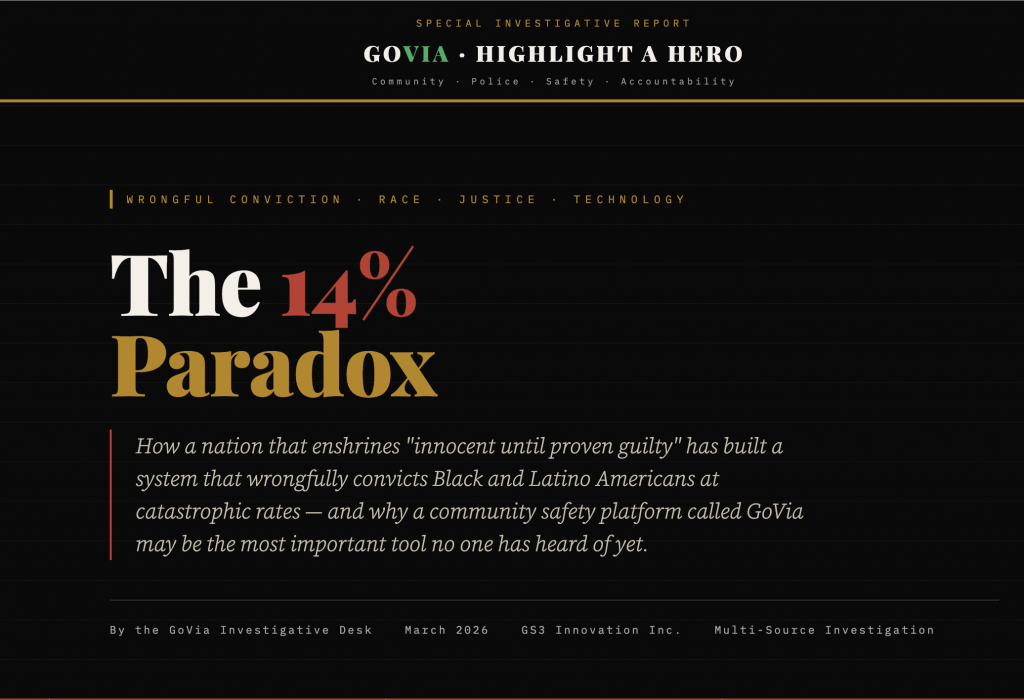

There is a number that should shake every courthouse in America to its foundation. Black people make up roughly 14 percent of this country’s population. And yet they account for 53 percent of every known exoneration since 1989 — meaning more than half the people this nation has wrongfully convicted, imprisoned, and later admitted it got wrong, are Black Americans.
This is not an anomaly. It is not a statistical blip. According to the National Registry of Exonerations — a joint project of the University of Michigan Law School, Michigan State University College of Law, and UC Irvine — it is a documented, decades-long epidemic. An epidemic of wrongful conviction that is systematically concentrated in Black and Latino communities, enabled at every stage by police misconduct, prosecutorial abuse, judicial indifference, and the coerced testimony of compromised witnesses.
This investigation draws on the most comprehensive wrongful conviction data available in the United States. What it reveals is not merely a pattern of errors. It is a chronicle of a broken system — one that has consumed the lives of hundreds of thousands of innocent people of color. And it arrives at a moment when a civic technology platform, GoVia: Highlight A Hero, is positioned to disrupt that system in ways that neither body cameras, nor civilian review boards, nor post-conviction innocence projects have been able to do alone.

What the Data Says: An Epidemic by Any Definition
In 2024, 147 people were exonerated in the United States after losing an average of 13.5 years of their lives to wrongful imprisonment. Seventy-eight percent of those exonerees were people of color. Sixty percent were Black. In total, those 147 people lost nearly 2,000 cumulative years to a system that failed them — with states now liable for an estimated $4.6 billion in damages.
Those numbers are staggering enough in isolation. Measured against the broader arc of wrongful conviction data since 1989, they become something else: evidence of a structural failure with specific, identifiable racial characteristics.
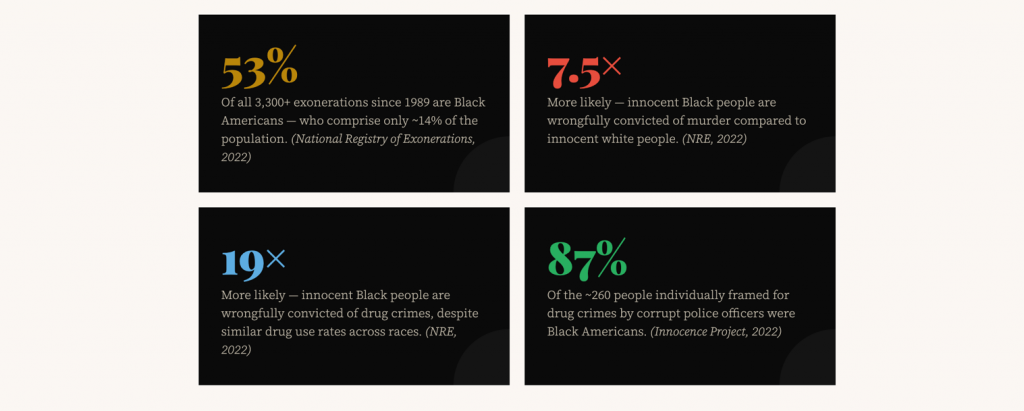
The drug crime numbers are especially damning because they expose the lie at the center of the War on Drugs. Black and white Americans use illegal substances at similar rates. And yet 69 percent of all drug crime exonerees are Black, while only 16 percent are white. The disparity is not about behavior. It is about who gets watched, who gets stopped, and who gets framed.
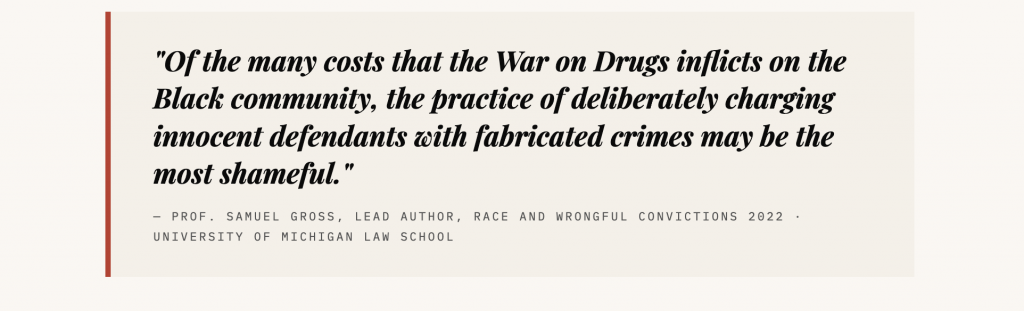

The Crimes Behind the Convictions: Murder, Sexual Assault, Drugs — and the Race Beneath Them
Murder
The National Registry of Exonerations analyzed 1,167 wrongful murder convictions since 1989. Black defendants are overrepresented in every category. Innocent Black people are about 7.5 times more likely to be convicted of murder than innocent white people. When the victim in the case is white, the risk compounds further. Among murder exonerees not sentenced to death or life imprisonment, Black defendants received an average sentence of 35 years — compared to 28 years for white defendants charged with equivalent crimes.
Of the 181 exonerees who spent 25 or more years in prison before release, 68 percent are Black. Among the ten who lost 40 or more years of their lives — an entire adult lifetime — 80 percent are Black.
Sexual Assault
Mistaken eyewitness identification — particularly cross-racial misidentification — has been a catastrophic driver of wrongful sexual assault convictions. Black men convicted of raping white women are six times more likely to be innocent than white men convicted of the same crime. Innocent Black sexual assault exonerees spent an average of four and a half more years in prison before exoneration than their white counterparts. The science is unambiguous: people are significantly worse at recognizing faces of a different race, and that cognitive failure has put Black men in prison for crimes they did not commit.
Drug Crimes
This is where the epidemic is most nakedly exposed. Since 1989, more than 1,800 defendants have been cleared in group exonerations following 17 large-scale police scandals — systematic operations in which officers planted drugs, fabricated evidence, and prosecuted innocent people en masse. These scandals occurred in Chicago, Cleveland, Los Angeles, New York, Philadelphia, and Houston. The victims were, with near-total consistency, Black and Latino residents of low-income housing communities who had no political power to fight back.

The Hidden Epidemic: Latino Wrongful Convictions
If the data on Black exonerees is alarming, the picture for Latino and Hispanic Americans is alarming in a different way: they are systematically undercounted. According to a Wisconsin Innocence Project review, Latino and Hispanic exonerees accounted for only 12 percent of exonerations despite making up 22 percent of the incarcerated population. The gap is not evidence that Latino people are wrongfully convicted less often. It is evidence that they are less able to fight their way out.
The barriers are multiple and compounding. Nearly 30 percent of the U.S. Hispanic population does not consider itself proficient in English, yet there is no constitutional right to an interpreter during law enforcement interrogation. When an interpreter is provided, it is often an officer who speaks the language — not a trained professional. Roughly 40 percent of Latino exonerees who falsely confessed to crimes reported that they did not fully understand the English being spoken during their interrogation.
Immigration status is weaponized too. Prosecutors and investigators have used witnesses’ immigration fears to coerce testimony. Innocent Latino immigrants facing deportation threats have entered guilty pleas to crimes they never committed, accepting convictions that would spare them immediate removal — only to suffer both imprisonment and eventual deportation anyway.

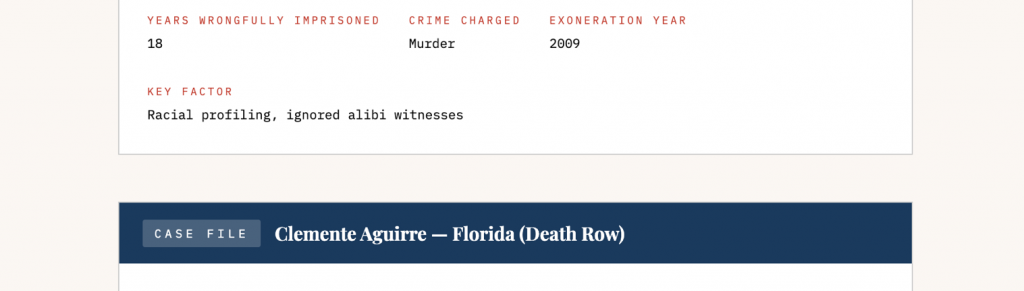
Fernando Bermudez, a young Latino man, was wrongfully convicted of a 1991 murder in New York City. He served 18 years in prison before his 2009 exoneration — becoming the first Latin American man in New York State exonerated on actual innocence grounds.
During the investigation, the lead detective asked one of Bermudez’s alibi witnesses — an Italian American — why he was friends with a Latino man, and used a racial slur to describe Bermudez. In a later recorded conversation, that same detective stated that if Bermudez hadn’t been convicted of this crime, he “would be in jail anyway” for something else. The officers pursued no other suspects and ignored all exculpatory leads.
“The detective saw me as someone who was disposable. They saw a young Latino male and thought I was just another criminal,” Bermudez told the Innocence Project.
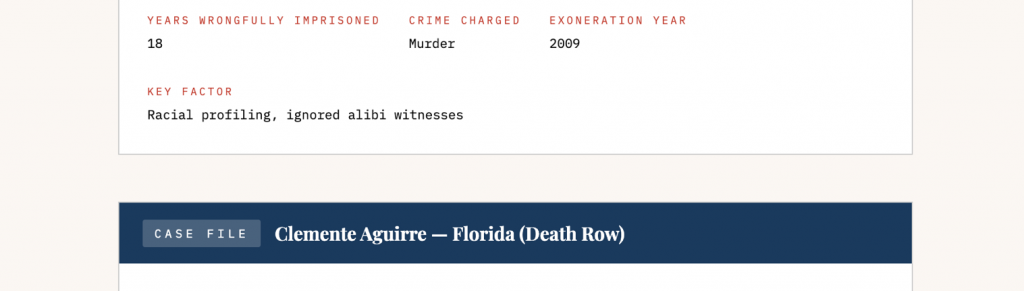
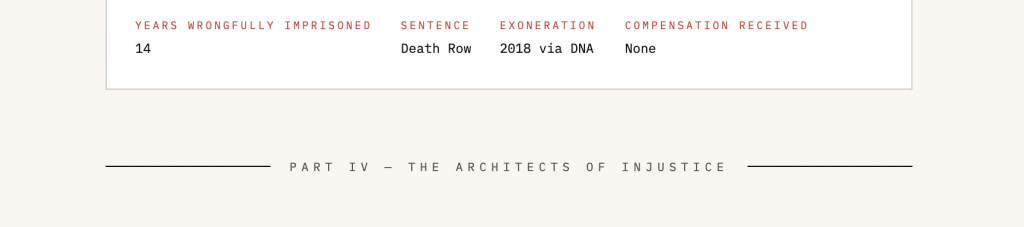
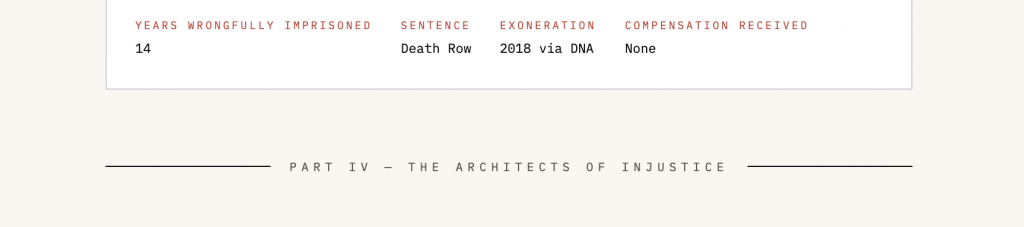
Clemente Aguirre, a Honduran immigrant, was convicted of murder and sentenced to death in Florida. He spent 14 years in prison — including a decade on death row — before being exonerated by DNA evidence in 2018. Despite his exoneration, Florida’s compensation law left him with no financial remedy for the years stolen from his life.
While incarcerated, Aguirre faced additional violence and brutality in prison due to his limited English fluency. “They emasculate you, they degrade you, and they punish you because they think you’re acting that you don’t speak English,” he recounted.
The Architects of Injustice
Behind every wrongful conviction is a chain of human decisions — decisions made by officers, prosecutors, judges, and witnesses who either abused their power or failed their duty. These are not isolated bad actors. They represent systemic patterns documented in thousands of cases.
| Name / Pattern | Role | Documented Harm |
| Sgt. Ronald WattsPolice Officer | Chicago Police Department | Led a narcotics unit that systematically planted drugs and extorted residents of the Ida B. Wells housing project — a predominantly Black community. More than 200+ people have since been exonerated from convictions tied to Watts. He was eventually convicted of federal extortion charges. |
| Sgt. Jon BurgePolice Officer | Chicago Police Department | Commanded a systematic torture operation from the 1970s through the 1990s, using beatings, electric shock, and suffocation to coerce false confessions — almost exclusively from Black suspects. More than 100 documented victims. Convicted of perjury in 2010. |
| Gerald GoinesPolice Officer | Houston Police Department | A narcotics officer whose fabricated evidence triggered 17 exonerations in 2024 alone — part of a broader scandal that led to dozens of overturned convictions in Houston. Goines falsified information used to obtain warrants, resulting in a deadly no-knock raid on an innocent couple’s home. |
| DA Doug EvansProsecutor | Mississippi District Attorney | Struck Black jurors 4.4 times more frequently than white jurors over a 30-year career. In the case of Curtis Flowers (Black defendant), Evans conducted six trials for the same charge, removing 41 of 42 potential Black jurors. The U.S. Supreme Court reversed Flowers’ conviction in 2019, citing Evans’ discriminatory conduct. |
| Chattahoochee Circuit Prosecutors (1975–1979)Prosecutor | Columbus, Georgia | Prosecutors in capital cases systematically marked Black prospective jurors with the letter “N,” ranked them as least desirable, and wrote derogatory descriptions to ensure all-white juries in every Black defendant’s capital trial during a five-year period. |
| Brady Violation PatternSystemic — Prosecutors | Nationwide | Concealing exculpatory evidence — so-called “Brady violations” — is the single most common form of official misconduct in wrongful conviction cases, occurring in 44 percent of documented misconduct cases. Prosecutors face near-total immunity even when evidence-hiding is proven. |
| Det. Glenn FordPolice Officer | Norfolk, Virginia | Lead detective in multiple wrongful convictions, including the “Norfolk Four” case. Convicted of perjury and other charges in 2010. Witnesses in his cases later recanted, stating they had been coerced by Ford to provide false testimony. |
| False Eyewitness — Systemic PatternWitnesses | Nationwide | More than half of all wrongful convictions can be traced to witnesses who lied in court or made false accusations. Intentionally suggestive witness identifications occur twice as frequently in the cases of Black and Latino exonerees as in white exonerees. |
| All-White Jury PatternJudicial / Systemic | Nationwide | Compared to diverse juries, all-white juries deliberate less, assess evidence less accurately, and apply racial stereotypes more frequently. Race-based jury exclusion remains a widespread, documented problem despite being constitutionally prohibited since Batson v. Kentucky (1986). |
| Prosecutorial Immunity DoctrineLegal Doctrine | Federal & State Courts | Prosecutors cannot be held personally liable for falsifying evidence, coercing witnesses, presenting false testimony, or withholding evidence — even in cases of gross misconduct. Only 17 percent of documented misconduct cases resulted in any discipline or punishment for the responsible official. |

GoVia · Highlight A Hero · Community Police Safety App
The Technology This Epidemic Has Been Waiting For
The wrongful conviction epidemic has persisted not because the truth was unavailable — but because there was never a real-time infrastructure to capture, preserve, and elevate it at the moment it mattered most: during the encounter itself. GoVia changes that equation.
GoVia: Highlight A Hero is a civic technology platform built on a foundational premise: that both communities and law enforcement are better served by transparency, accountability, and real-time legal support than by the silence and power asymmetry that has defined police-civilian encounters for generations. GoVia does not position itself as adversarial to police. It positions itself as the infrastructure that honest policing deserves — and that innocent people of color have never had.
⚖️
Live Legal & Mental Health Support
Real-time access to legal counsel and crisis support during police encounters — the moment when most wrongful convictions begin to form.
📋
Digital Affidavits
Timestamped, tamper-resistant documentation of encounters that creates an evidentiary record no one can alter after the fact.
🦸
Hero Recognition Feed
A public platform to identify and celebrate officers who serve with integrity — rebuilding trust one verified interaction at a time.
📚
Know Your Rights Library
Multilingual, accessible, and searchable — the legal knowledge that has historically been available only to those who could afford an attorney.
🔒
Anonymous Tip Line
A secure channel for witnesses to report misconduct without fear of retaliation — the tool that could have stopped Watts, Burge, and Goines years earlier.
📊
Community Intelligence
Aggregated, anonymized data that allows communities, researchers, and policymakers to identify patterns of misconduct before they become scandals.
Consider what GoVia’s architecture might have meant in the documented epidemic cases above. Sgt. Ronald Watts operated for more than a decade because the residents of Ida B. Wells had no mechanism to report misconduct safely, no way to document the drugs being planted, and no legal resources to challenge fabricated charges in real time. An anonymous tip line with encrypted evidence capture would have shortened that timeline from a decade to months. Digital affidavits would have created an immediate evidentiary chain. Live legal support would have prevented countless coerced guilty pleas.
GoVia is not a surveillance tool. It is the antithesis of surveillance: a citizen-controlled, legally-grounded platform that restores the power balance in the most consequential interaction most Americans will ever have with their government. It is validated by MIT Solve, NSF iCorps, Berkeley Law SLI, GSV, and gBeta/gener8tor — and it is being built right now, at the intersection of civic technology, constitutional rights, and community trust.

This Is Not a Statistic. This Is a Person.
Behind every data point in this investigation is a face, a name, a family, a community. Anthony Ray Hinton — 30 years on Alabama’s death row for a crime he did not commit. Marvin Anderson — 20 years for a sexual assault he never committed, identified by a victim because he was “the only Black man in town with a white girlfriend.” The 200-plus residents of Chicago’s Ida B. Wells development who were framed by Ronald Watts because they were poor, Black, and had no one powerful enough to believe them.
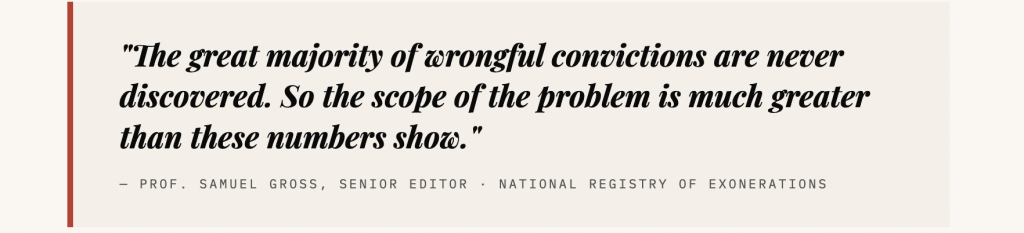
The National Registry of Exonerations estimates that the innocent people not yet exonerated — still sitting in cells right now — number in the hundreds of thousands. More than half, they believe, are Black.
This is the epidemic. It is not new. It is not accidental. And it will not end on its own. It will end when communities have real tools for real-time accountability. It will end when a platform like GoVia is in the hands of every resident of every neighborhood where the weight of the criminal justice system falls heaviest.
Highlight a hero. Document the truth. Build the record. That is how epidemics end.
Sources & References
- National Registry of Exonerations —Race and Wrongful Convictions in the United States 2022. University of Michigan Law School, Michigan State University College of Law, UC Irvine Newkirk Center. September 23, 2022. exonerationregistry.org
- National Registry of Exonerations —2024 Annual Report. Michigan State University College of Law. Released April 1, 2025. exonerationregistry.org
- Innocence Project —Race and Wrongful Conviction. innocenceproject.org (Updated October 2024)
- Innocence Project —New Report Highlights Persistent Racial Disparities Among Wrongful Convictions. September 27, 2022. innocenceproject.org
- Innocence Project —Why Latinx People Are Uniquely Vulnerable to Wrongful Conviction. April 26, 2023. innocenceproject.org
- NPR —Wrongful Convictions Disproportionately Affect Black Americans, Report Shows. Ailsa Chang, September 27, 2022. npr.org
- University of Michigan Law School —National Registry of Exonerations Report Highlights Racial Disparity in Wrongful Convictions. michigan.law.umich.edu
- Equal Justice Initiative —Wrongful Convictions. eji.org
- NAACP —Criminal Justice Fact Sheet. naacp.org
- NAACP Legal Defense Fund —How Racism in the Courtroom Produces Wrongful Convictions and Mass Incarceration. naacpldf.org
- Death Penalty Information Center —Report: Black People 7.5 Times More Likely to Be Wrongfully Convicted of Murder. deathpenaltyinfo.org
- Death Penalty Information Center —Official Misconduct / Prosecutorial Accountability. deathpenaltyinfo.org
- UC Irvine School of Social Ecology —Government Misconduct Cause of Most Wrongful Convictions. socialecology.uci.edu
- NBC News —Government Corruption and Negligence Drive Most Wrongful Convictions, Report Finds. September 15, 2020. nbcnews.com
- Criminal Legal News —New Report Shows More Than Half of Wrongful Convictions Involved Misconduct by Police and Prosecutors. criminallegalnews.org
- Criminal Legal News —Racism and Wrongful Convictions. criminallegalnews.org
- Syracuse University Law Review —Race and Exonerations: Why Black Defendants Are More Likely To Be Wrongfully Convicted. lawreview.syr.edu
- Wisconsin Law School / Wisconsin Innocence Project —In Search of Justice for Wrongfully Incarcerated Latino Inmates. gargoyle.law.wisc.edu
- Parriva —Latinx Defendants, False Convictions, and the Difficult Road to Exoneration. parriva.com
- Georgia Innocence Project —Beneath the Statistics: The Structural and Systemic Causes of Our Wrongful Conviction Problem. georgiainnocenceproject.org
- Harvard Law School Fair Punishment Project —America’s Top Five Deadliest Prosecutors.
- MSU Today —MSU Professor’s Report Reveals Nearly 150 Exonerations in 2024. April 2025. msutoday.msu.edu
- Bureau of Justice Statistics, U.S. Department of Justice — Homicide Trends and Incarceration Data.
- Pew Research Center —English Proficiency Among U.S. Hispanic Population.
- GS3 Innovation Inc. / GoVia: Highlight A Hero — Platform Documentation and Feature Architecture. gs3innovation.com
I may have told a lie…

There is a number that should shake every courthouse in America to its foundation. Black people make up roughly 14 percent of this country’s population. And yet they account for 53 percent of every known exoneration since 1989 — meaning more than half the people this nation has wrongfully convicted, imprisoned, and later admitted it got wrong, are Black Americans.
This is not an anomaly. It is not a statistical blip. According to the National Registry of Exonerations — a joint project of the University of Michigan Law School, Michigan State University College of Law, and UC Irvine — it is a documented, decades-long epidemic. An epidemic of wrongful conviction that is systematically concentrated in Black and Latino communities, enabled at every stage by police misconduct, prosecutorial abuse, judicial indifference, and the coerced testimony of compromised witnesses.
This investigation draws on the most comprehensive wrongful conviction data available in the United States. What it reveals is not merely a pattern of errors. It is a chronicle of a broken system — one that has consumed the lives of hundreds of thousands of innocent people of color. And it arrives at a moment when a civic technology platform, GoVia: Highlight A Hero, is positioned to disrupt that system in ways that neither body cameras, nor civilian review boards, nor post-conviction innocence projects have been able to do alone.
What the Data Says: An Epidemic by Any Definition
In 2024, 147 people were exonerated in the United States after losing an average of 13.5 years of their lives to wrongful imprisonment. Seventy-eight percent of those exonerees were people of color. Sixty percent were Black. In total, those 147 people lost nearly 2,000 cumulative years to a system that failed them — with states now liable for an estimated $4.6 billion in damages.
Those numbers are staggering enough in isolation. Measured against the broader arc of wrongful conviction data since 1989, they become something else: evidence of a structural failure with specific, identifiable racial characteristics.
The drug crime numbers are especially damning because they expose the lie at the center of the War on Drugs. Black and white Americans use illegal substances at similar rates. And yet 69 percent of all drug crime exonerees are Black, while only 16 percent are white. The disparity is not about behavior. It is about who gets watched, who gets stopped, and who gets framed.
The Crimes Behind the Convictions: Murder, Sexual Assault, Drugs — and the Race Beneath Them
Murder
The National Registry of Exonerations analyzed 1,167 wrongful murder convictions since 1989. Black defendants are overrepresented in every category. Innocent Black people are about 7.5 times more likely to be convicted of murder than innocent white people. When the victim in the case is white, the risk compounds further. Among murder exonerees not sentenced to death or life imprisonment, Black defendants received an average sentence of 35 years — compared to 28 years for white defendants charged with equivalent crimes.
Of the 181 exonerees who spent 25 or more years in prison before release, 68 percent are Black. Among the ten who lost 40 or more years of their lives — an entire adult lifetime — 80 percent are Black.
Sexual Assault
Mistaken eyewitness identification — particularly cross-racial misidentification — has been a catastrophic driver of wrongful sexual assault convictions. Black men convicted of raping white women are six times more likely to be innocent than white men convicted of the same crime. Innocent Black sexual assault exonerees spent an average of four and a half more years in prison before exoneration than their white counterparts. The science is unambiguous: people are significantly worse at recognizing faces of a different race, and that cognitive failure has put Black men in prison for crimes they did not commit.
Drug Crimes
This is where the epidemic is most nakedly exposed. Since 1989, more than 1,800 defendants have been cleared in group exonerations following 17 large-scale police scandals — systematic operations in which officers planted drugs, fabricated evidence, and prosecuted innocent people en masse. These scandals occurred in Chicago, Cleveland, Los Angeles, New York, Philadelphia, and Houston. The victims were, with near-total consistency, Black and Latino residents of low-income housing communities who had no political power to fight back.
The Hidden Epidemic: Latino Wrongful Convictions
If the data on Black exonerees is alarming, the picture for Latino and Hispanic Americans is alarming in a different way: they are systematically undercounted. According to a Wisconsin Innocence Project review, Latino and Hispanic exonerees accounted for only 12 percent of exonerations despite making up 22 percent of the incarcerated population. The gap is not evidence that Latino people are wrongfully convicted less often. It is evidence that they are less able to fight their way out.
The barriers are multiple and compounding. Nearly 30 percent of the U.S. Hispanic population does not consider itself proficient in English, yet there is no constitutional right to an interpreter during law enforcement interrogation. When an interpreter is provided, it is often an officer who speaks the language — not a trained professional. Roughly 40 percent of Latino exonerees who falsely confessed to crimes reported that they did not fully understand the English being spoken during their interrogation.
Immigration status is weaponized too. Prosecutors and investigators have used witnesses’ immigration fears to coerce testimony. Innocent Latino immigrants facing deportation threats have entered guilty pleas to crimes they never committed, accepting convictions that would spare them immediate removal — only to suffer both imprisonment and eventual deportation anyway.
Fernando Bermudez, a young Latino man, was wrongfully convicted of a 1991 murder in New York City. He served 18 years in prison before his 2009 exoneration — becoming the first Latin American man in New York State exonerated on actual innocence grounds.
During the investigation, the lead detective asked one of Bermudez’s alibi witnesses — an Italian American — why he was friends with a Latino man, and used a racial slur to describe Bermudez. In a later recorded conversation, that same detective stated that if Bermudez hadn’t been convicted of this crime, he “would be in jail anyway” for something else. The officers pursued no other suspects and ignored all exculpatory leads.
“The detective saw me as someone who was disposable. They saw a young Latino male and thought I was just another criminal,” Bermudez told the Innocence Project.
Clemente Aguirre, a Honduran immigrant, was convicted of murder and sentenced to death in Florida. He spent 14 years in prison — including a decade on death row — before being exonerated by DNA evidence in 2018. Despite his exoneration, Florida’s compensation law left him with no financial remedy for the years stolen from his life.
While incarcerated, Aguirre faced additional violence and brutality in prison due to his limited English fluency. “They emasculate you, they degrade you, and they punish you because they think you’re acting that you don’t speak English,” he recounted.
The Architects of Injustice
Behind every wrongful conviction is a chain of human decisions — decisions made by officers, prosecutors, judges, and witnesses who either abused their power or failed their duty. These are not isolated bad actors. They represent systemic patterns documented in thousands of cases.
| Name / Pattern | Role | Documented Harm |
| Sgt. Ronald WattsPolice Officer | Chicago Police Department | Led a narcotics unit that systematically planted drugs and extorted residents of the Ida B. Wells housing project — a predominantly Black community. More than 200+ people have since been exonerated from convictions tied to Watts. He was eventually convicted of federal extortion charges. |
| Sgt. Jon BurgePolice Officer | Chicago Police Department | Commanded a systematic torture operation from the 1970s through the 1990s, using beatings, electric shock, and suffocation to coerce false confessions — almost exclusively from Black suspects. More than 100 documented victims. Convicted of perjury in 2010. |
| Gerald GoinesPolice Officer | Houston Police Department | A narcotics officer whose fabricated evidence triggered 17 exonerations in 2024 alone — part of a broader scandal that led to dozens of overturned convictions in Houston. Goines falsified information used to obtain warrants, resulting in a deadly no-knock raid on an innocent couple’s home. |
| DA Doug EvansProsecutor | Mississippi District Attorney | Struck Black jurors 4.4 times more frequently than white jurors over a 30-year career. In the case of Curtis Flowers (Black defendant), Evans conducted six trials for the same charge, removing 41 of 42 potential Black jurors. The U.S. Supreme Court reversed Flowers’ conviction in 2019, citing Evans’ discriminatory conduct. |
| Chattahoochee Circuit Prosecutors (1975–1979)Prosecutor | Columbus, Georgia | Prosecutors in capital cases systematically marked Black prospective jurors with the letter “N,” ranked them as least desirable, and wrote derogatory descriptions to ensure all-white juries in every Black defendant’s capital trial during a five-year period. |
| Brady Violation PatternSystemic — Prosecutors | Nationwide | Concealing exculpatory evidence — so-called “Brady violations” — is the single most common form of official misconduct in wrongful conviction cases, occurring in 44 percent of documented misconduct cases. Prosecutors face near-total immunity even when evidence-hiding is proven. |
| Det. Glenn FordPolice Officer | Norfolk, Virginia | Lead detective in multiple wrongful convictions, including the “Norfolk Four” case. Convicted of perjury and other charges in 2010. Witnesses in his cases later recanted, stating they had been coerced by Ford to provide false testimony. |
| False Eyewitness — Systemic PatternWitnesses | Nationwide | More than half of all wrongful convictions can be traced to witnesses who lied in court or made false accusations. Intentionally suggestive witness identifications occur twice as frequently in the cases of Black and Latino exonerees as in white exonerees. |
| All-White Jury PatternJudicial / Systemic | Nationwide | Compared to diverse juries, all-white juries deliberate less, assess evidence less accurately, and apply racial stereotypes more frequently. Race-based jury exclusion remains a widespread, documented problem despite being constitutionally prohibited since Batson v. Kentucky (1986). |
| Prosecutorial Immunity DoctrineLegal Doctrine | Federal & State Courts | Prosecutors cannot be held personally liable for falsifying evidence, coercing witnesses, presenting false testimony, or withholding evidence — even in cases of gross misconduct. Only 17 percent of documented misconduct cases resulted in any discipline or punishment for the responsible official. |

GoVia · Highlight A Hero · Community Police Safety App
The Technology This Epidemic Has Been Waiting For
The wrongful conviction epidemic has persisted not because the truth was unavailable — but because there was never a real-time infrastructure to capture, preserve, and elevate it at the moment it mattered most: during the encounter itself. GoVia changes that equation.
GoVia: Highlight A Hero is a civic technology platform built on a foundational premise: that both communities and law enforcement are better served by transparency, accountability, and real-time legal support than by the silence and power asymmetry that has defined police-civilian encounters for generations. GoVia does not position itself as adversarial to police. It positions itself as the infrastructure that honest policing deserves — and that innocent people of color have never had.
⚖️
Live Legal & Mental Health Support
Real-time access to legal counsel and crisis support during police encounters — the moment when most wrongful convictions begin to form.
📋
Digital Affidavits
Timestamped, tamper-resistant documentation of encounters that creates an evidentiary record no one can alter after the fact.
🦸
Hero Recognition Feed
A public platform to identify and celebrate officers who serve with integrity — rebuilding trust one verified interaction at a time.
📚
Know Your Rights Library
Multilingual, accessible, and searchable — the legal knowledge that has historically been available only to those who could afford an attorney.
🔒
Anonymous Tip Line
A secure channel for witnesses to report misconduct without fear of retaliation — the tool that could have stopped Watts, Burge, and Goines years earlier.
📊
Community Intelligence
Aggregated, anonymized data that allows communities, researchers, and policymakers to identify patterns of misconduct before they become scandals.
Consider what GoVia’s architecture might have meant in the documented epidemic cases above. Sgt. Ronald Watts operated for more than a decade because the residents of Ida B. Wells had no mechanism to report misconduct safely, no way to document the drugs being planted, and no legal resources to challenge fabricated charges in real time. An anonymous tip line with encrypted evidence capture would have shortened that timeline from a decade to months. Digital affidavits would have created an immediate evidentiary chain. Live legal support would have prevented countless coerced guilty pleas.
GoVia is not a surveillance tool. It is the antithesis of surveillance: a citizen-controlled, legally-grounded platform that restores the power balance in the most consequential interaction most Americans will ever have with their government. It is validated by MIT Solve, NSF iCorps, Berkeley Law SLI, GSV, and gBeta/gener8tor — and it is being built right now, at the intersection of civic technology, constitutional rights, and community trust.

This Is Not a Statistic. This Is a Person.
Behind every data point in this investigation is a face, a name, a family, a community. Anthony Ray Hinton — 30 years on Alabama’s death row for a crime he did not commit. Marvin Anderson — 20 years for a sexual assault he never committed, identified by a victim because he was “the only Black man in town with a white girlfriend.” The 200-plus residents of Chicago’s Ida B. Wells development who were framed by Ronald Watts because they were poor, Black, and had no one powerful enough to believe them.
The National Registry of Exonerations estimates that the innocent people not yet exonerated — still sitting in cells right now — number in the hundreds of thousands. More than half, they believe, are Black.
This is the epidemic. It is not new. It is not accidental. And it will not end on its own. It will end when communities have real tools for real-time accountability. It will end when a platform like GoVia is in the hands of every resident of every neighborhood where the weight of the criminal justice system falls heaviest.
Highlight a hero. Document the truth. Build the record. That is how epidemics end.
Sources & References
- National Registry of Exonerations —Race and Wrongful Convictions in the United States 2022. University of Michigan Law School, Michigan State University College of Law, UC Irvine Newkirk Center. September 23, 2022. exonerationregistry.org
- National Registry of Exonerations —2024 Annual Report. Michigan State University College of Law. Released April 1, 2025. exonerationregistry.org
- Innocence Project —Race and Wrongful Conviction. innocenceproject.org (Updated October 2024)
- Innocence Project —New Report Highlights Persistent Racial Disparities Among Wrongful Convictions. September 27, 2022. innocenceproject.org
- Innocence Project —Why Latinx People Are Uniquely Vulnerable to Wrongful Conviction. April 26, 2023. innocenceproject.org
- NPR —Wrongful Convictions Disproportionately Affect Black Americans, Report Shows. Ailsa Chang, September 27, 2022. npr.org
- University of Michigan Law School —National Registry of Exonerations Report Highlights Racial Disparity in Wrongful Convictions. michigan.law.umich.edu
- Equal Justice Initiative —Wrongful Convictions. eji.org
- NAACP —Criminal Justice Fact Sheet. naacp.org
- NAACP Legal Defense Fund —How Racism in the Courtroom Produces Wrongful Convictions and Mass Incarceration. naacpldf.org
- Death Penalty Information Center —Report: Black People 7.5 Times More Likely to Be Wrongfully Convicted of Murder. deathpenaltyinfo.org
- Death Penalty Information Center —Official Misconduct / Prosecutorial Accountability. deathpenaltyinfo.org
- UC Irvine School of Social Ecology —Government Misconduct Cause of Most Wrongful Convictions. socialecology.uci.edu
- NBC News —Government Corruption and Negligence Drive Most Wrongful Convictions, Report Finds. September 15, 2020. nbcnews.com
- Criminal Legal News —New Report Shows More Than Half of Wrongful Convictions Involved Misconduct by Police and Prosecutors. criminallegalnews.org
- Criminal Legal News —Racism and Wrongful Convictions. criminallegalnews.org
- Syracuse University Law Review —Race and Exonerations: Why Black Defendants Are More Likely To Be Wrongfully Convicted. lawreview.syr.edu
- Wisconsin Law School / Wisconsin Innocence Project —In Search of Justice for Wrongfully Incarcerated Latino Inmates. gargoyle.law.wisc.edu
- Parriva —Latinx Defendants, False Convictions, and the Difficult Road to Exoneration. parriva.com
- Georgia Innocence Project —Beneath the Statistics: The Structural and Systemic Causes of Our Wrongful Conviction Problem. georgiainnocenceproject.org
- Harvard Law School Fair Punishment Project —America’s Top Five Deadliest Prosecutors.
- MSU Today —MSU Professor’s Report Reveals Nearly 150 Exonerations in 2024. April 2025. msutoday.msu.edu
- Bureau of Justice Statistics, U.S. Department of Justice — Homicide Trends and Incarceration Data.
- Pew Research Center —English Proficiency Among U.S. Hispanic Population.
- GS3 Innovation Inc. / GoVia: Highlight A Hero — Platform Documentation and Feature Architecture. gs3innovation.com
I may have told a lie…