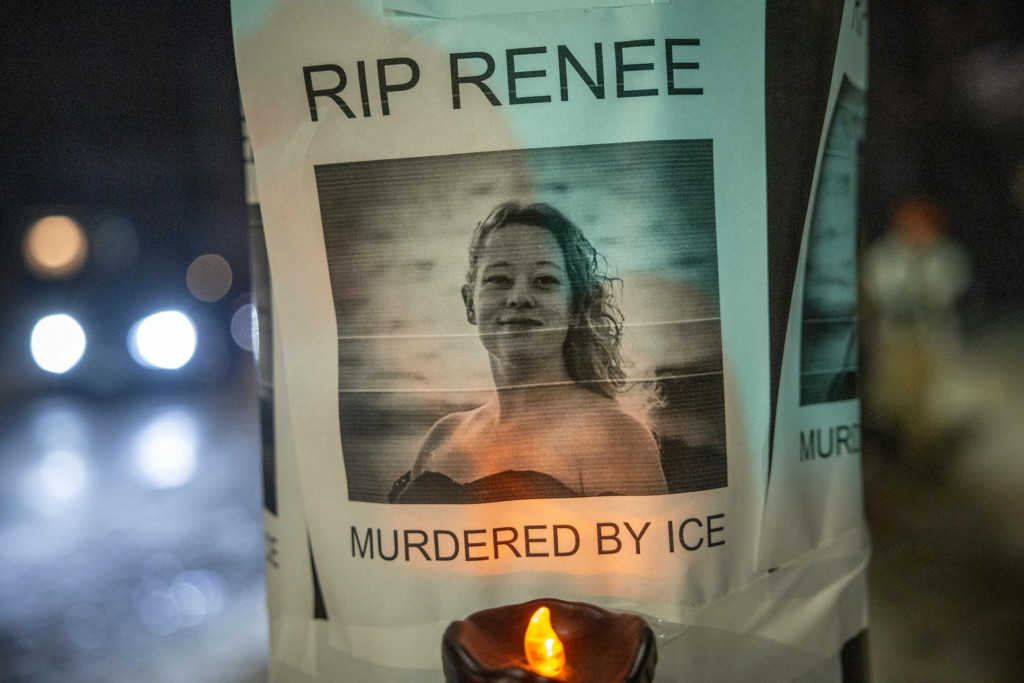
A poster showing a photograph of Renee Nicole Good, 37, hangs on a lamppost at the site where she was shot and killed by a federal agent while she was in her vehicle in Minneapolis on Wednesday, Jan. 7. (David Guttenfelder/The New York Times)
Police Law Brief
Over the past 24 hours, few incidents have generated as much national debate as the fatal shooting involving ICE agents in Minneapolis, Minnesota. Public reaction has been swift—and largely reflexive—splitting into predictable camps of “ICE is always wrong” versus *“ICE is always justified.”
What has been largely missing from the discourse is a careful, fact-based examination grounded in law, policy, and constitutional standards, rather than ideology.
Involved Individual
Renee Nicole Good
What Happened
On January 7, 2026, ICE agents operating as part of a federal enforcement operation were traveling in a pickup truck through a residential street in Minneapolis. At the same time, a woman later identified as Renee Nicole Good was driving a burgundy SUV.
Ms. Good positioned her vehicle in front of the ICE truck, effectively blocking the roadway and preventing the federal vehicle from proceeding.
Two ICE agents exited the truck and approached the SUV. A third agent, already on foot, moved toward the driver’s side of the vehicle. Agents issued verbal commands instructing Ms. Good to exit the vehicle. She refused to comply.
Moments later, Ms. Good accelerated forward. According to available video footage, the SUV moved directly toward the agent positioned near the front driver’s side of the vehicle. At least one video appears to show the vehicle striking the agent.
The agent discharged his firearm three times as the SUV advanced. Ms. Good’s vehicle then collided with a parked car. She sustained fatal injuries at the scene.
Within minutes, protests formed in the surrounding area. Political leaders across the spectrum issued statements, many before all facts were publicly available.
- Democratic officials, including Minneapolis Mayor Jacob Frey and Minnesota Governor Tim Walz, publicly questioned whether the use of deadly force was justified.
- Republican officials, including former President Donald Trump and other national leaders, expressed support for the ICE agent involved.
Legal Framework: Use of Deadly Force
Two foundational principles govern this analysis:
- Law enforcement officers may use deadly force only when they reasonably believe they face an imminent threat of death or serious bodily injury.
- A motor vehicle, depending on its use, can constitute a deadly weapon under both federal and state law.
These standards are well-established in constitutional jurisprudence and federal use-of-force policy.
1. The Stop
By blocking the roadway and interfering with a federal vehicle engaged in an official operation, Ms. Good’s actions constituted unlawful interference with federal officers. Under these circumstances, ICE agents had a legal basis to detain her.
The agent was positioned near the front driver’s side of the SUV. While standing in close proximity to a vehicle during an enforcement encounter carries inherent risk, position alone does not determine legality. The key question remains whether the threat became imminent.
3. Acceleration
Video evidence indicates that Ms. Good accelerated her vehicle forward toward the agent. At least one recording suggests the agent was struck or narrowly avoided being struck.
The agent discharged his weapon while the vehicle was moving toward him during an active detention. Under prevailing legal standards, the decisive issue is whether a reasonable officer in the same position would perceive the vehicle’s movement as an imminent threat capable of causing death or serious bodily harm.
That determination is ultimately a matter for independent investigation, not political declaration.
Why This Case Matters
This incident sits at the intersection of immigration enforcement, use-of-force law, civil rights, and public trust. Rapid political conclusions—on either side—risk undermining due process and public confidence.
Cases involving federal agents operating in civilian neighborhoods demand:
- Transparent investigations
- Evidence-based analysis
- Clear separation between legal judgment and political rhetoric
Only through that process can accountability, justice, and legitimacy be preserved.