By an investigative collaboration examining justice, technology, and public finance
In 2000, a federal jury awarded $3.1 million to Curtis Harris, a Cleveland man paralyzed after being shot by a patrol officer. It was one of many warning flares over the next decade.
By 2012, 13 officers would fire 137 rounds into a fleeing car, killing Timothy Russell and Malissa Williams. The shooting would become shorthand for systemic breakdown inside the Cleveland Division of Police.
Between those two moments lies a pattern — lawsuits, investigations, disputed force, sealed records, disproportionate stops — that ultimately triggered federal intervention and a consent decree in 2015.
Now, as Cleveland debates ending that oversight, a harder question looms:
What would durable accountability look like in an AI-driven justice system?
I. A Timeline of Major Cleveland Police Controversies (2000–2012)
Below is a structured record of high-profile controversies that shaped federal intervention.
| Year | Incident | Allegations / Findings | Financial / Legal Outcome |
| 2000 | Curtis Harris shooting (1997 case resolved) | Shot in back during struggle; paralyzed | $3.1M jury award |
| 2000 | DOJ launches investigation | Pattern-or-practice probe into constitutional violations | Investigation opens |
| 2003 | Larger caliber handgun request | Community concern over weapon use; 8 police killings in 5 years | Public controversy |
| 2004 | DOJ closes 4-year probe | Found shootings “may have been avoidable”; criticized complaint handling | Settlement agreement signed |
| 2005 | Brandon McCloud (15) killed | Dispatcher reportedly advised “shoot to kill” | Prosecutor ruled for police |
| 2007 | 4,427 use-of-force investigations | All resolved in officers’ favor (2003–2006 period) | No sustained discipline trend |
| 2008 | Police chases deaths | 18 killed regionally since 2003; 6 innocent bystanders | Policy tightened |
| 2010 | Harold Harris arrest | Mistaken identity; struck multiple times | Civil scrutiny |
| 2010 | Marlando Williams tased | Jaywalking stop; bias questions raised | Justified by department |
| 2011 | Edward Henderson beating | Officers charged; charges later dropped | Federal scrutiny |
| 2011 | Jalil Anderson case | Video contradicted officer’s assault claim; video withheld | Public records dispute |
| 2011 | $900,000 settlement | State corrections officer case | Civil payout |
| 2011 | ACLU drug enforcement report | Disproportionate impact on Black residents | Legislative calls (no law passed) |
| 2012 | 137-shot chase | 13 officers fired 137 rounds; two killed | Catalyst for DOJ reinvestigation |
These were not isolated events. They formed a statistical pattern: repeated force incidents, low sustained complaint rates, and costly settlements.
II. Post-Decree Era: 2020–2025 — Reform Meets Recurrence
Federal oversight did not end controversy.
While the Cleveland Division of Police operates separately from the East Cleveland Police Department (ECPD), both fall within Cuyahoga County and shape public perception.
East Cleveland Police Department (2020–2025)
Federal indictments between 2023 and 2025 charged at least 18 ECPD officers with crimes including assault, civil rights violations, and falsification of records.
Notable cases include:
- Vincent Belmonte (2021): Shot after pursuit; autopsy found wounds to back of head and lower back. No indictment.
- Ian McInnes: Sentenced (2025) to 2.5 years for assaults on handcuffed suspects.
- Larry McDonald: Sentenced (2025) to 4 years for evidence tampering related to pursuit death.
- Anthony Holmes and Tristan Homan: Convictions for civil rights violations and falsifying reports.
Cleveland Division of Police (2020–2025)
- $18M settlement (2020) to Kwame Ajamu, Wiley Bridgeman, and Rickey Jackson for a 1975 wrongful conviction.
- $85,000 settlement (2023) over improper 2022 stop.
- $3.7M settlement to family of a Euclid man killed by an off-duty officer (2012 case resolved later).
- $2.25M settlement to family of Daniel Ficker (2011 case).
Cumulative exposure: Tens of millions in settlements over two decades — not including litigation defense costs, monitoring expenses, or insurance premium effects.
III. The Financial Cost of Policing Failure
From a public-finance perspective, police misconduct is not only a civil-rights issue. It is a budgetary one.
Costs include:
- Civil settlements and jury awards
- Outside counsel and litigation defense
- Federal monitoring compliance costs
- Insurance premium increases
- Lost economic productivity in over-policed neighborhoods
- Protest and unrest response expenses
- Property damage during unrest (a downstream cost of trust erosion)
While riots and protests are complex social phenomena, municipal accounting often includes emergency overtime, property repair, and business interruption losses tied to public disorder.
Violence has a multiplier effect.
When trust collapses, public safety spending rises.
IV. The AI Inflection Point
Across the United States, AI tools are reshaping criminal justice:
- Predictive policing algorithms
- Risk-assessment tools in bail and sentencing
- Automated license plate readers
- Body camera analytics
Yet these tools carry risk:
- Algorithmic bias reflecting historical disparities
- Opaque proprietary systems
- Over-reliance on flawed data inputs
- Feedback loops amplifying over-policing
Studies nationally have shown that risk assessment algorithms can replicate racial disparities embedded in historical arrest data. AI does not eliminate bias; it scales the data it is trained on.
Without independent auditing, AI may deepen inequity under the veneer of neutrality.
V. The Missing Layer: Civilian Evidence Systems
Most technology investment has strengthened law enforcement’s data capabilities. Few cities have invested in civilian-side evidentiary systems.
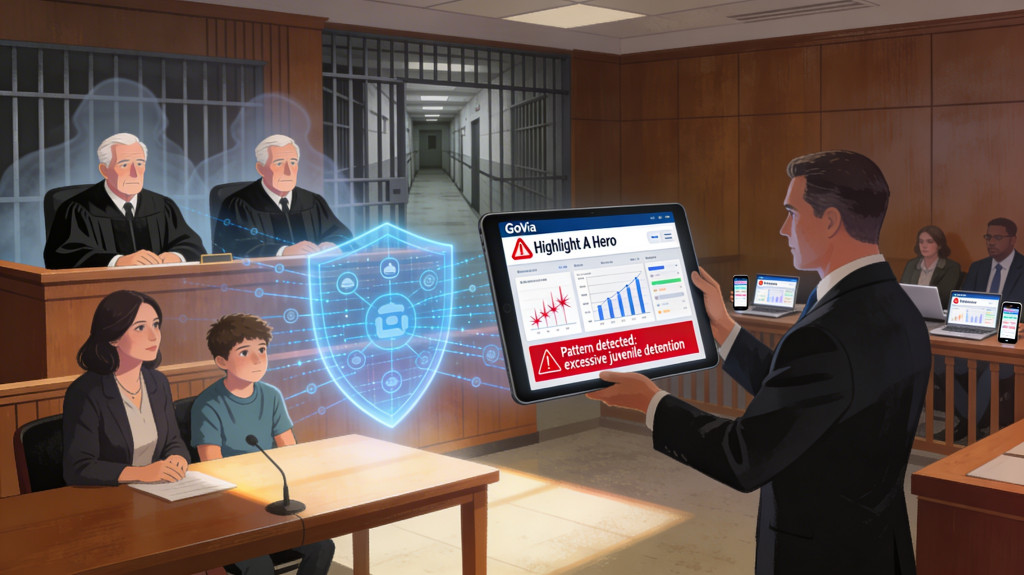
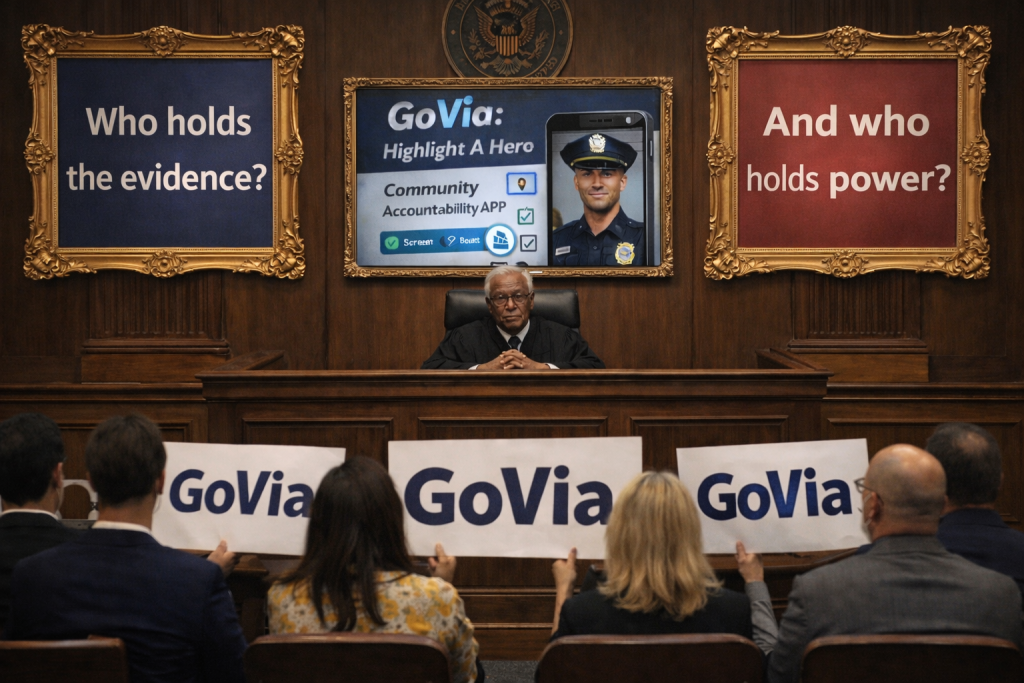
A structured civilian documentation platform — such as GoVia’s proposed model — could provide:
- Time-stamped encrypted documentation of encounters
- Secure chain-of-custody logs
- Pattern-detection analytics across complaints
- Commendation features highlighting positive policing
- Transparent dashboards for public reporting
From a data science standpoint, symmetrical evidence collection reduces asymmetry bias.
From a legal standpoint, contemporaneous digital logs can strengthen or refute claims on both sides.
From a fiscal standpoint, earlier fact resolution reduces prolonged litigation.
VI. What AI Could Fix — and What It Cannot
AI can:
- Identify statistical anomalies in stop-and-search patterns
- Flag officers with disproportionate complaint clustering
- Predict high-risk pursuit conditions
- Monitor use-of-force escalation sequences
AI cannot:
- Replace moral accountability
- Repair institutional trust alone
- Substitute for independent oversight
Technology must operate within governance guardrails:
- Transparent procurement
- Independent auditing
- Civilian oversight integration
- Clear admissibility standards
VII. The Core Question Before Cleveland
The consent decree was imposed because internal systems failed to self-correct.
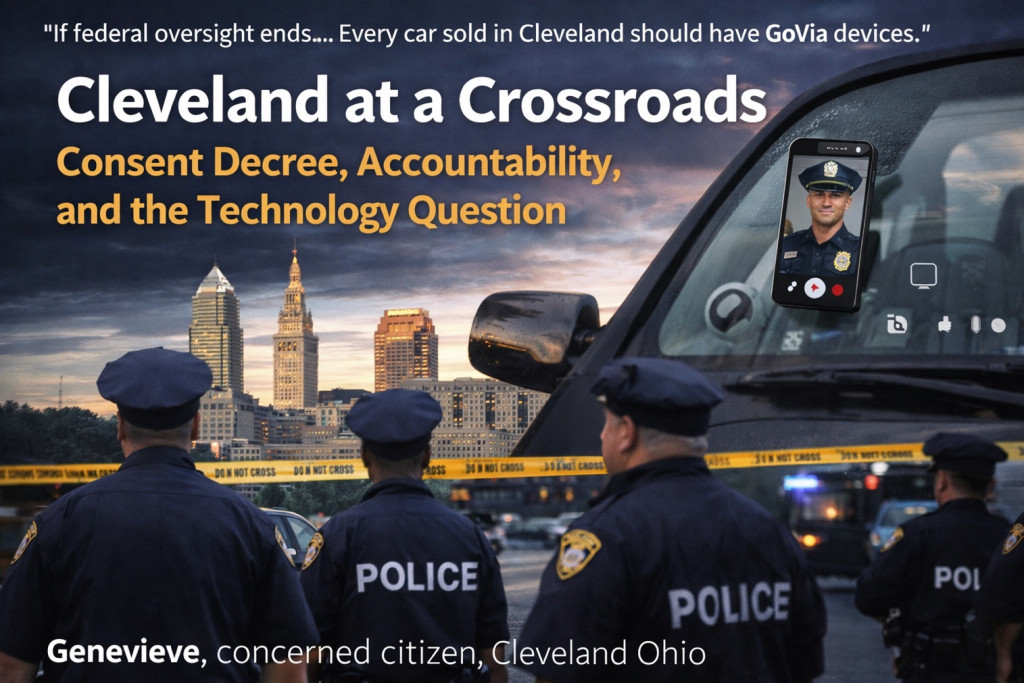
As Cleveland debates the future of federal oversight, it stands at a technological crossroads:
- Maintain traditional structures and hope reform holds
- Or embed verifiable, AI-audited accountability infrastructure
The cost of failure is measurable — in settlements, in federal intervention, in lives lost.
The cost of prevention is measurable, too — but rarely modeled.
Over two decades, Cleveland has paid tens of millions in misconduct-related settlements. Even a 15% reduction in future litigation exposure through improved documentation, AI auditing, and earlier intervention could save millions over the next decade.
More importantly, it could prevent the next headline.
VIII. The Structural Pattern
From Curtis Harris in 2000 to 137 shots in 2012, to multimillion-dollar settlements in the 2020s, the throughline is not simply force.
It is documentation.
It is oversight.
It is transparency.
The question now is whether Cleveland’s next chapter relies on memory — or measurable systems.Because in the AI era of justice, the decisive issue is no longer whether data exists.
It is who controls it.