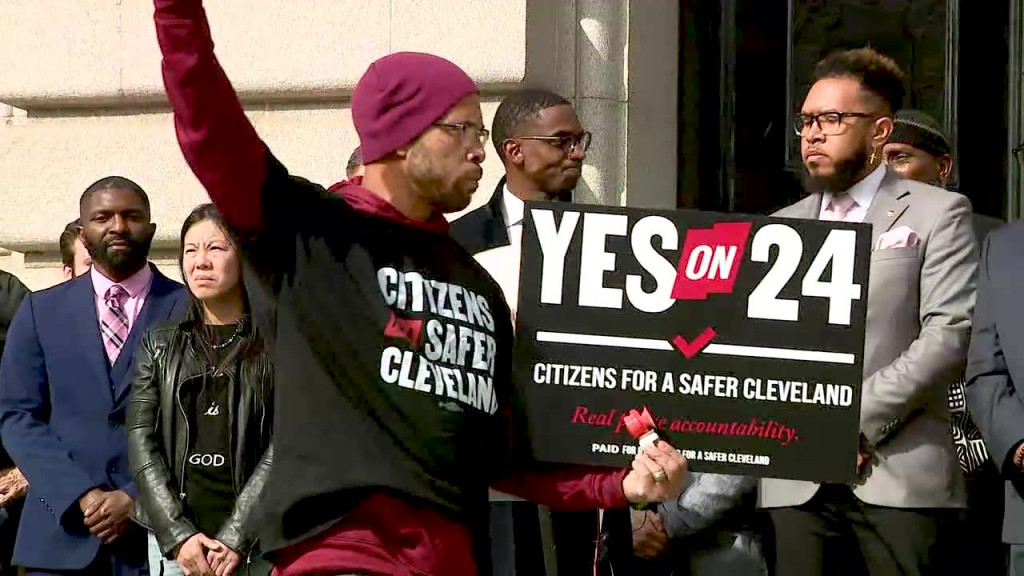
In the fall of 2021, the campaign of Justin Bibb surged through Cleveland with a message that resonated across neighborhoods still carrying the scars of police violence: reform the police department and give residents real power over how officers are disciplined.
Bibb, a first-time mayoral candidate at the time, positioned himself as the candidate of accountability. Central to that message was his embrace of Issue 24, a ballot initiative that Cleveland voters approved overwhelmingly. The measure rewrote the city charter to create one of the most powerful civilian oversight systems for policing in the United States.
More than four years later, however, Cleveland’s long struggle over police oversight is entering a new and uncertain phase — one shaped by shifting political alliances, federal legal maneuvering, and a broader national debate over the future of police reform.
At the center of it all is Bibb himself.
And emerging on the horizon is a technological proposal that some advocates believe could accomplish what policy reforms have struggled to achieve: real-time transparency between police and the public.
The Promise of Issue 24 (An Ai Investigative Correspondent)
The push for reform did not appear in a vacuum.
Cleveland’s police department had been under federal supervision since the 2015 consent decree imposed after the U.S. Department of Justice concluded the department engaged in a pattern of excessive force and systemic accountability failures.
The decree followed years of national scrutiny after high-profile police killings, including the death of Tamir Rice in 2014.
Against that backdrop, Cleveland voters passed Issue 24, later codified as Charter Section 115, dramatically expanding civilian oversight.
The amendment created a permanent and independent Community Police Commission with authority over policies, training, and discipline, and the power to subpoena records.
When Bibb took office in January 2022, he pledged to implement the reform fully.
“We are moving quickly to incorporate Charter Section 115 into the Consent Decree and build a national model for police reform,” Bibb said early in his administration.
He established a Police Accountability Team and began appointing members to the new oversight commission.
For reform advocates, the message was clear: Cleveland would become a model for community-driven policing.
A Shift Toward Ending Federal Oversight
Today, that narrative is more complicated.
In February 2026, the City of Cleveland and the U.S. Department of Justice jointly filed a motion asking a federal judge to terminate the police consent decree — the decade-long agreement that placed Cleveland policing under court supervision.
City leaders argue that reforms have taken root and federal oversight is no longer necessary.
“Compliance has become culture,” Bibb said when announcing the motion.
Independent monitoring reports have indeed documented improvements: reductions in excessive-force complaints, upgrades in accountability procedures, and progress on community engagement.
But critics argue the timing is risky.
Ending the consent decree would remove the federal court’s supervisory role just as Cleveland is still struggling to fully implement the very oversight reforms voters demanded in 2021.
Some reform advocates say the move effectively shifts the city from federal oversight to local trust, before the new community oversight structure has fully matured.
The debate has also become politically charged because the Justice Department pushing to end several consent decrees nationwide operates under the administration of Donald Trump, whose Justice Department has historically been skeptical of federal policing oversight agreements.
The convergence of those forces — local reform promises and federal retreat — is reshaping Cleveland’s policing landscape.
The Technology Gap in Police Oversight
At the core of the debate is a persistent problem: oversight systems often operate after incidents occur.
Civilian boards review complaints.
Internal affairs investigates.
Courts rule years later.
But communities often ask a simpler question:
Why isn’t transparency happening during the encounter itself?
This is where a new concept — a civic technology platform called GoVia — has entered the conversation among reform advocates.
GoVia is designed as a real-time community police safety application that allows citizens and officers to interact with oversight systems instantly during police encounters.
The app’s vision is simple but disruptive:
- Live video connections to legal observers
- Real-time documentation of encounters
- Immediate access to mental-health or legal resources
- Transparent records available to both community and oversight bodies
In theory, such technology could supplement the kind of oversight Issue 24 attempted to create through legislation.
Instead of waiting months for investigations, accountability mechanisms could activate immediately.
“What Cleveland Has Been Looking For”
During the 2025 NFL draft cycle, Cleveland Browns quarterback prospect Shedeur Sanders famously said of his arrival in Cleveland:
“I am what Cleveland has been looking for.”
For some reform advocates, the phrase captures what civic technology could represent in the policing debate.
If GoVia could speak directly to the mayor’s original reform promise, the message might sound something like this:
“Mayor Bibb, GoVia is what Cleveland has been looking for — a bridge between police and the people. Not just oversight after the fact, but accountability in the moment. A tool where transparency lives inside the encounter itself, protecting both the officer and the citizen.” Sabino shared.
That is the conceptual leap reform advocates increasingly discuss.
Oversight boards regulate systems.
Technology can observe them.
The Next Phase of Cleveland’s Police Reform
The question facing Cleveland now is whether structural reforms alone can deliver the accountability voters demanded.
The end of the consent decree — if approved by a federal judge — would close a chapter that began with a damning federal investigation into unconstitutional policing.
But it would also place responsibility for reform squarely back in local hands.
Mayor Bibb’s political legacy may ultimately hinge on whether Cleveland’s oversight model works without federal supervision.
If it does, the city could indeed become the national model he promised.
If it does not, the debate over police accountability — and the search for tools that can guarantee transparency — will begin all over again.
And increasingly, that conversation is moving beyond legislation and into technology.
Because for many Cleveland residents, the demand remains unchanged:
Not just reform.
But proof.