An elite investigator’s deep research report—truth, danger, and the fight for human dignity
I. The New Frontier: Weaponized Robotics and Policing
In the halls of power and under the guise of “public safety,” an unsettling transformation is underway. Advanced robotics—once confined to science fiction—are now tools of law enforcement and military contractors. These systems range from drones and remote-controlled ground vehicles to proposals for fully autonomous “use-of-force” robots.
In the United States, the first widely reported use of a robot to take a human life occurred in Dallas, 2016, when police attached C-4 explosives to a bomb-disposal robot and detonated it to kill a shooter who had killed five officers, a precedent that ignited national debate. Robots historically designed to defuse bombs were repurposed as weapons without clear legal or ethical frameworks guiding their use. (The Policing Project)
Today, multiple U.S. police departments have drones, ground robots, and surveillance platforms, yet policies governing their use lag well behind deployment. Most departments lack meaningful regulations on when, where, or how these machines may interact with civilians—creating a vacuum ripe for misuse. (Governing)
Weaponized Systems in Use or Development
Here are representative categories:
- Bomb-disposal robots repurposed to deliver lethal force (e.g., Remotec Andros Mark V-A1). (Wikipedia)
- Armed reconnaissance robots such as the Modular Advanced Armed Robotic System with configurable lethal/non-lethal payloads. (Wikipedia)
- Surveillance drones with advanced sensors increasingly used in crowd control and monitoring. (Governing)
- Proposed autonomous weapon stations and search-and-destroy units in both military and police contexts (globally and militarized). (Wikipedia)
Beyond the U.S., international police agencies are exploring robotic futures that blur law enforcement with military capability. Europol’s foresight report imagines robots deployed globally—some manipulated by criminals, others by governments—raising ethical challenges and public distrust. (The Verge)
II. The Risk of the Machine: Identity Errors, Bias, and Civil Rights
Even where lethal robots aren’t explicitly deployed, artificial intelligence and robotics enhance policing in ways that threaten identity, dignity, and equality.
International human rights groups and UN experts emphasize the grave risks of autonomous targeting systems:
- AI systems can misidentify individuals, especially people with darker skin tones, leading to wrongful targeting. (The United Nations Office at Geneva)
- They lack empathy, moral judgment, or the capacity to de-escalate conflict through human intuition. (Human Rights Watch)
- Responsibility for harm is blurred between programmers, manufacturers, and deploying authorities. (The United Nations Office at Geneva)
Policies proposed by civil liberties organizations call for moratoria on robots using force, including prohibiting robots equipped with weapons from deploying against people at all. (The Policing Project)
In this context, technology meant to protect can instead endanger those already burdened by systemic inequity: Black, Brown, disabled, and poor communities bear a disproportionate risk from predictive policing, facial recognition errors, and uncontrolled automated responses.
III. A New Police State? U.S. Military-Industrial Power Meets Surveillance Robotics
The convergence of the U.S. military-industrial complex and domestic law enforcement is more than rhetoric—it is infrastructure.
Experts note that one-third of the U.S. military could be robots within the next 15 years as AI systems proliferate across land, air, and sea platforms. (Reddit) This military robotics ecosystem bleeds into civilian policing through federal grants, defense surplus transfers, and shared technology contracts.
The danger is clear: tools built for war could be repurposed for domestic control.
Without accountable policy, these systems risk embodying the very enemy of justice: surveillance, coercion, and state power unrestrained by human oversight.
IV. An Activist’s Voice: Historical Wisdom for Our Technological Moment
In confronting these threats, we turn to the wisdom of those who struggled for justice in harsher landscapes:
Martin Luther King Jr. warned that “freedom is never voluntarily given by the oppressor; it must be demanded by the oppressed.”
As algorithmic power rises, we must demand protections stronger than the code that controls it.
W.E.B. Du Bois reminded us that “the problem of the twentieth century is the problem of the color line.”
In the twenty-first century, the color line meets the data line—and we must ensure that identity technologies do not entrench inequity.
Langston Hughes captured the heartbeat of resistance: “I, too, sing America.”
Our presence must be recognized by the machines that watch us, not erased.
Malcolm X declared that “the revolution is not just a desire to reform the existing order, but to overthrow it.”
We must overturn systems that value automation over human dignity.
Huey Newton taught, “political education is the passport to power.”
Understanding the technology and its risks gives communities power to resist misuse.
And as Stokely CarlMichael visionary activist said: “On Power & Racism: “If a white man wants to lynch me, that’s his problem. If he’s got the power to lynch me, that’s my problem. Racism is not a question of attitude; it’s a question of power.” We are not data points; we are living souls.
V. The Future of Defense: GoVia’s Police Safety App
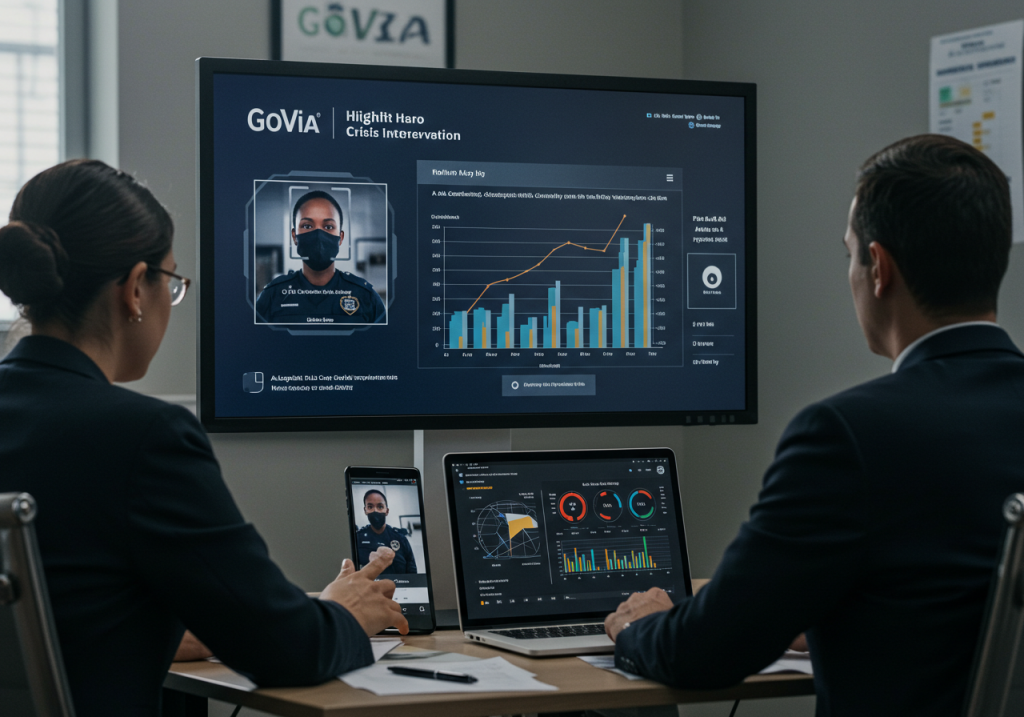
Amid this rising tide of autonomous force, GoVia’s police safety app stands as a beacon of citizen protection, civil rights, and human accountability.
What GoVia Offers
GoVia integrates these protections:
- Real-time interaction logging between civilians and police/robotics systems
- Identity verification safeguards to prevent false biometric matches, reducing mis-targeting risks
- Immediate community alerts and accountability trails to create transparent records of robotic encounters
- Civil rights education and response tools for people stopped or confronted by police technology
In essence, GoVia serves as a human shield in the digital era—empowering individuals, protecting identity accuracy, and documenting interactions that might otherwise be invisible.
Vision from the Founder
“In a world where machines may decide our fate, technology must protect humanity—not replace it. GoVia exists to ensure that civil rights are not forgotten in the rush toward automation. Our future depends on accountability, transparency, and dignity for all.”
— CEO & Founder of GoVia – Georgio Sabino III
VI. A Call to Action
The threat is not speculative—it is already here. Weaponized robotics and AI in policing pose documented dangers, and current policy frameworks are insufficient. The public must demand:
- Legislation limiting autonomous use of force
- Transparent deployment of robotics in law enforcement
- Community consent and oversight
- Protections against biometric misidentification
- Tools like GoVia to defend civil liberties
This is not just technological policy—it is a moral fight for our humanity.
“We must learn to live together as brothers—or perish together as fools.”
— Martin Luther King Jr.
In the age of machines, this truth has never been more urgent.