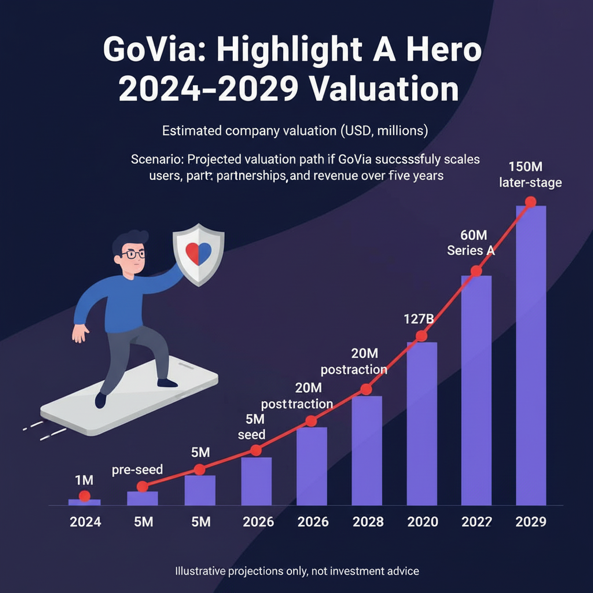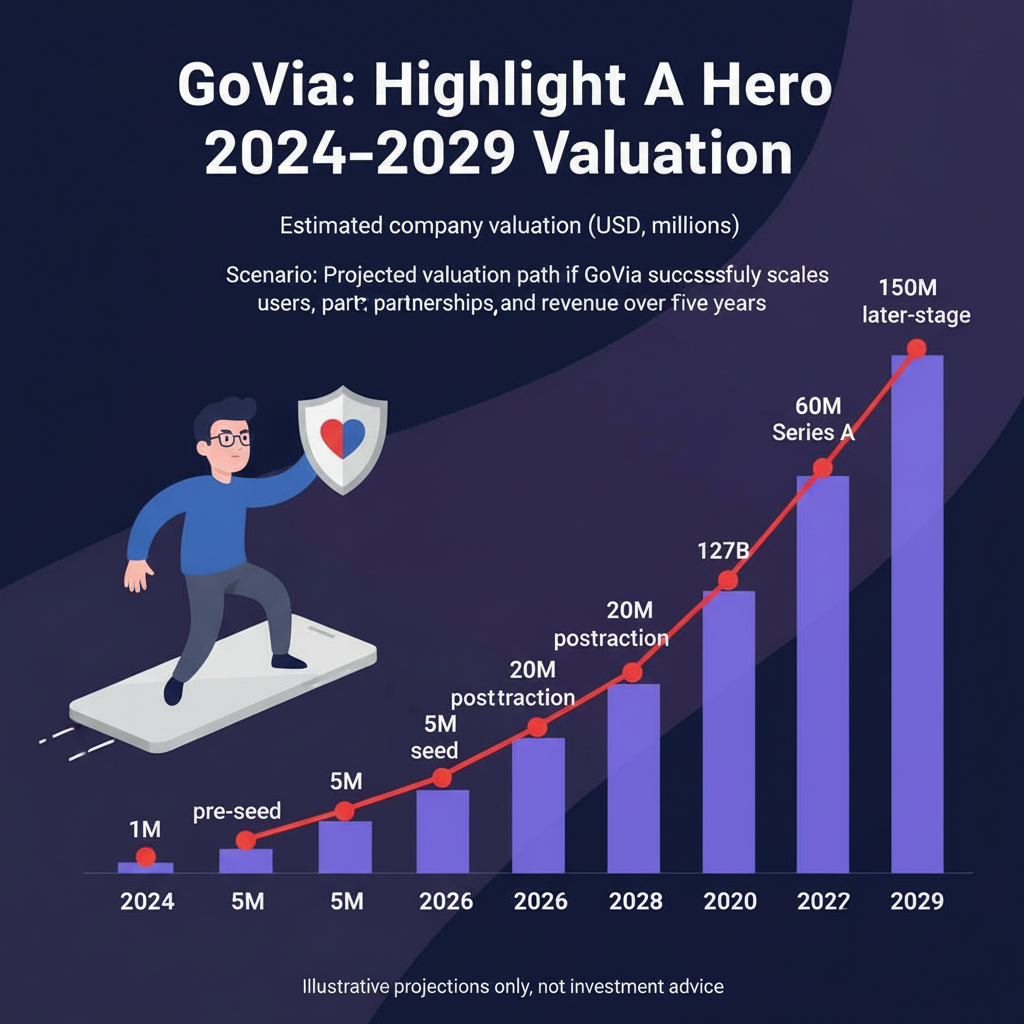
GoVia could plausibly justify a 150 million dollar valuation by 2029 if it converts its early proof‑of‑concept into a scaled, defensible platform in a fast‑growing public‑safety market, with real contracts, recurring revenue and international reach.
Market and timing
The global community‑policing and personal‑safety app market is already measured in the low billions of dollars and is projected to grow to roughly 7.7 billion dollars by 2034, at a mid‑teens annual growth rate. North America alone accounts for about one‑third of current revenue, reflecting high smartphone penetration and demand for public‑safety technology. A focused platform that solves a high‑stakes problem—police encounters, legal risk, and community trust—sits in a premium slice of that market where cities and institutions are willing to pay for outcomes, not just downloads. In this context, a company that captures even a few percent of global spend can support a valuation well into nine figures.
Product differentiation and moat
GoVia is not a generic SOS button; it integrates real‑time attorney access, verified affidavits, mental‑health intervention, and a police‑oversight portal that syncs citizen video with official reports and body‑cam evidence. That combination—legal, clinical, and law‑enforcement stakeholders interacting in one workflow—creates a system‑level product that is harder to copy than any single feature. The affidavit and evidence vault functions turn subjective encounters into structured, legally useful data, giving GoVia proprietary datasets on officer behavior, risk hot‑spots, and de‑escalation outcomes. If those data feed into AI‑driven analytics that help cities cut misconduct claims and training costs, GoVia earns both switching costs and pricing power, which are central to a 150 million dollar story.
Traction, pilots, and revenue mechanics
GoVia’s own roadmap materials describe a first‑year pilot model with five cities and around five thousand users, with a paid conversion layer and supplemental revenue from calls, partnerships, and grants. Even with conservative assumptions—limited pilots and modest subscription uptake—this establishes a pattern: early revenue is small, but every successful city contract becomes a reference account in a politically sensitive domain where trust is rare. Layer in recurring revenue from municipal or police‑department licenses, legal‑aid partnerships, and potentially insurer‑backed deployments aimed at reducing misconduct‑related payouts, and the annual revenue base can scale non‑linearly after the first few wins. In venture terms, a path to, say, 15–20 million dollars in annual recurring revenue with strong retention by 2029 could justify a mid‑single‑digit revenue multiple for a mission‑critical SaaS‑plus‑services platform, which places a 150 million valuation squarely within late‑Series‑B norms.
Partnerships and geographic upside
GoVia is already framing itself as more than a local app, positioning alongside media and civic platforms like Pulse of Africa and exploring cross‑Atlantic collaborations focused on storytelling, ethics, and digital infrastructure. It is also publicly courting partnerships with African governments such as Tanzania, explicitly tying its growth to workforce development and mobile‑first services in emerging markets. These relationships matter because they offer a route to scale in regions where mobile safety tools can leapfrog traditional oversight mechanisms and where youth demographics and urbanization create outsized demand. A credible narrative that GoVia can operate in both U.S. municipalities and rapidly growing African metros increases its total addressable market and supports a higher strategic valuation, especially if larger tech or civic‑tech firms view it as an acquisition target.
Risk, execution, and why 150M is still disciplined
There are real risks: data‑privacy concerns, political pushback, uneven police cooperation, and the challenge of monetizing a tool tied to traumatic events. Regulatory missteps or a high‑profile security failure could slow adoption or compress multiples, and GoVia will have to prove that its evidence systems protect both citizens and officers without becoming a partisan flashpoint. That is why 150 million by 2029 should be viewed not as a moon‑shot unicorn number but as an upper‑midrange outcome for a company that becomes the default infrastructure for recording and managing police–community encounters across dozens of jurisdictions. If GoVia can show measurable reductions in litigation, faster resolution of complaints, and improved recruitment optics for departments that adopt it, then a nine‑figure valuation becomes less a speculative bet and more a recognition of an essential piece of civic technology priced at a rational multiple of durable revenue.