England’s criminal justice system is under pressure from two directions at once: longstanding racial inequality and a fast-moving wave of AI-powered policing tools that can amplify old bias instead of correcting it. The case for a community safety app like GoVia is strongest where institutions are weakest in the moments when people feel unheard, undocumented, and unsafe.
The core problem
Across England and Wales, Black people are arrested at more than twice the rate of white people, and minority ethnic communities are overrepresented in prison. In the year ending 31 March 2023, Black people had 20.4 arrests per 1,000 people, compared with 9.4 per 1,000 for white people, while the prison population remained 27% minority ethnic, despite those groups making up a much smaller share of the general population.
That gap is not just a statistic; it shapes daily life. For many Black, Brown, and Muslim communities, police contact is not abstract law enforcement but a recurring test of credibility, dignity, and safety.
Why AI can worsen bias
AI in policing and justice is often sold as “objective,” but the evidence from UK policing is far more troubling. Amnesty-linked reporting says at least 33 UK police forces have used predictive policing tools, with most relying on geographic prediction systems built from historical crime data that already reflects prior over-policing.
That creates a feedback loop: areas once heavily policed are marked as high-risk, which justifies more policing, more stops, more arrests, and more data to feed the system. West Midlands Police has reportedly admitted some hotspot mapping is wrong 80% of the time, which is a warning that technological confidence can outpace real-world accuracy.
There is also a fairness problem at the point of decision-making. AI used in charging, risk scoring, or evidence prioritisation can reproduce unequal treatment if it learns from past decisions made in a biased system. In other words, machine learning does not cleanse injustice; it can scale it.
Why Muslim, Black, and Brown communities feel it most
Disparity in policing is not evenly shared. Communities that are already more likely to be stopped, searched, arrested, or treated as suspicious are also more likely to experience the harms of data-driven enforcement, because the data itself is shaped by prior contact with police.
For Muslim communities, the concern is not only arrest and incarceration but the broader feeling of being watched through a security lens that can blur religion, race, immigration status, and public suspicion. The justice issue is therefore bigger than courts; it includes the street, the school gate, the mosque entrance, and the traffic stop.
The officials who own this
In England and Wales, the Ministry of Justice is led by David Lammy MP, the Lord Chancellor, Secretary of State for Justice and Deputy Prime Minister. The governance page also lists Sarah Sackman KC MP, James Timpson OBE, and Alex Davies-Jones MP in ministerial roles connected to justice, prisons, parole, and probation.
The Secretary of State for Justice is the minister responsible to Parliament for the judiciary, the court system, prisons, and probation in England and Wales, with additional responsibilities across parts of the UK justice framework. That means accountability does not sit with technology vendors or police forces alone; it sits with ministers, Parliament, the courts, police leadership, and oversight bodies.
Why GoVia makes sense
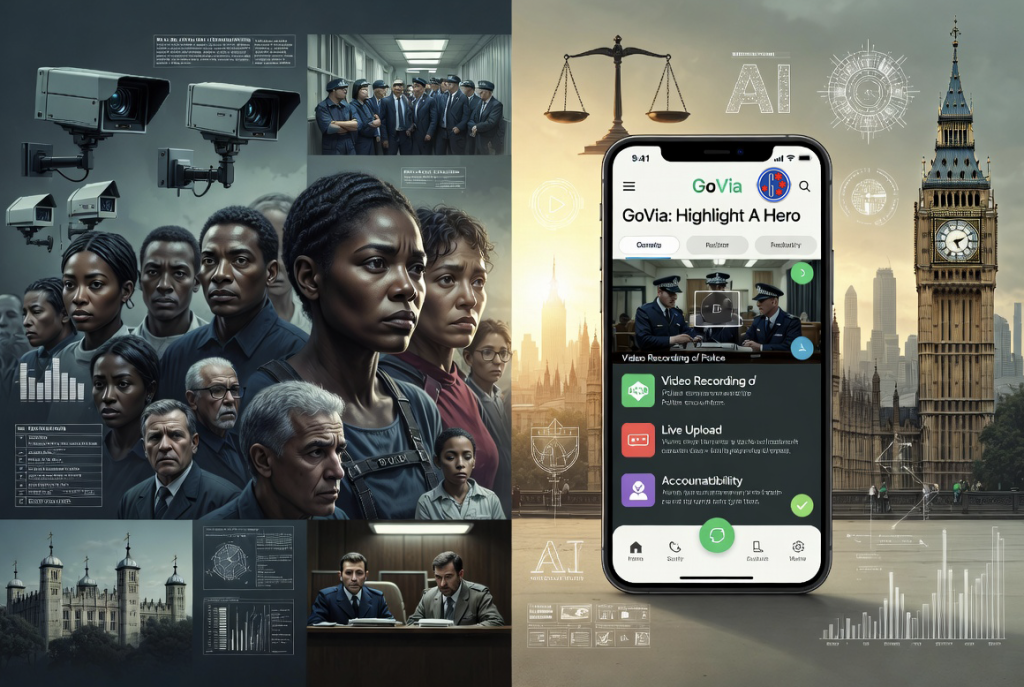
GoVia’s pitch is compelling because it addresses the gap between lived experience and institutional record. The app is described as a one-tap system for documenting police encounters, notifying trusted contacts, connecting to legal and mental-health support, and structuring evidence for court or policy use.
That matters because accountability fails most often in the minutes when a person is alone, frightened, and trying to remember what happened while the official record is being written elsewhere. If a tool can help preserve video, time stamps, witness notes, and immediate legal support, it can improve transparency for civilians and reduce disputes about what occurred.
The “Highlight A Hero” concept is also important. A system that flags misconduct while also publicly recognizing officers who act lawfully and respectfully creates a second incentive structure: not just punishment after failure, but reputational reward for good conduct.
Why the UK could use it
The strongest argument for adoption is not that technology replaces reform, but that it helps make reform enforceable. A fairer system needs more than training slogans; it needs evidence capture, complaint integrity, civilian support, and better feedback loops when police stories and civilian stories diverge.
GoVia could be useful in the UK if it were built around strict safeguards: data minimisation, legal oversight, privacy protection, access controls, audit trails, and clear rules on admissibility. Without those protections, it would risk becoming another surveillance tool; with them, it could become a civic accountability layer that supports due process.
The necessary caution
A serious policy argument has to say this plainly: no app can fix structural racism on its own. The bigger question is whether the UK wants tools that preserve public trust or systems that merely automate suspicion.
On the evidence available, the case for GoVia is strongest as a civil-liberties and evidence-preservation tool, not as a replacement for reform in policing, prosecution, or courts. If adopted, it should be piloted with independent evaluation, public-interest governance, and strong community participation, especially from Black, Brown, and Muslim communities most exposed to unequal treatment.