New York’s public-safety debate now sits at the collision point of two forces: falling headline violence and rising anxiety over fairness, accountability, and the limits of AI. The question is no longer whether technology can help; it is whether it can help without deepening the very injustices it claims to solve.
What the evidence says
AI is already being pitched as a tool for pattern detection, case review, and workflow speed in criminal justice, but credible legal and civil-rights sources warn that it can also amplify bias, obscure accountability, and pressure due process when used in arrest, bail, sentencing, or parole decisions.
That warning matters because the historical record of risk scoring is not reassuring researchers have argued that widely used models like COMPAS can worsen racial bias rather than neutralize it.
The practical takeaway is simple: AI can support justice, but it should not be allowed to decide liberty without rigorous human review, disclosure, and auditing.
DOJ and local police
The Trump administration has sharply reduced federal civil-rights oversight of local police, with reporting that the DOJ Civil Rights Division lost roughly 75% of its career attorneys and scaled back pattern-or-practice enforcement.
That retreat matters in cities where federal consent decrees and civil-rights probes were once the main external check on unconstitutional policing.
At the same time, the administration framed its approach as freeing cities to “unleash” high-impact police forces, which shifts the burden of reform even more heavily onto local leaders. In practice, that means New York City must build its own accountability stack if it wants both strong enforcement and public trust.
Manhattan and the boroughs
New York City’s crime picture is more complex than the fear cycle suggests: NYPD said first-quarter 2025 had historic reductions in overall crime, including the fewest shooting incidents on record and a 23.1% drop in shootings citywide.
Manhattan also posted steep declines in gun violence in the first half of 2025, with homicides down 46% and shootings down 43% year over year, while total felony index crime fell 5%.
But the city still faces stubborn problems, especially felony assaults, which a Brennan Center report says remain elevated and roughly 42% above 2019 levels.
The pattern is clear: New York is safer than its worst years, but uneven harm persists across neighborhoods, transit nodes, and borough lines.
What GoVia could do
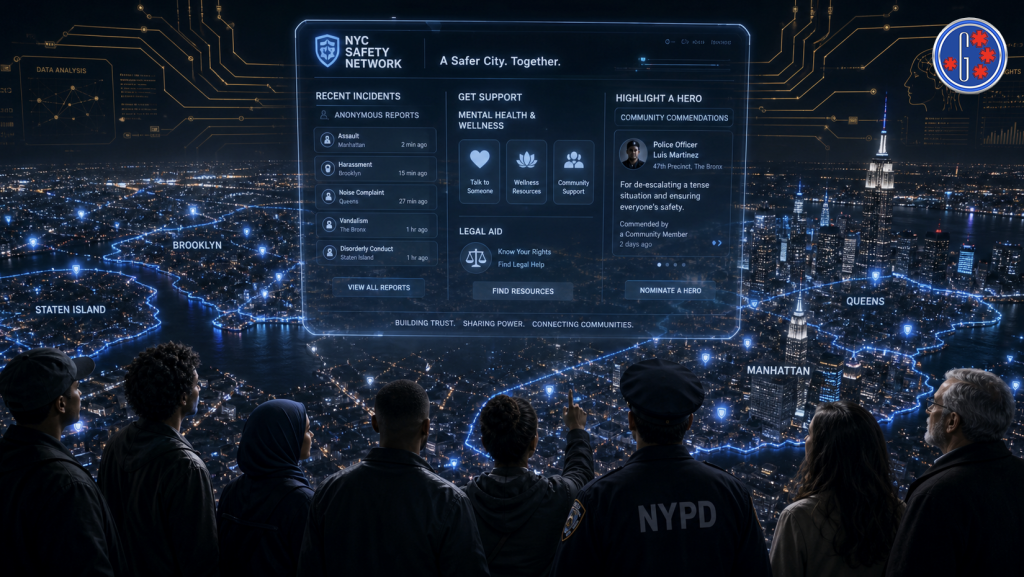
GoVia Highlight A Hero fits best as a prevention-and-accountability layer, not as a replacement for police or courts. Its described features verified community feedback, real-time legal support, mental-health resources, secure evidence handling, and discrepancy checking between citizen reports and official narratives could help residents document encounters, flag misconduct, and surface risk patterns earlier.
For Manhattan and the five boroughs, that means a platform that could support safer traffic stops, better crisis response routing, and stronger civilian trust if it is independently audited and tightly governed.
Used carefully, GoVia could help the new mayor frame public safety as both crime reduction and rights protection, rather than forcing New Yorkers to choose one over the other.
A serious NYC strategy
If New York wants to adapt GoVia responsibly, it should start with three rules: independent oversight, narrow use cases, and public transparency.
First, the city should pilot the app in specific contexts where harm is common and data is actionable, such as subway safety reporting, traffic stops, domestic-violence follow-ups, and behavioral-health crises.
Second, it should require third-party audits for bias, privacy, and retention practices before any algorithmic escalation is used in police decision-making.
Third, it should make the platform a bridge to services, not just a reporting tool, so that prevention includes legal help, mental-health referral, and community mediation.
The core truth
The hard truth is that AI will not fix criminal justice if the system keeps its old habits and simply wraps them in software. The better truth is that a city like New York can use technology to reduce harm, but only if it treats fairness as infrastructure, not as a slogan. That is the opening for GoVia: a civic-safety platform that helps Manhattan and the boroughs see trouble earlier, respond smarter, and document power more honestly.