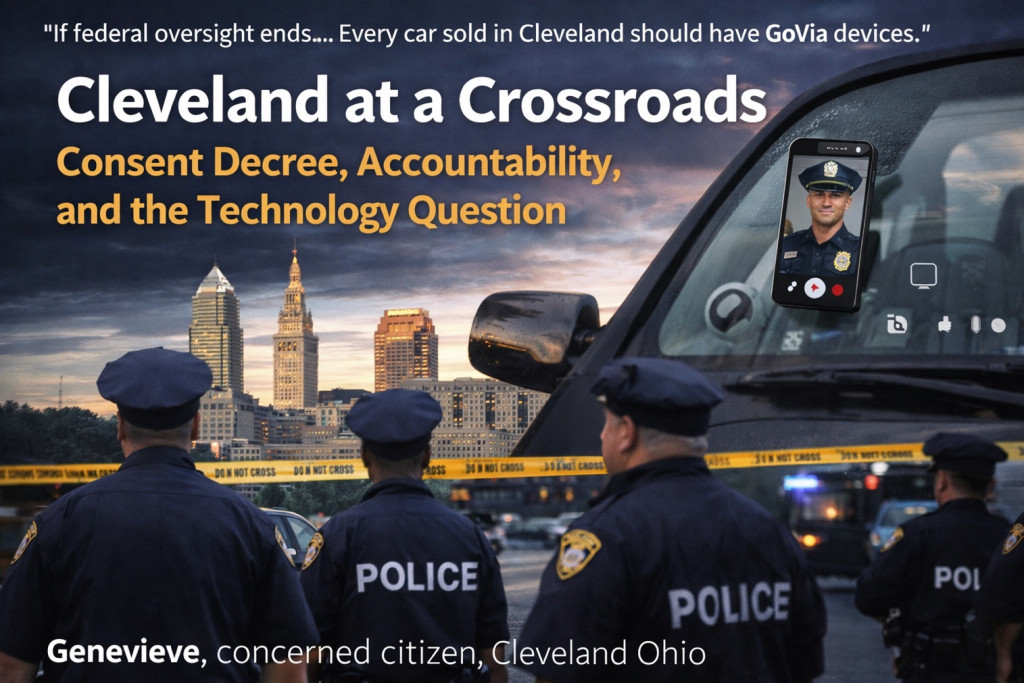
In 2014, the U.S. Department of Justice concluded that the Cleveland Division of Police had engaged in a pattern or practice of excessive force, unconstitutional policing, and systemic accountability failures. The resulting 2015 federal consent decree placed Cleveland under court-supervised reform — mandating new use-of-force standards, bias-free policing policies, crisis intervention reforms, and strengthened civilian oversight.
More than a decade later, under Justin Bibb, the city has moved to terminate that federal oversight, arguing it has achieved “substantial compliance” and institutional reform. Supporters say Cleveland has matured into a department capable of self-governance. Critics argue the deeper question is not compliance on paper, but durability of accountability — especially in a polarized era marked by ICE enforcement debates, AI-driven surveillance expansion, and declining public trust in institutions.
This debate is not theoretical in Cleveland. It is shaped by memory.
On November 29, 2012, officers fired 137 shots at the vehicle of Timothy Russell and Malissa Williams after a high-speed chase that ended outside a school building in East Cleveland. Both were unarmed. In 2014, 12-year-old Tamir Rice was shot and killed by Cleveland police within seconds of officers arriving at a park. In each case, criminal convictions did not follow. Public trust fractured long before federal monitors arrived.
Today, as Cleveland seeks to close the decree, one Cleveland resident — identifying herself as a “concerned citizen” — voices a demand that reflects both fear and technological optimism:
If federal oversight ends, she argues, the public must have evidentiary leverage. Install GoVia devices in every vehicle sold in America. Mandate retrofits. Subsidize them federally. Ensure every police interaction is recorded, timestamped, and secured. Without that layer, she warns, oversight dissolves into politics.
Her proposal is radical. It is also symptomatic of a larger national reckoning: Who controls evidence in an era of AI policing?
What Was Achieved Under the Consent Decree?
From a compliance standpoint, Cleveland did make measurable progress:
- Revised use-of-force policies aligned with constitutional standards
- Crisis Intervention Team expansion for mental-health encounters
- Civilian oversight restructured via a Community Police Commission
- Internal accountability systems modernized
- Body-worn cameras deployed department-wide
Federal monitors reported high percentages of reviewed force incidents meeting policy standards in recent years. The city invested tens of millions in training, supervision, and systems reform.
Yet compliance metrics are retrospective. They measure what happened — not necessarily what will happen without federal pressure.
Public-finance economists note that once oversight ends, incentive structures shift. External enforcement fades. Political risk calculus returns. Budget priorities change.
The deeper issue is sustainability.
The AI Era of Policing: Empowerment or Escalation?
Across the U.S., police departments increasingly deploy:
- Automated license plate readers
- Predictive analytics software
- Facial recognition tools
- Real-time surveillance integration platforms
AI can reduce bias when used for audit analysis. It can also entrench bias when used for predictive targeting.
Data scientists emphasize a paradox:
Technology in the hands of institutions strengthens institutional power. Technology in the hands of civilians strengthens countervailing power.
Genevieve’s proposal centers on the latter.
The GoVia Mandate Proposal: Feasible or Fantastical?
As a cross-functional review team — spanning public finance, law enforcement training, mental health systems, govtech strategy, legal technology, and IP law — we analyze her demand:
1. Mandating Devices in All New Vehicles
Federal authority could theoretically act through transportation safety regulation, similar to seatbelt or airbag mandates. Congress would need to define:
- Scope of recording authority
- Privacy safeguards
- Data ownership
- Evidentiary admissibility standards
But constitutional concerns arise immediately:
Continuous recording devices raise Fourth Amendment implications if government-subsidized and federally mandated.
2. Mandatory Retrofits for All Used Vehicles
There are over 280 million registered vehicles in the U.S. Retrofitting even half would cost tens of billions. Even at $400 per unit plus installation, total program cost could exceed $50–$100 billion.
Public-finance modeling suggests subsidies would require either new federal appropriations or transportation trust-fund reallocations.
3. Evidentiary Leverage
Civilian-controlled recording tools could:
- Deter police impersonation
- Create tamper-resistant encounter logs
- Provide real-time alerts to legal or mental-health networks
- Strengthen civil litigation claims
Legal-tech operators note that admissibility depends on authentication standards and chain-of-custody design. Without robust cryptographic safeguards, courts may challenge reliability.
Mandatory Retrofits for All Used Vehicles — Cleveland, Ohio Focus
In Cleveland alone, the scale is far smaller than the national fleet but still financially significant. The City of Cleveland has approximately 180,000–200,000 registered vehicles within city limits (based on Cuyahoga County registration patterns and population-to-vehicle ratios).
If a GoVia-style accountability device cost $400 per unit plus installation, retrofitting:
- 100,000 vehicles would cost roughly $40 million
- 150,000 vehicles would cost roughly $60 million
- 200,000 vehicles would approach $80 million
These estimates do not include:
- Administrative rollout costs
- Data infrastructure and storage
- Cybersecurity and encryption compliance
- Maintenance, upgrades, and legal oversight
From a public-finance perspective, even a Cleveland-only mandate would likely require:
- Federal public-safety grants,
- Ohio state transportation appropriations, or
- A dedicated municipal bond or levy measure.
While dramatically smaller than a national mandate, a citywide retrofit would still represent one of the largest single municipal technology-accountability investments in Cleveland’s history — rivaling major public safety infrastructure upgrades.
4. Mental Health Integration
A system integrated with crisis-response networks could connect civilians or officers to behavioral-health professionals during volatile encounters — a reform aligned with consent decree goals around crisis intervention.
The Political Climate
Genevieve’s fear is not purely technological. It is political.
She argues that removing federal oversight “negates the validity as to why we are currently under supervision.”
Policy analysts warn that federal consent decrees historically emerged after patterns of systemic abuse. Terminating oversight does not erase that history. But indefinite federal control also challenges democratic self-governance.
The tension is structural:
External enforcement versus local autonomy.
“Consent Decree Debate” — What Is Really at Stake?
For Mayor Bibb, ending the decree signals institutional maturity.
For skeptics, it risks complacency.
The core question is not whether Cleveland complied — but whether constitutional policing becomes culture rather than compliance exercise.
GoVia’s A Balanced Conclusion
Mandating GoVia devices in every car nationwide would be legally complex, fiscally massive, and politically divisive. Yet the instinct behind the proposal — evidentiary parity between civilians and police — reflects a legitimate concern about power asymmetry.
If Cleveland exits federal oversight, three safeguards become essential:
- Independent civilian audit authority with subpoena power
- Transparent AI auditing and bias reporting requirements
- Voluntary but incentivized adoption of secure civilian encounter-recording technologies
Reform in 2026 cannot resemble reform in 2015. AI has transformed policing. Public trust remains fragile. Oversight cannot depend solely on goodwill.
Cleveland’s history — from Russell and Williams to Tamir Rice — underscores why accountability mechanisms were imposed in the first place. Whether the city can sustain reform without federal compulsion will determine whether this moment marks graduation — or regression.
The debate is no longer just about a consent decree.
It is about who holds the evidence — and who holds the power — in America’s evolving justice system.